
Introduction
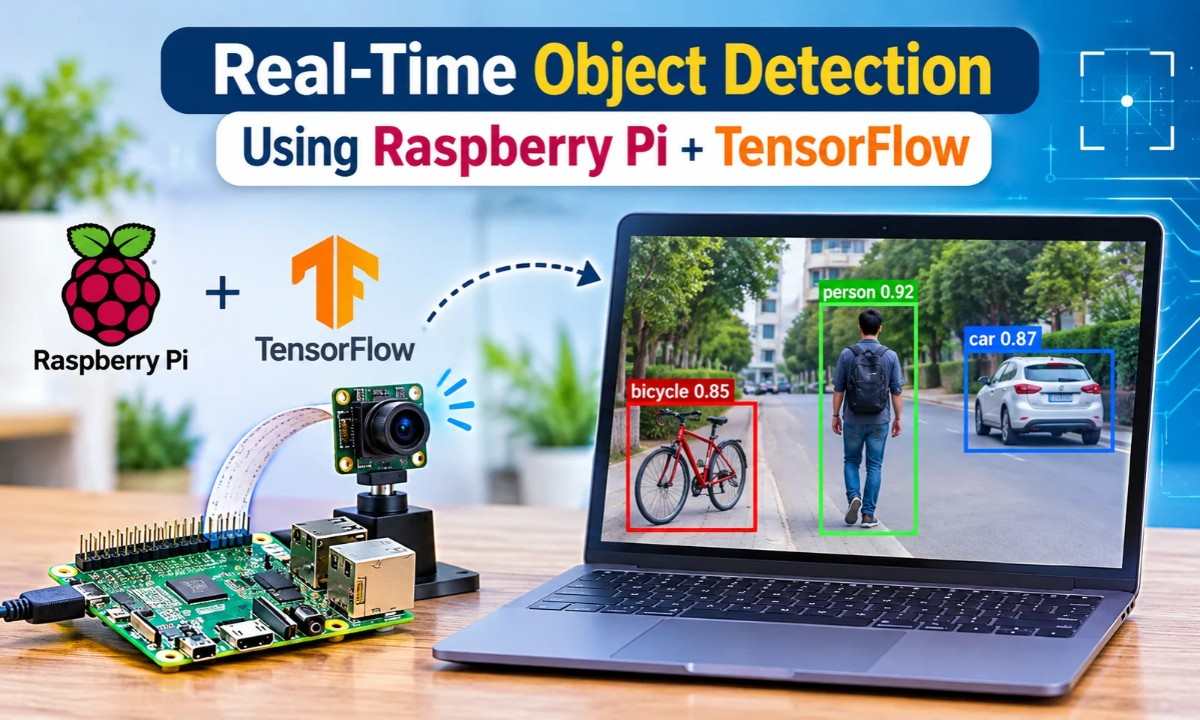
Artificial Intelligence (AI) and Machine Learning (ML) are transforming the way computers understand and interact with the real world. One of the most interesting applications of these technologies is object detection, which enables machines to identify and locate different objects through images and videos. Object Detection Using Raspberry Pi + TensorFlow is an innovative project that combines embedded systems, computer vision, and deep learning to develop an intelligent real-time detection system.
Takeoff Edu Group provides technical guidance and project development assistance for engineering students interested in exploring advanced technologies such as Artificial Intelligence, Machine Learning, and Internet of Things (IoT). This project helps students understand how AI-based models can be implemented on compact computing devices to solve practical problems.
What Is Real-Time Object Detection Using Raspberry Pi + TensorFlow?
Real-time object detection is a computer vision technique that identifies multiple objects in images or video streams and determines their locations. Unlike basic image classification, which identifies the overall content of an image, object detection can recognize individual objects and mark their positions using bounding boxes.
In this project, Raspberry Pi acts as the main processing unit, while TensorFlow provides the machine learning framework required to perform object detection.
TensorFlow Lite is commonly used to deploy lightweight machine learning models on resource-constrained devices like Raspberry Pi. A camera captures live video, and the trained detection model processes individual frames to identify objects such as people, vehicles, animals, bottles, and other everyday items.
The system displays the detected objects along with their labels, confidence scores, and bounding boxes.
Objectives of the Project
The primary objective of this project is to develop an intelligent object detection system that can identify different objects from a live camera feed.
The major objectives include:
- Implementing a real-time object detection model using Raspberry Pi.
- Integrating TensorFlow Lite for efficient machine learning inference.
- Capturing live images and video through a camera module.
- Identifying multiple objects using deep learning techniques.
- Displaying object labels and detection confidence scores.
- Understanding the practical implementation of AI and computer vision.
- Developing an affordable and compact intelligent vision system.
Hardware and Software Requirements
To implement Object Detection Using Raspberry Pi + TensorFlow, students need suitable hardware components and software tools.
Hardware Requirements:
- Raspberry Pi 4 or Raspberry Pi 5.
- Raspberry Pi Camera Module or USB webcam.
- MicroSD card with sufficient storage.
- Power supply for Raspberry Pi.
- Monitor and HDMI cable (optional).
- Keyboard and mouse (optional).
Software Requirements:
- Raspberry Pi OS.
- Python programming language.
- TensorFlow Lite Runtime.
- OpenCV library.
- NumPy.
- Pre-trained object detection model.
- Required Python libraries for camera integration.
The hardware captures visual information, while the software processes the camera frames and identifies objects using a trained machine learning model.

How Does the Object Detection System Work?
The working process of this project involves several stages, from image acquisition to object identification.
1. Image Acquisition
The camera module connected to Raspberry Pi continuously captures images or video frames from the surrounding environment. These frames serve as input data for the object detection model.
2. Image Preprocessing
Before processing, the captured image is resized and converted into the required input format. Preprocessing helps ensure that the image dimensions and data representation match the requirements of the trained model.
3. Model Loading
A pre-trained TensorFlow Lite object detection model is loaded into the Raspberry Pi environment. Lightweight models such as Efficient Det-Lite and Mobile Net SSD can be considered depending on the required detection accuracy and processing performance.
4. Object Detection
The TensorFlow Lite model processes the input image and predicts the objects present in the frame. It generates object categories, bounding box coordinates, and confidence scores.
5. Result Visualization
OpenCV can be used to draw bounding boxes around detected objects. The system displays the object name and confidence score alongside the live camera feed.
6. Continuous Monitoring
The process repeats for incoming video frames, allowing the system to identify objects continuously and provide real-time detection results.
Role of Raspberry Pi and TensorFlow
Both Raspberry Pi and TensorFlow play important roles in developing this intelligent system.
Raspberry Pi: Raspberry Pi is a compact single-board computer that performs the processing operations and connects the camera module with the detection software. Its small size, affordability, and GPIO support make it suitable for embedded AI applications.
TensorFlow: TensorFlow is an open-source machine learning framework used to develop and deploy deep learning models. TensorFlow Lite provides an optimized runtime for running suitable models on devices with limited computing resources.
Together, these technologies make it possible to implement practical AI applications without depending entirely on high-performance desktop computers or cloud-based processing.
Applications of Real-Time Object Detection
Object detection technology has several applications across different industries.
1. Smart Surveillance Systems: Identifies people, vehicles, and other objects in monitored environments to support intelligent surveillance applications.
2. Autonomous Robotics: Helps robots recognize surrounding objects and understand their environments while performing automated tasks.
3. Traffic Monitoring: Can identify vehicles and monitor traffic conditions in specific locations.
4. Smart Home Automation: Supports intelligent home applications by recognizing people and selected objects through camera-based systems.
5. Industrial Automation: Helps identify products, components, and selected objects in manufacturing environments.
6. Safety Monitoring: Can be adapted to detect specific objects or safety-related conditions in controlled environments.

Raspberry Pi Projects for Engineering Students
Raspberry Pi Projects for Engineering Students provide an excellent opportunity to explore embedded systems, Artificial Intelligence, IoT, robotics, and automation. Raspberry Pi is widely used in academic projects because it supports multiple programming languages, external sensors, cameras, and hardware interfaces.
Engineering students from Computer Science and Engineering (CSE), Electronics and Communication Engineering (ECE), and Electrical and Electronics Engineering (EEE) can develop innovative applications using this platform.
Some interesting project ideas include:
- AI-Based Face Recognition System: Identifies individuals using facial recognition techniques.
- Smart Home Automation: Controls electrical appliances using sensors and wireless communication.
- IoT-Based Weather Monitoring: Collects and displays environmental information such as temperature and humidity.
- Smart Traffic Management System: Uses camera-based detection to monitor vehicle movement.
- Real-Time Object Detection: Identifies different objects using Raspberry Pi and TensorFlow.
- AI-Based Surveillance System: Monitors selected areas using intelligent image processing.
- Obstacle Detection Robot: Identifies nearby obstacles and supports automated navigation.
- Smart Agriculture Monitoring: Uses sensors to monitor environmental conditions in agricultural applications.
These projects help students gain practical knowledge of programming, hardware integration, sensor interfacing, and intelligent system development. They also provide opportunities to understand how theoretical engineering concepts can be transformed into functional applications.
Advantages of Object Detection Using Raspberry Pi + TensorFlow
This project offers several technical and educational benefits.
- Affordable Implementation: Raspberry Pi provides a compact and relatively low-cost computing platform.
- Real-Time Processing: The system can process continuous camera input and identify objects.
- Compact Design: The complete setup can be developed as a portable embedded system.
- AI Integration: Students gain practical exposure to deep learning and computer vision.
- Flexible Applications: The system can be adapted for surveillance, robotics, and automation.
- Hands-On Learning: Students understand the integration of hardware and software technologies.
Challenges and Future Enhancements
Although Raspberry Pi-based object detection is useful for academic and practical applications, it also involves certain challenges.
Limited processing resources may affect detection speed, particularly when using larger machine learning models. Camera quality, lighting conditions, model complexity, and image resolution can also influence detection performance.
These challenges can be addressed by using optimized TensorFlow Lite models, reducing input image dimensions, selecting suitable detection thresholds, and improving the camera setup.
Future enhancements may include custom object detection models, voice-based alerts, cloud connectivity, automated tracking, and integration with robotic systems. An optional AI accelerator can also be considered to improve inference performance when supported by the selected model and hardware.

Conclusion
Object Detection Using Raspberry Pi + TensorFlow is an innovative engineering project that demonstrates how Artificial Intelligence, Machine Learning, and embedded computing can work together to develop intelligent vision-based applications. By integrating a camera module, Raspberry Pi, TensorFlow Lite, and computer vision techniques, students can build a system capable of identifying multiple objects from a live video stream.
This project is particularly valuable for students exploring AI, IoT, robotics, and embedded systems. Takeoff Edu Group supports engineering students through project development assistance and technical guidance, helping them explore practical implementations of emerging technologies. With the growing demand for intelligent automation, Object Detection Using Raspberry Pi + TensorFlow and other Raspberry Pi Projects for Engineering Students offer exciting opportunities to develop technical skills and innovative engineering solutions.
FAQs
1. What is object detection using Raspberry Pi and TensorFlow?
It is an AI-based system that uses a Raspberry Pi camera and a TensorFlow Lite model to identify and locate objects in real-time video streams.
2. Which Raspberry Pi is suitable for object detection?
Raspberry Pi 4 and Raspberry Pi 5 are suitable options for implementing lightweight object detection models.
3. What is the role of TensorFlow Lite in this project?
TensorFlow Lite provides an optimized runtime to execute machine learning models on devices with limited computing resources.
4. Which programming language is used for Raspberry Pi object detection?
Python is commonly used for implementing object detection applications using TensorFlow Lite and OpenCV.
5. What are the applications of Raspberry Pi object detection?
Applications include smart surveillance, robotics, traffic monitoring, industrial automation, and intelligent home systems.
 Digital Twin Technology in Electrical Engineering: Creating Virtual Power Systems
 Lightweight AI Models for Edge Computing Using Raspberry Pi
 Smart Traffic Monitoring System Using OpenCV
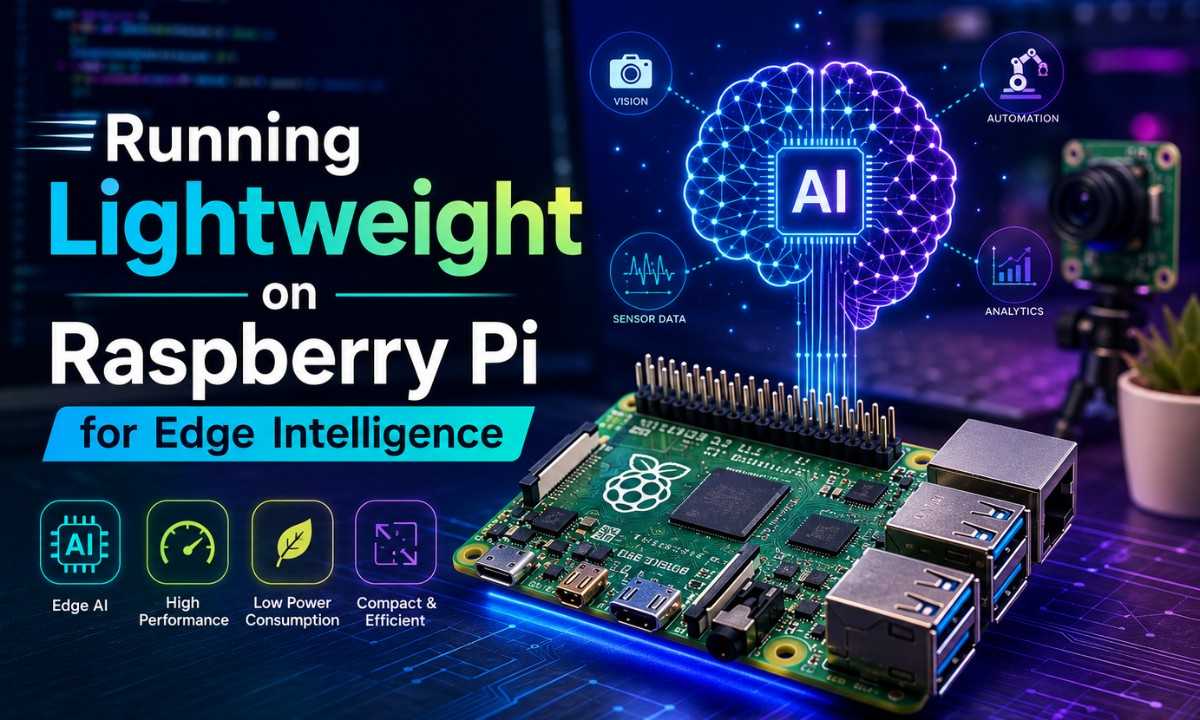 Running Lightweight AI Models on Raspberry Pi for Edge AI
 Smart Irrigation with Embedded AI: Digital Farming
 Designing Smarter Cities: Embedded IoT Systems for Urban Innovation
 Top 5 PIC16F77A Projects for Embedded Students
 Top 7 Arduino Projects for Students
 Top 5 Node MCU Projects
 Top 5 Raspberry Pi Projects
 Top 7 ARM7 Project Ideas
 Top 5 Mechatronics Projects for ECE
 Top 5 Renewable Energy Projects Ideas
 Top 7 Biomedical Projects for Students
 Top 7 Artificial Intelligence Project Ideas
 Top 7 WSN Projects for Students
 Top 7 Machine Learning Projects for BTech & MTech
 Top 7 Image Processing Projects
 Top 7 Industrial Automation Projects
 Top 7 Deep Learning Projects for Final Year Students
 Top 7 Robotics Projects for Engineering Students
 Top 7 IoT Projects for Students
 Arduino based Projects for Final Year
 Embedded Projects for ECE
 FPGA Projects for Engineering Students
 New Deep Learning Projects Ideas & Topics
 Machine Learning Projects for Final Year CSE
 Engineering Projects on Machine Learning
 Wireless Sensor Network Projects
 Wireless Sensor Network Projects with Source Code
 Latest Bio Medical Projects for Students
 Innovative Bio Medical Project Ideas & Topics
 21+ Interesting Mini Projects on Robotics
 Engineering Student Projects on Robotics
 Innovative IoT Project Ideas for Engineering Students
 Latest Mini Projects for ECE Students 2022
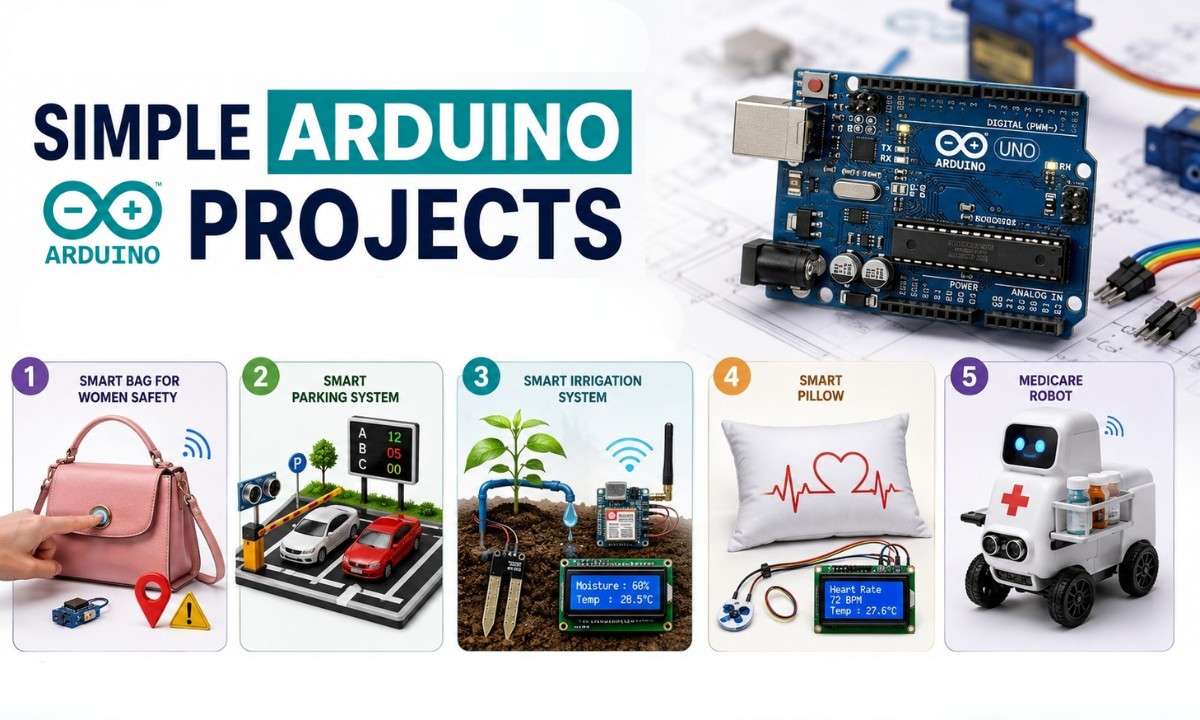 List of Simple Arduino Projects
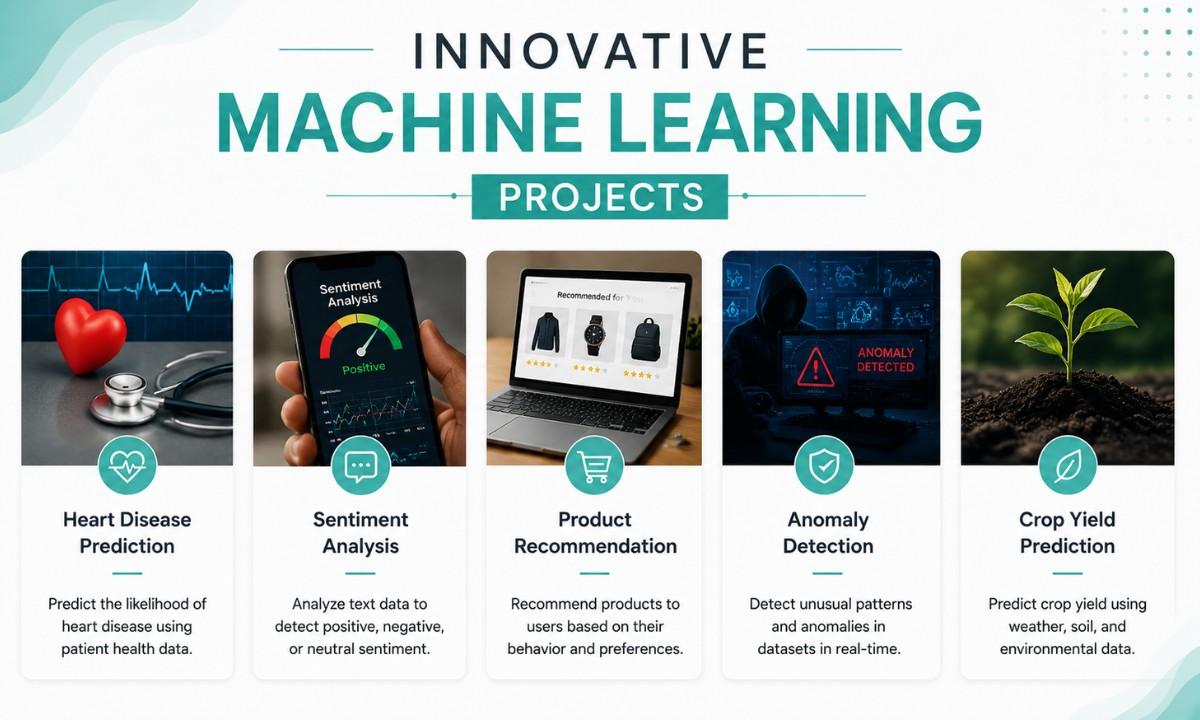 Innovative Machine Learning Projects
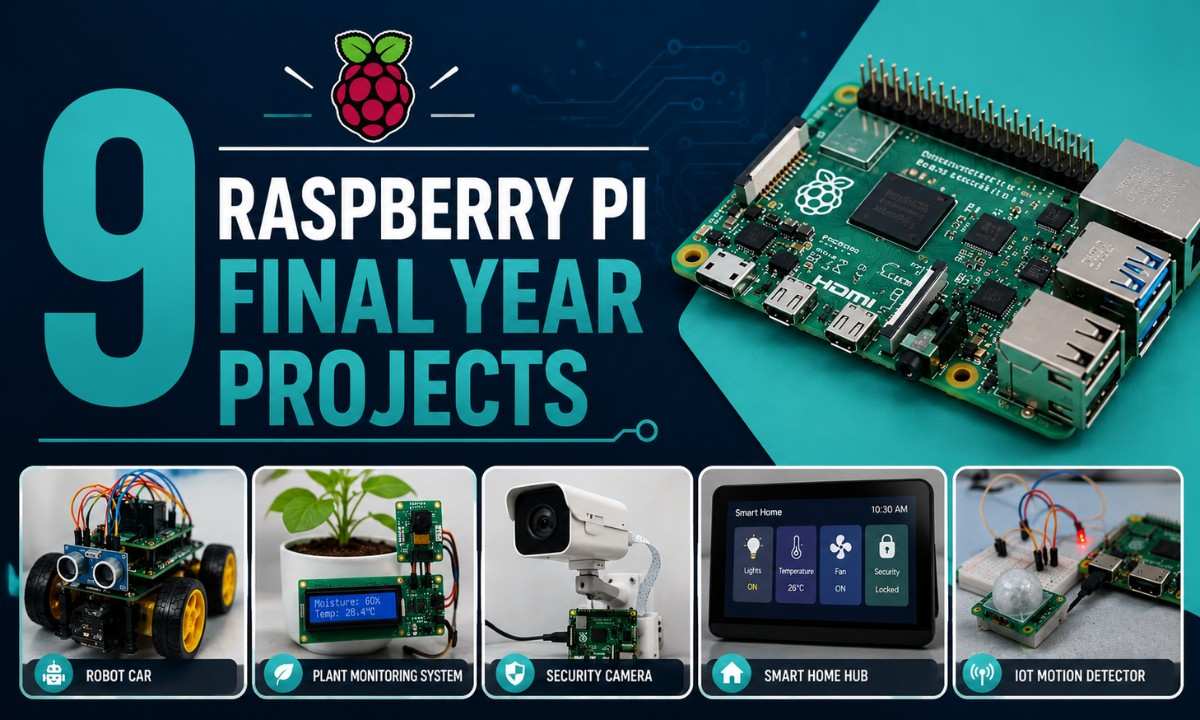 9 Raspberry Pi Final Year Projects
 7 Interesting IoT Based Projects
 Latest Real Time Embedded Systems Projects for Final Year Students




































 Paper Publishing