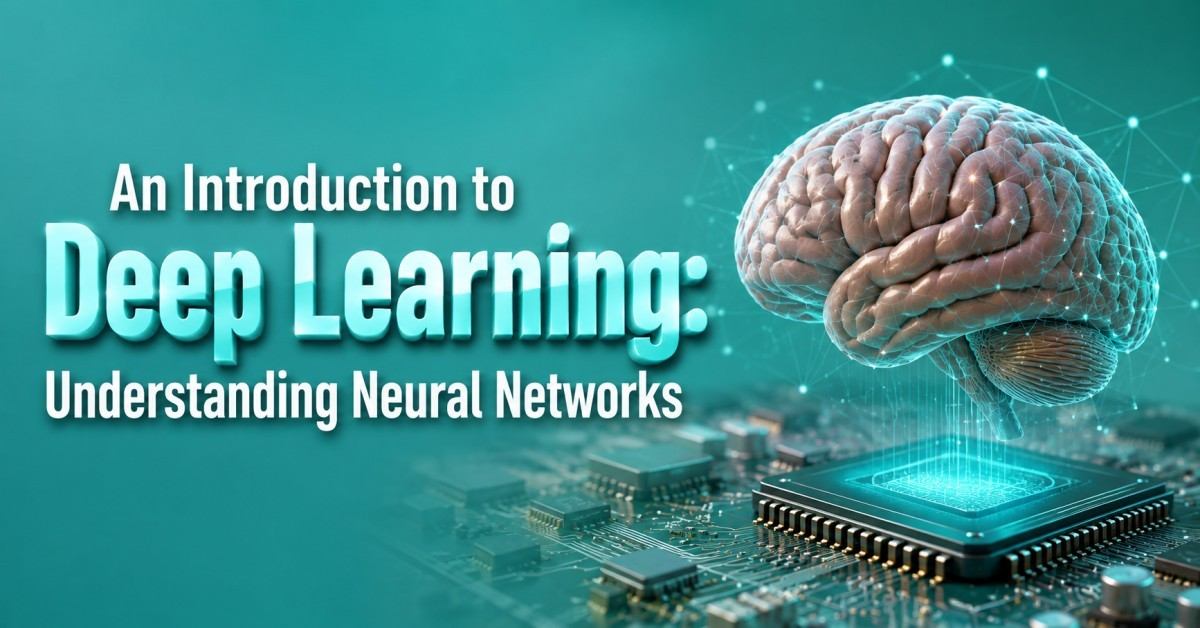

An Introduction to Deep Learning: Understanding Neural Networks
Introduction
Deep Learning is one of the most important technologies in the field of artificial intelligence (AI). It helps computers learn from large amounts of data, recognize patterns, understand complex information, and make intelligent decisions. From voice assistants and image recognition to self-driving vehicles and recommendation systems, deep learning is being used in many real-world applications.
For beginners, understanding Deep learning and neural networks is an important first step toward exploring AI and machine learning. This guide explains the basics of deep learning, how neural networks work, their major types, and their applications in different industries.
What Is Deep Learning?
Deep learning is a branch of machine learning that uses artificial neural networks with multiple layers to learn from data. These networks are inspired by the way the human brain processes information.
Traditional machine learning often requires humans to select important features from data. Deep learning can automatically identify useful patterns and features from large and complex datasets.
For example, when a deep learning model is trained to recognize images of cats and dogs, it can gradually learn features such as shapes, edges, colors, and patterns to distinguish between the two.
What Are Neural Networks?
A neural network is a computational model made up of interconnected processing units called neurons. These neurons work together to process information and identify patterns in data.
A basic neural network consists of three main layers:
1. Input Layer
The input layer receives data that is provided to the neural network. Depending on the application, the input could be images, text, audio, numerical data, or other information.
2. Hidden Layers
Hidden layers process the information received from the input layer. A deep learning model generally contains multiple hidden layers, allowing it to learn increasingly complex patterns.
3. Output Layer
The output layer provides the final prediction or result. For example, it may classify an image, predict a value, or identify the meaning of a piece of text.
How Does Deep Learning Work?
Deep learning works through a training process in which a neural network learns from examples.
The general process includes:
1. Collecting Data – Relevant data is gathered for training the model.
2. Preparing Data – The data is cleaned, processed, and converted into a suitable format.
3. Training the Model – The neural network processes training examples and makes predictions.
4. Calculating Error – The difference between the predicted result and the actual result is measured.
5. Updating Weights – The network adjusts its internal parameters to reduce errors.
6. Repeating the Process – Training continues over multiple iterations until the model achieves suitable performance.
7. Testing the Model – The trained model is evaluated using new data.
This ability to learn complex patterns from data makes deep learning useful for many challenging problems.
Types of Neural Networks
Different neural network architectures are designed for different types of tasks.
Convolutional Neural Networks (CNNs)
CNNs are widely used for image and computer vision applications. They can identify visual patterns such as edges, shapes, textures, and objects.
Common applications include:
- Image classification
- Face recognition
- Medical image analysis
- Object detection
- Autonomous vehicles
Recurrent Neural Networks (RNNs)
RNNs are designed to process sequential data where the order of information is important. They have been used for applications involving text, speech, and time-series data.
Examples include:
- Speech processing
- Language modeling
- Time-series prediction
- Text analysis
Transformers
Transformers have become an important architecture for processing sequential and language-based information. They are widely used in modern natural language processing and generative AI systems.
Applications include:
- Text generation
- Machine translation
- Question answering
- Text summarization
- Conversational AI
Deep Learning vs. Machine Learning
Deep learning is a subset of machine learning, but there are some important differences.
|
Machine Learning |
Deep Learning |
|
Often works well with smaller datasets |
Usually benefits from large datasets |
|
Feature engineering may be required |
Can automatically learn useful features |
|
Many algorithms can work effectively on CPUs |
Often benefits from GPUs or specialized hardware |
|
Suitable for many structured-data problems |
Particularly powerful for complex data such as images, audio, and text |
Both machine learning and deep learning are important areas of artificial intelligence, and the best approach depends on the problem, data, and available resources.
Applications of Deep Learning
Deep learning has applications across numerous industries and technologies.
Healthcare
Deep learning can help analyze medical images, identify patterns in patient data, and support medical research. It can assist professionals in tasks such as image classification and disease detection.
Computer Vision
Deep learning is widely used to help computers understand images and videos. Applications include facial recognition, object detection, image classification, and video analysis.
Natural Language Processing
Deep learning models can process and understand human language. They are used in chatbots, translation systems, text analysis, speech recognition, and content-generation systems.
Autonomous Vehicles
Deep learning can help autonomous systems understand their surroundings by processing information from cameras and other sensors. It can support object detection, road recognition, and decision-making.
Finance
Financial organizations can use deep learning for areas such as fraud detection, risk analysis, forecasting, and pattern recognition.
E-Commerce and Recommendation Systems
Deep learning can analyze customer behavior and preferences to provide personalized product or content recommendations.
Benefits of Deep Learning
Some important advantages of deep learning include:
- Ability to learn complex patterns
- Automatic feature extraction
- Strong performance on large datasets
- Applications across multiple industries
- Support for image, text, audio, and video processing
- Ability to improve performance with suitable training data and models
Challenges of Deep Learning
Although deep learning offers many benefits, it also has challenges. Training sophisticated models can require large datasets, significant computing resources, and considerable time. Deep learning models can also be difficult to interpret, especially when users need to understand why a particular prediction was made.
Data quality is another important consideration. Poor-quality or biased training data can negatively affect model performance.
How Beginners Can Start Learning Deep Learning
Beginners interested in deep learning can start by building a strong foundation in:
1. Python programming
2. Basic mathematics and statistics
3. Machine learning concepts
4. Neural networks
5. Data preprocessing
6. Model training and evaluation
8. Practical projects
Starting with simple neural network projects can help learners understand concepts such as training, weights, activation functions, loss functions, and model evaluation.
Conclusion
Deep learning has become a powerful part of artificial intelligence, enabling computers to learn complex patterns from large amounts of data. At the center of deep learning are neural networks, which process information through interconnected layers and learn from examples.
Understanding neural networks and the basics of deep learning provides a strong foundation for exploring advanced areas such as computer vision, natural language processing, generative AI, robotics, and autonomous systems. For beginners, learning the fundamental concepts and applying them through practical projects can be an effective way to develop deep learning skills.
 Computer Science Projects: A Step-by-Step Guide for Students
  The Impact of Large Language Models on Natural Language Processing
  What is Agentic AI? Understanding Autonomous Decision-Making in AI Systems
  Confused About Choosing Data Science Projects for Final Year? Here's Everything You Need to Know
  What Are the Best Natural Language Processing Projects for Final Year Students?
  Top 10 Machine Learning Final Year Projects for Engineering Students
  How to Choose AI Projects for Students for Your Final Year Project?
  Exploring the Future of LLMs: What’s next for AI in Language Understanding?
  What is Generative AI? A Complete Guide to Its Technology and Applications
  Artificial Intelligence Projects in Python with Complete Project Support
  Trending Data Mining Projects for BTech Students in 2026
  100+ Machine Learning Projects & Ideas for Students
  Top 10 Innovative AI Project Ideas for Final Year Students
  Explainable Artificial Intelligence (XAI) in the Era of Black Box Foundation Models
  Personalized AI Companions: A new wave of Emotional Intelligence in GenAI
  Responsible GenAI: Guardrails, Bias Control, and Alignment Techniques
  Synthetic Data Generation for Training Robust AI Models
  GenAI for Software Development: Code Generation, Refactoring & Debugging
  Agentic AI: The Rise of Multi-Agent Autonomous Systems
  Machine Learning Projects
  Fine-Tuning Llama 4 A Guide With Demo Project
  Top Advanced Machine Learning Projects for 2025
  Machine Learning Projects for Final Year Students
  Computer Science Projects
  ML Projects for Final Year
  Project Ideas for BTech CSE
  Mini Projects for Computer Science
  Major Project for CSE
  IEEE Projects for CSE
  Latest CSE Projects Ideas & Topics for Engineering Students
  List of Final Year Projects for Computer Science
  Top 6 Computer Science Engineering Projects
































 Paper Publishing




