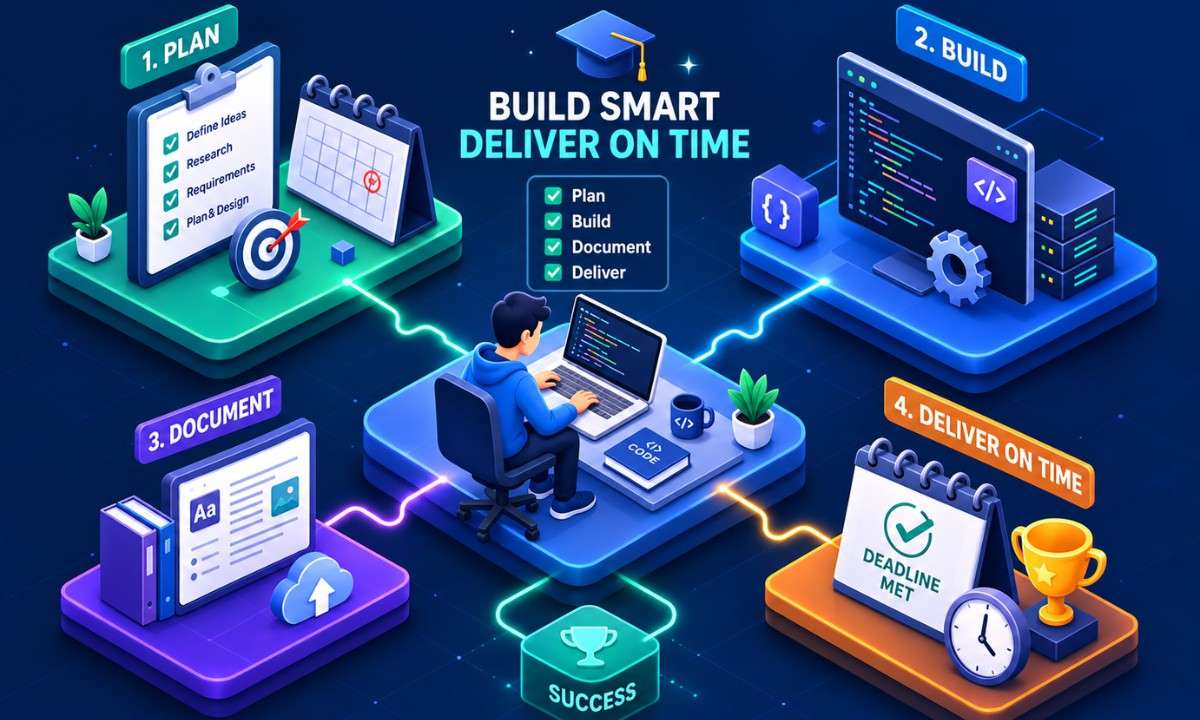

Picture this it is the first week of your final semester. You have a project registration form in front of you, a deadline in three days, and your mind is completely blank. You know you are supposed to build something with code. Something impressive. Something that demonstrates four years of learning. But where exactly do you start? If you are choosing among computer science projects right now with no clear direction, you are not alone, this is the moment most final-year engineering students dread. The challenge with computer science projects is not a lack of ideas floating around on the internet. It is the gap between a vague topic and a working, documented, submission-ready project. That gap is what this guide is here to help you close. By the time you finish reading, you will have two or three concrete ideas matched to your skill level, a shortlist of technologies you can realistically learn and use, and a clear four-phase plan to take you from first commit to final viva. Many students who contact Takeoff Projects report facing a similar crossroads, which is what shaped this guide. Think of it as a companion for the whole process, not just a list of topics to copy.
How to choose the right computer science projects for your skill level
The biggest mistake students make is committing to a project without being honest about where they stand. Some pick something too simple and lose interest by week four. Others pick something wildly ambitious, hit a wall during implementation, and end up submitting a half-working demo they cannot explain in the viva. Neither outcome is what you want.
Before you finalise anything, ask yourself three questions. What can you already build without looking everything up? What problem genuinely interests you enough to spend twelve weeks on it? And what can you realistically complete in one semester without leaning entirely on pre-built libraries to do the actual thinking? Answer those honestly and you will save yourself weeks of frustration.
Beginner, intermediate or advanced: where do you honestly sit?
A beginner is comfortable in one programming language, understands basic databases, and has built a few small scripts or static pages. An intermediate student has completed at least one functional web app or trained a simple machine learning model. An advanced student is ready to integrate multiple systems, work with APIs at scale, or experiment with novel algorithms. Place yourself honestly in one of these groups. Ambition is useful, but overestimating your current level at the project selection stage almost always costs you marks later.

Computer science project ideas and capstone project ideas worth building in 2026
The goal here is not to overwhelm you with sixty options. It is to give you a curated shortlist of CS project ideas you can actually act on this week. Each cluster below is grouped by subfield so you understand the domain you are entering, not just the task you are completing.
Beginner and intermediate ideas across web, data and recognition
For beginner and intermediate students, these final-year computer science projects offer a solid balance of scope and buildability within one semester:
· Online examination portal
· Sentiment analysis dashboard
· Library management system
· Face recognition attendance system
· Student performance prediction model
· Smart expense tracker with analytics
· E-learning platform with quizzes
Each of these mini projects for CSE students has a clear deliverable: a working application, a trained model where applicable, and a documented report. A Python and Flask combination works well for ML backed web apps; React and Node.js suit portal and dashboard projects. All seven ideas are scoped to be completable within an 8, 12 week semester plan, making them realistic targets for internal assessment milestones.
Advanced ideas in AI/ML, IoT and blockchain
If you have built functional projects before and want something that stands out on your originality rubric, these directions are worth exploring:
· AI-powered résumé screening tool
· Fake news detection using NLP
· Network intrusion detection system
· Smart home automation with IoT sensors
· Plant disease detection using convolutional neural networks
· Blockchain-based academic certificate verification
These advanced computer science projects tend to score higher on novelty at many Indian universities, which directly affects your internal assessment marks, originality is a recognised criterion in most evaluation rubrics. They also give you more to talk about during the viva because the design decisions are genuinely interesting.
Trending subfields shaping final-year projects right now
Choosing a popular subfield is not about following the crowd. It is about understanding why certain topics are popular before you commit to one. That distinction changes how you approach the project and how you explain it to an examiner.
Why AI/ML, computer vision and NLP dominate project lists
The practical reason is access. Datasets are freely available on platforms such as Kaggle, the UCI Machine Learning Repository, and Hugging Face, all well-maintained sources with datasets suited to one semester computer science projects. Pre-trained models reduce from-scratch complexity significantly. Examiners at many Indian universities also recognise the real-world relevance of these projects. Attendance systems using OpenCV, job-matching tools using NLP, and fraud detection models using scikit-learn are well-understood by evaluation committees and supported by enough public resources to be genuinely buildable in one semester. For project implementation, GitHub is the natural home: version control your code from day one and your commit history becomes evidence of consistent progress.
IoT, cloud and blockchain: where the originality marks hide
While AI projects are common, a well-executed IoT or blockchain project stands out precisely because fewer students attempt them. Smart agriculture systems, health monitoring wearables, and academic certificate verification on a blockchain are concrete directions that examiners notice. These typically require a hardware component or a deployment step, which adds a visible layer of completeness to your demo. That completeness is exactly what separates a good project from a distinction-level one.
A realistic 8, 12 week plan for computer science projects
Here is something worth knowing upfront: most project timelines students write in week one look nothing like reality by week six. Dataset preparation takes longer than expected. Integration breaks things that worked separately. Documentation always feels like something you can push to next week, until suddenly there are no weeks left. A good plan accounts for all of this upfront.
Breaking the semester into four clear phases
Phase one covers weeks one and two: define the problem clearly, complete a focused literature review, set up your tools and repository, and source your dataset or hardware components. At the end of week two, you should have a working development environment and a clear problem statement. Phase two runs from week’s three to six and covers core development. Build a working prototype before you start adding features. A simple version that actually runs is more valuable than an ambitious version that only partially works.
Phase three covers weeks seven to nine: test your system against edge cases, iterate based on what breaks, and integrate any remaining components. Phase four, week’s ten to twelve, is for documentation, presentation preparation, and the final submission review. Each phase has a clear definition of done. Do not move to the next phase until you have hit that marker.
The three planning mistakes that derail most students
The first is underestimating dataset preparation time. Cleaning, formatting, and validating data for an ML project can take as long as building the model itself, sometimes longer. Budget for it explicitly in your phase one and two schedule. The second is skipping the prototype review before starting the final build. A ten-minute walkthrough with your guide after the first working version saves you from building in the wrong direction for three weeks. The third is leaving documentation to the final two weeks. Write your abstract, introduction, and literature review chapters during phases one and two while the thinking is fresh. Your report will be significantly stronger for it.
What your university examiner actually looks for
Most students have no clear picture of how their project will be assessed, and that uncertainty generates genuine anxiety. Indian universities typically split project marks between internal and external assessment, common examples include a 60/40 or 75/25 split in favour of internal marks, a structure seen at institutions such as Anna University. This means your periodic reviews, your report quality, and your consistent progress matter more than a last-minute sprint before the submission deadline.
Deliverables that carry the most marks
The core deliverables are a working prototype or software demo, a structured project report, periodic review submissions, and the final viva voce. Internal assessment, which often carries the heavier share of marks, rewards consistency across the semester rather than a single impressive final product. In practice, periodic review submissions typically involve a brief progress demonstration to your internal guide, showing completed phases, screenshots, or a partially working model, rather than a polished final demo. Showing up to each review with something concrete to demonstrate is one of the most straightforward ways to protect your internal marks.
What a strong project report includes
A well-structured report follows this sequence: abstract, introduction, literature review, system design, implementation details, results and discussion, conclusion, and references in IEEE format. Most Indian universities also require a bonafide certificate, a declaration page, and a list of figures and tables. A common formatting guideline is Times New Roman at 12pt with 1.5 line spacing on A4 paper, though you should always verify your specific college template, as requirements vary. What separates an average report from a distinction-level one is not length but clarity: clear diagrams, honest discussion of results, and evidence that you understood the problem before you started building the solution?

How Takeoff Projects supports you from rough idea to final submission
Understanding the process is one thing. Having someone to check your decisions at each step is something else entirely. Students who work with Takeoff Projects are guided through each phase of the plan, not just reviewed at the end, which helps them sidestep the common pitfalls covered earlier.
Consider what that looks like in practice. A CSE student arrives with an interest in AI but no dataset plan and no clear scope. Through structured mentorship, that vague interest becomes a credit card fraud detection system: a defined problem, a cleaned dataset from a public repository, a trained model with measurable accuracy, a working Flask-based demo, and a formatted report ready for submission. The idea was always there, what was missing was the structure around it.
Takeoff Projects offers end-to-end support covering idea finalisation, technology selection, implementation guidance, prototype development, and documentation support, including report templates and presentation frameworks. If you need a project idea, implementation help, or a report review before submission, reach out directly to speak with a mentor from the Takeoff Projects team
From blank page to submitted project: a closing thought
Go back to that opening moment: the registration form, the deadline, the blank mind. Every strong final year project started exactly there. The panic is not a sign that you are behind. It is a sign that you are taking the work seriously, which is actually a reasonable starting point.
The path forward is clearer than it feels right now. Pick a project that matches your honest skill level. Plan in four phases. Build a working prototype before you touch your report. And give your documentation the same attention you give your code, because examiners read both.
The best computer science projects are not always the most technically complex ones. They are the ones where the student understood the problem deeply, implemented it honestly, and explained it clearly. That clarity is within reach, regardless of where you are starting from. If the path still feels uncertain, Takeoff Projects is there to walk alongside you from first idea to final submission.
 The Impact of Large Language Models on Natural Language Processing
  An Introduction to Deep Learning: Understanding Neural Networks
  What is Agentic AI? Understanding Autonomous Decision-Making in AI Systems
  Confused About Choosing Data Science Projects for Final Year? Here's Everything You Need to Know
  What Are the Best Natural Language Processing Projects for Final Year Students?
  Top 10 Machine Learning Final Year Projects for Engineering Students
  How to Choose AI Projects for Students for Your Final Year Project?
  Exploring the Future of LLMs: What’s next for AI in Language Understanding?
  What is Generative AI? A Complete Guide to Its Technology and Applications
  Artificial Intelligence Projects in Python with Complete Project Support
  Trending Data Mining Projects for BTech Students in 2026
  100+ Machine Learning Projects & Ideas for Students
  Top 10 Innovative AI Project Ideas for Final Year Students
  Explainable Artificial Intelligence (XAI) in the Era of Black Box Foundation Models
  Personalized AI Companions: A new wave of Emotional Intelligence in GenAI
  Responsible GenAI: Guardrails, Bias Control, and Alignment Techniques
  Synthetic Data Generation for Training Robust AI Models
  GenAI for Software Development: Code Generation, Refactoring & Debugging
  Agentic AI: The Rise of Multi-Agent Autonomous Systems
  Machine Learning Projects
  Fine-Tuning Llama 4 A Guide With Demo Project
 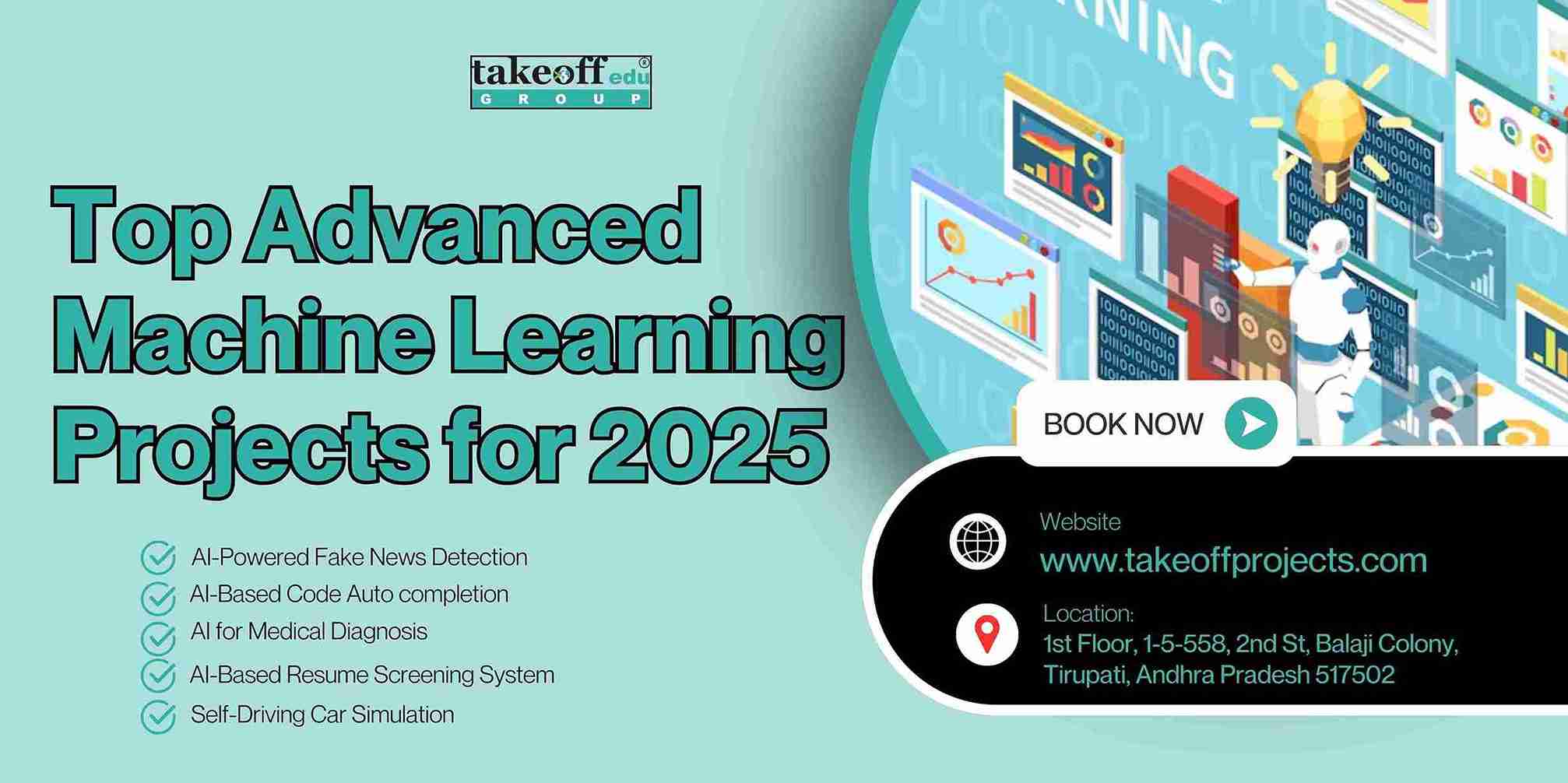 Top Advanced Machine Learning Projects for 2025
  Machine Learning Projects for Final Year Students
  Computer Science Projects
  ML Projects for Final Year
  Project Ideas for BTech CSE
  Mini Projects for Computer Science
  Major Project for CSE
  IEEE Projects for CSE
  Latest CSE Projects Ideas & Topics for Engineering Students
  List of Final Year Projects for Computer Science
  Top 6 Computer Science Engineering Projects































 Paper Publishing




