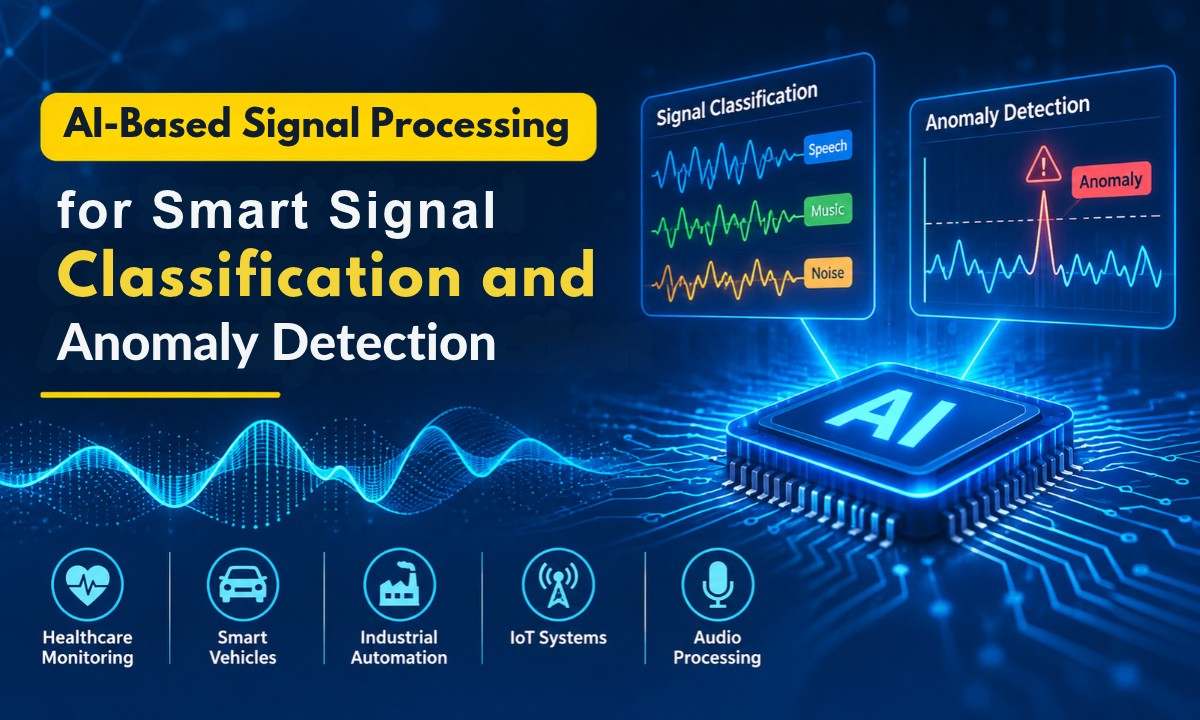

Signal processing plays an important role in modern engineering applications such as healthcare monitoring, radar communication, speech enhancement, and intelligent systems. With the integration of artificial intelligence, AI Signal Processing is transforming how digital signals are collected, analyzed, classified, and interpreted. It combines traditional Digital Signal Processing (DSP) techniques with machine learning and deep learning algorithms to identify patterns, reduce noise, and detect unusual signal behaviour.
For engineering students, AI Signal Processing offers exciting opportunities to develop innovative projects using real-world signals and intelligent algorithms. Smart signal classification and anomaly detection are two important applications that help identify signal categories and recognize abnormal patterns. Takeoff Edu Group supports engineering students in exploring innovative project ideas and developing practical technical skills through quality final-year projects.
What Is AI Signal Processing?
AI Signal Processing refers to the application of artificial intelligence techniques to process and analyze different types of signals, including audio, biomedical, radar, and communication signals.
Traditional signal processing generally uses mathematical models and predefined algorithms for filtering and analysis. AI-based approaches use machine learning and deep learning models to learn patterns from data and improve signal interpretation.
Some important techniques used in AI-Based Signal Processing include:
- Digital Filtering: Removes unwanted noise and interference from signals.
- Machine Learning: Identifies patterns and classifies signals using extracted features.
- Deep Learning: Uses neural networks to analyze complex signal characteristics.
- Adaptive Signal Processing: Automatically adjusts filter parameters according to changing signal conditions.
- Anomaly Detection: Identifies unusual patterns that may indicate abnormalities.
- Feature Extraction: Extracts meaningful information from raw signals for further analysis.
Understanding Smart Signal Classification Using AI
Smart signal classification is the process of identifying and assigning signals to predefined categories based on their characteristics. Artificial intelligence algorithms can learn patterns from signal data and use those patterns to classify new signals.
For example, in biomedical applications, machine learning and deep learning models can analyze ECG signals and classify different heart rhythm patterns. In audio applications, AI models can distinguish speech signals from background noise or categorize different audio patterns.
CNNs are commonly explored for signal classification because they can learn useful features from input data. The classification performance can be evaluated using metrics such as accuracy, precision, recall, and F1-score.
Important applications of smart signal classification include:
· ECG signal and arrhythmia classification.
· Speech and audio signal recognition.
· Radar signal identification.
· Biomedical signal analysis.
· Intelligent communication systems.
By developing signal classification projects, students can understand data preprocessing, feature extraction, model training, and performance evaluation.
Understanding Anomaly Detection in Signal Processing
Anomaly detection is the process of identifying unusual patterns or behaviours that differ from normal signal characteristics. In signal processing, unexpected variations may occur because of noise, interference, equipment faults, or abnormal physiological activity.
AI-based anomaly detection techniques analyze signal patterns and identify data points or signal segments that require further investigation.
For example, ECG signal analysis can help identify unusual heartbeat patterns. In radar and communication systems, signal monitoring can help recognize unexpected signal variations or interference.
Important applications of anomaly detection include:
· Identifying abnormal patterns in ECG signals.
· Detecting unexpected signal variations.
· Monitoring noise and interference.
· Recognizing unusual patterns in sensor data.
· Supporting intelligent monitoring systems.
Signal classification and anomaly detection are related but different tasks. Classification assigns signals to known categories, whereas anomaly detection identifies patterns that differ from expected behaviour.

Why Are AI Signal Processing Projects Important for Students?
AI Signal Processing projects allow engineering students to combine theoretical concepts with practical implementation. They provide experience in developing intelligent systems that solve real-world engineering challenges.
Key benefits include:
1. Practical Knowledge: Understand signal acquisition, filtering, classification, and analysis.
2. AI Skill Development: Gain exposure to machine learning, deep learning, and neural network models.
3. Research Opportunities: Explore algorithm optimization and performance improvement.
4. Real-World Applications: Work on healthcare, radar, audio, and communication-related problems.
5. Technical Expertise: Improve programming and simulation skills using Python, MATLAB, and other tools.
Digital Signal Processing Based Projects for Final Year Students
Digital Signal Processing based Projects for final year students provide an opportunity to explore practical engineering applications involving signal acquisition, filtering, transformation, classification, and analysis.
Students can combine DSP concepts with artificial intelligence to work on biomedical signal processing, speech enhancement, and radar detection. The five projects discussed above introduce different approaches to solving signal processing challenges.
During project development, students can experiment with different algorithms, compare performance metrics, optimize computational requirements, and explore hardware implementation using FPGA platforms.
These projects also help students understand how theoretical concepts are applied to practical engineering problems.
The following five project topics demonstrate how artificial intelligence and digital signal processing techniques can address different engineering challenges.
1. Adaptive Detection Algorithm with Dynamic Dual Threshold for Low Probability of Intercept Radar Signals and Its FPGA Implementation
Radar systems are widely used in surveillance, navigation, and security applications. Detecting Low Probability of Intercept (LPI) radar signals can be challenging because these signals are designed to be difficult to identify.
This project focuses on developing an adaptive detection algorithm using a dynamic dual-threshold technique. Instead of depending on a fixed threshold, the algorithm adjusts its detection levels according to changing signal conditions.
The project also explores FPGA implementation, helping students understand how signal detection algorithms can be implemented using dedicated hardware.
Key Features:
- Dynamic dual-threshold signal detection.
- Adaptive processing under changing noise conditions.
- Detection of LPI radar signals.
- FPGA-based hardware implementation.
- Performance evaluation under different signal conditions.
Applications: Radar surveillance, defence systems, and electronic signal monitoring.
Connection to the topic: This project demonstrates adaptive radar signal detection. It can help students understand how signal detection differs from general signal classification and how detection performance changes under different signal conditions.
2. Multistage Cascaded LMS Adaptive FIR Filter and Its Application to Multiple Artifacts Removal From ECG
Electrocardiogram (ECG) signals are used to monitor the electrical activity of the human heart. However, recorded ECG signals may contain unwanted disturbances caused by muscle activity, baseline wandering, and power-line interference.
This project uses a multistage cascaded Least Mean Square (LMS) adaptive Finite Impulse Response (FIR) filter to remove multiple artifacts from ECG signals.
The adaptive filter updates its coefficients based on the input signal and error feedback. Multiple filtering stages help reduce unwanted noise while preserving important ECG characteristics.
Key Features:
- ECG signal acquisition and preprocessing.
- Multistage cascaded adaptive FIR filtering.
- LMS-based coefficient optimization.
- Removal of multiple ECG artifacts.
- Comparison of filtered and original signals.
Applications: Biomedical monitoring, ECG analysis, and patient monitoring systems.
Connection to the topic: This project focuses on signal filtering and noise reduction. Clean ECG signals can support further analysis, including classification and identification of abnormal patterns.
3. OCADN: Improving Accuracy in Multi-Class Arrhythmia Detection From ECG Signals With a Hyperparameter-Optimized CNN
Cardiac arrhythmia refers to an irregular heartbeat that can require medical attention. Automated arrhythmia detection helps analyze ECG recordings and identify abnormal heart rhythm patterns.
This project focuses on improving multi-class arrhythmia classification using a Convolutional Neural Network (CNN) with hyperparameter optimization. The CNN learns important features from ECG signals and classifies them into different rhythm categories.
Hyperparameter optimization helps identify suitable model configurations, including learning rate, batch size, and network parameters, to improve classification performance.
Key Features:
- ECG signal preprocessing.
- CNN-based feature learning.
- Multi-class arrhythmia classification.
- Hyperparameter optimization.
- Performance evaluation using accuracy, precision, recall, and F1-score.
Applications: Automated ECG analysis, cardiac monitoring, and healthcare research.
Connection to the topic: This is a direct example of smart signal classification. The CNN identifies ECG patterns and assigns them to different arrhythmia categories. Abnormal rhythm categories can also be important in further anomaly-monitoring applications.

4. Enhancing Speech for Hearing Impaired Aids Through CNN
Background noise can make it difficult for people using hearing assistance devices to understand speech clearly. Speech enhancement techniques help improve audio quality by reducing unwanted interference.
This project explores Convolutional Neural Networks to enhance speech signals. The CNN model learns useful speech characteristics and helps distinguish speech information from background noise.
Students can explore audio preprocessing, feature extraction, CNN model training, and speech quality evaluation while developing this project.
Key Features:
- Audio signal acquisition and preprocessing.
- CNN-based speech enhancement.
- Noise reduction techniques.
- Speech feature extraction and analysis.
- Evaluation of enhanced audio quality.
Applications: Hearing assistance devices, assistive communication systems, and speech processing.
Connection to the topic: This project demonstrates intelligent audio signal analysis. Students can explore how speech characteristics differ from unwanted background noise and how CNN models can support speech enhancement.
5. A Resource-Efficient Time-Domain-Based Algorithm to Estimate Respiration Rate From Single-Lead ECG Signal
Respiration rate is an important physiological measurement used in healthcare monitoring. Estimating respiration rate from ECG signals provides an alternative approach when dedicated respiratory sensors are unavailable.
This project focuses on a resource-efficient, time-domain-based algorithm that estimates respiration rate using a single-lead ECG signal. It analyzes variations and patterns in the ECG waveform associated with respiratory activity.
The project also emphasizes computational efficiency, making it relevant to systems with limited processing power and memory.
Key Features:
- Single-lead ECG signal analysis.
- Time-domain feature extraction.
- Identification of respiration-related patterns.
- Resource-efficient algorithm development.
- Respiration rate estimation and performance evaluation.
Applications: Wearable healthcare devices, remote patient monitoring, and portable medical systems.
Connection to the topic: This project demonstrates physiological signal analysis and feature extraction. Students can explore how variations in ECG signals provide useful information for estimating respiration rate.

Conclusion
AI Signal Processing is an evolving engineering field that combines artificial intelligence with digital signal analysis to develop intelligent and efficient solutions. Smart signal classification helps categorize signal patterns, while anomaly detection identifies unusual signal behaviour that may require further analysis.
Projects involving radar detection, ECG artifact removal, arrhythmia classification, speech enhancement, and respiration rate estimation provide valuable opportunities for students to explore practical applications. Takeoff Edu Group helps engineering students explore innovative project opportunities through quality projects, plagiarism-free reports, journal publication support, and project add-ons. Choosing the right AI-Based Signal Processing project can be a valuable step toward building practical technical skills and completing a successful final-year engineering project.
FAQs
1. What is smart signal classification in AI Signal Processing?
Smart signal classification uses AI algorithms to identify signal patterns and assign them to predefined categories. It is used in ECG analysis, speech recognition, and radar signal identification.
2. What is anomaly detection in signal processing?
Anomaly detection identifies unusual patterns or variations that differ from normal signal behaviour. It is useful in ECG monitoring, sensor analysis, and signal interference detection.
3. What are the best AI Signal Processing projects for engineering students?
Popular topics include adaptive radar detection, ECG artifact removal, CNN-based arrhythmia classification, speech enhancement, and respiration rate estimation using ECG signals.
4. How are CNN models used in signal classification?
CNN models learn important features from signal data and use them to classify different patterns. They are useful for applications such as multi-class arrhythmia detection and speech analysis.
5. Which tools are used for AI Signal Processing projects?
Python, MATLAB, TensorFlow, Keras, NumPy, and SciPy are commonly used for signal processing and AI development. FPGA platforms can also be used for hardware implementation.
 Medical Image Segmentation Projects for Final Year Students
 YOLO-Based Object Detection Projects for Students
 Enhancing Security in 5G Device-to-Device Communication with a Secure Gale-Shapley Algorithm
 MATLAB Projects in 5G and Beyond: Beamforming, NOMA and More
 Design and Simulation of MIMO Systems Using MATLAB
 Speech and Audio Signal Processing in MATLAB: From Basics to Projects
 Power Spectral Density Analysis in MATLAB: Methods and Applications
 How to Filter Noise in ECG and EEG Signals Using MATLAB
 Real-Time Object Detection in Images Using MATLAB: A Practical Approach
 Enhancing Image Quality in MATLAB: Techniques and Tools You Must Know
 Medical Image Analysis in MATLAB: Applications in Diagnosis and Research
 Top 5 Projects on 5G Networks
 Top 5 Projects on Modulation Techniques
 Top 7 Projects on MIMO Transmissions
 Top 5 Device to Device Communications Projects
 Top 7 Image Detection Projects
 Top 7 Image Compression Projects
 Top 5 Fusion and Saliency Projects
 Top 7 Image Retrieval Projects
 Top 5 Image Denoising Projects
 Top 7 Projects on Security Applications
 Top 7 Image Enhancement Projects
 Top 10 Deep Learning Projects for B.Tech
 Top 5 Image Segmentation Projects
 Top 5 Artificial Neural Network Projects















 Paper Publishing