Adaptive Detection Algorithm With Dynamic Dual Threshold for Low Probability of Intercept Radar Signals and Its FPGA Implementation
Objective
To develop a robust signal detection framework for LPI radar signals in non-Gaussian environments using adaptive dual-threshold hysteresis and CFAR-based noise estimation, improving detection accuracy, continuity, and performance at low SNR conditions.
Abstract
Abstract:
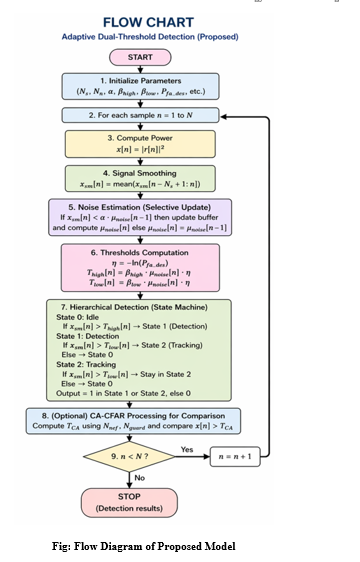
This work presents a robust signal detection framework for low probability of intercept (LPI) radar signals operating in non-Gaussian and cluttered environments. The proposed method integrates adaptive thresholding with a hierarchical dual-threshold detection mechanism to enhance detection performance under low signal-to-noise ratio (SNR) conditions. A sliding window-based preprocessing stage is employed for noise smoothing, followed by dynamic noise estimation using constant false alarm rate (CFAR) principles. The core contribution lies in a three-state hysteresis detector that utilizes high and low adaptive thresholds to suppress noise-induced fluctuations while preserving weak signal continuity. The system is evaluated using Monte Carlo simulations under composite clutter models, including K-distributed and impulsive noise scenarios. Performance comparisons with conventional CFAR techniques demonstrate improved detection probability, reduced false alarms, and better pulse continuity, particularly at low SNR levels. The proposed approach achieves reliable detection with low computational complexity, making it suitable for real-time radar and electronic warfare applications.
Keywords: LPI radar, CFAR detection, adaptive thresholding, hysteresis detection, dual-threshold method, non-Gaussian noise, K-distributed clutter, Monte Carlo simulation, signal detection, low SNR, pulse detection, radar signal processing.
NOTE: Without the concern of our team, please don't submit to the college. This Abstract varies based on student requirements.
Block Diagram
Specifications
Software: Matlab 2022b or above
Hardware:
Operating Systems:
- Windows 10
- Windows 7 Service Pack 1
- Windows Server 2019
- Windows Server 2016
Processors:
Minimum: Any Intel or AMD x86-64 processor
Recommended: Any Intel or AMD x86-64 processor with four logical cores and AVX2 instruction set support
Disk:
Minimum: 2.9 GB of HDD space for MATLAB only, 5-8 GB for a typical installation
Recommended: An SSD is recommended A full installation of all MathWorks products may take up to 29 GB of disk space
RAM:
Minimum: 4 GB
Recommended: 8 GB
Learning Outcomes
· Introduction to Matlab
· What is EISPACK & LINPACK
· How to start with MATLAB
· About Matlab language
· Matlab coding skills
· About tools & libraries
· Application Program Interface in Matlab
· About Matlab desktop
· How to use Matlab editor to create M-Files
· Features of Matlab
· Basics on Matlab
· What is Signal Processing?
· About Signal Processing
· Introduction to Signal Processing
· How analog and digital signal is formed
· Importing the signal via signal acquisition tools
· Analyzing and manipulation of signals.
· Phases of signal processing:
· Acquisition
· Signal enhancement
· Signal restoration
· Medical Signal Processing
· Medical Signal Analysis
· Medical Signal Diagnosis
· Filtering techniques
· Machine Learning Algorithms
· Deep Learning Algorithms etc.
· How to extend our work to another real time applications
· Project development Skills
o Problem analyzing skills
o Problem solving skills
o Creativity and imaginary skills
o Programming skills
o Deployment
o Testing skills
o Debugging skills
o Project presentation skills
o Thesis writing skills
Demo Video


Request for Video
 Paper Publishing
Request Call Back
Would you like to receive a free callback now?
Choose the best time for callback:
Leave your message and we will contact you as soon as possible

6-2-85/B, Old Maternity Hospital Road, Thyagaraja Nagar, Tirupati, Andhra Pradesh – 517501
+91 9030333433
+91 9393939065
0877-2261612

Disclaimer - Takeoff Edu Group Projects are not associated or affiliated with IEEE in any way. The IEEE Projects mentioned here are mentioned in the context of student projects, whose ideas are derived from IEEE publications, not projects of or by IEEE.

