A Resource-Efficient Time-Domain-Based Algorithm to Estimate Respiration Rate from Single-Lead ECG Signal
Objective
To develop a computationally efficient time-domain MPD algorithm for accurate breath rate estimation from single-lead ECG signals, enabling real-time wearable respiratory monitoring.
Abstract
ABSTRACT
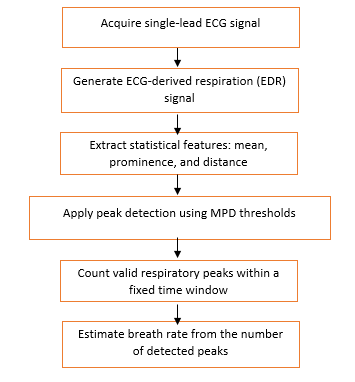
This study introduces a novel, computationally efficient time-domain (TD) algorithm for accurate breath rate (BR) estimation from single-lead ECG signals, designed for wearable devices. The proposed algorithm uses statistical TD parameters—mean, prominence, and distance (MPD)—to detect valid respiratory peaks in ECG-derived respiration (EDR) signals. The performance of the MPD algorithm was evaluated using two datasets: 1) a benchmark database containing ECG acquired during dynamic activities and 2) a real-time dataset comprising ECG signals from five subjects performing dynamic activities, including standing, jogging, and recovery. Comparative analysis against state-of-the-art TD methods, such as count-orig, zero-crossing detection, peak detection, and adaptive threshold techniques, demonstrates the superiority of MPD in both accuracy and computational efficiency. On the benchmark dataset, MPD achieved a mean absolute error (MAE) of 3.66 bpm and mean absolute percentage error (MAPE) of 23.69%, outperforming the Count-Orig method (MAE = 5.09 bpm, MAPE = 32.76%). For real-time data, MPD further demonstrated robust performance with an MAE of 1.53 bpm and MAPE of 7.25%. The algorithm’s design simplicity, combined with its ability to handle spurious peaks and varying signal conditions, makes it particularly suitable for resource-constrained wearable applications. Its high accuracy, low computational demands, and adaptability across activity conditions underscore its potential for continuous, real-time respiratory monitoring in diverse scenarios.
Keywords: Bio medical signal processing, denoising, ECG-derived respiration (EDR) rate, ECG signal processing, signal processing, wearable devices.
NOTE: Without the concern of our team, please don't submit to the college. This Abstract varies based on student requirements.
Block Diagram
Specifications
Software: Matlab 2020a or above
Hardware:
Operating Systems:
- Windows 10
- Windows 7 Service Pack 1
- Windows Server 2019
- Windows Server 2016
Processors:
Minimum: Any Intel or AMD x86-64 processor
Recommended: Any Intel or AMD x86-64 processor with four logical cores and AVX2 instruction set support
Disk:
Minimum: 2.9 GB of HDD space for MATLAB only, 5-8 GB for a typical installation
Recommended: An SSD is recommended A full installation of all MathWorks products may take up to 29 GB of disk space
RAM:
Minimum: 4 GB
Recommended: 8 GB
Learning Outcomes
· Introduction to Matlab
· What is EISPACK & LINPACK
· How to start with MATLAB
· About Matlab language
· Matlab coding skills
· About tools & libraries
· Application Program Interface in Matlab
· About Matlab desktop
· How to use Matlab editor to create M-Files
· Features of Matlab
· Basics on Matlab
· What is Signal Processing?
· About Signal Processing
· Introduction to Signal Processing
· How analog and digital signal is formed
· Importing the signal via signal acquisition tools
· Analyzing and manipulation of signals.
· Phases of signal processing:
· Acquisition
· Signal enhancement
· Signal restoration
· Medical Signal Processing
· Medical Signal Analysis
· Medical Signal Diagnosis
· Filtering techniques
· Machine Learning Algorithms
· Deep Learning Algorithms etc.
· How to extend our work to another real time applications
· Project development Skills
o Problem analyzing skills
o Problem solving skills
o Creativity and imaginary skills
o Programming skills
o Deployment
o Testing skills
o Debugging skills
o Project presentation skills
o Thesis writing skills
Demo Video


Request for Video
 Paper Publishing
Request Call Back
Would you like to receive a free callback now?
Choose the best time for callback:
Leave your message and we will contact you as soon as possible

6-2-85/B, Old Maternity Hospital Road, Thyagaraja Nagar, Tirupati, Andhra Pradesh – 517501
+91 9030333433
+91 9393939065
0877-2261612

Disclaimer - Takeoff Edu Group Projects are not associated or affiliated with IEEE in any way. The IEEE Projects mentioned here are mentioned in the context of student projects, whose ideas are derived from IEEE publications, not projects of or by IEEE.

