
Introduction
Artificial intelligence is increasingly being deployed in smartphones, robotics, smart cameras, industrial systems, autonomous devices, and other edge applications. As AI workloads become more demanding, choosing the right hardware architecture is important.
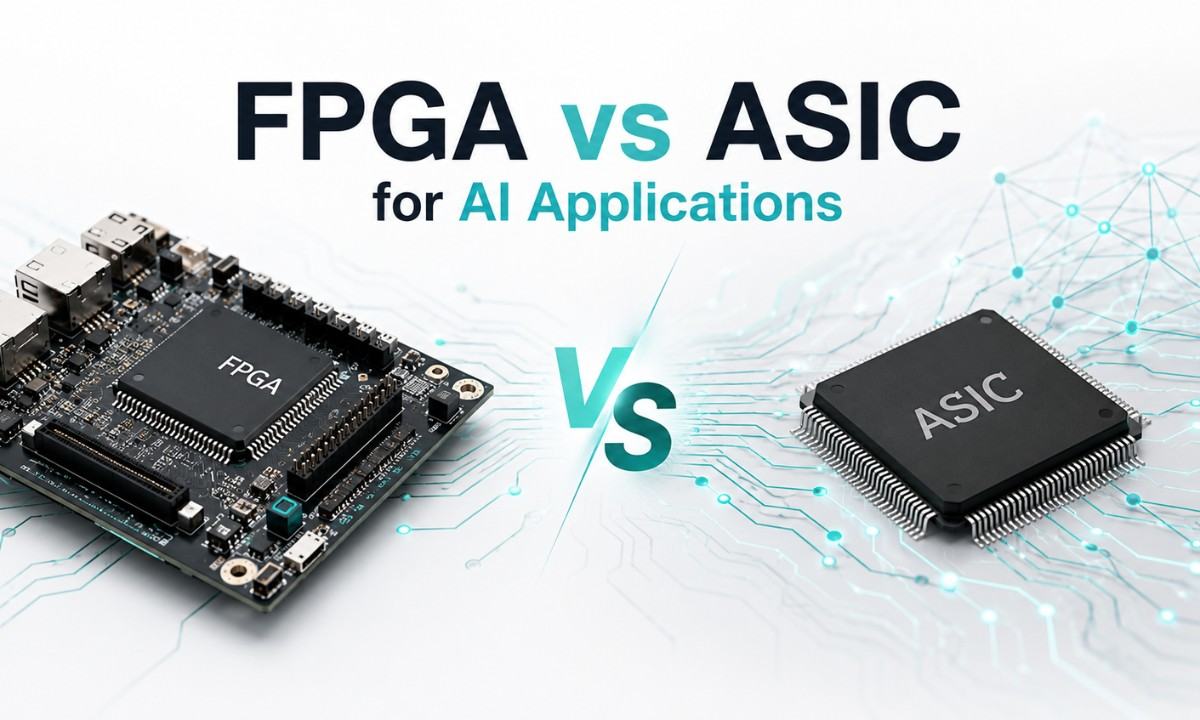
Two technologies widely used for specialized AI hardware are FPGA (Field-Programmable Gate Array) and ASIC (Application-Specific Integrated Circuit).
So, FPGA vs ASIC for AI applications: which is better?
There is no single answer. FPGA provides flexibility and reconfigurability, while ASIC can deliver higher workload-specific optimization, power efficiency, and cost advantages at large production volumes.
The right choice depends on performance, power requirements, development cost, workload stability, and production scale.
At Takeoff Edu Group, students and aspiring engineers can explore practical technology areas such as artificial intelligence, machine learning, FPGA, embedded systems, edge AI, and hardware acceleration. Understanding the differences between FPGA and ASIC can help learners make better decisions when selecting hardware for AI applications and engineering projects.
Key Takeaways
- FPGA can be reconfigured after manufacturing.
- ASIC is designed for a specific workload and is generally fixed after fabrication.
- FPGA is suitable for research, prototyping, and changing AI workloads.
- ASIC is suitable for stable workloads and high-volume production.
- ASIC can provide better performance-per-watt when highly optimized.
- FPGA generally requires lower initial investment.
- ASIC has higher upfront development/NRE costs but can have a lower per-unit cost at high volumes.
- AI hardware performance also depends on memory bandwidth and data movement.
What Is an FPGA?
An FPGA is a semiconductor device containing programmable logic, memory resources, and configurable interconnections.
Unlike a fixed-function chip, an FPGA can be programmed and reconfigured after manufacturing. It can implement customized hardware logic and execute multiple operations in parallel.
This makes FPGA useful for:
- AI and machine learning inference
- Computer vision
- Robotics
- Signal processing
- Industrial automation
- Edge computing
- Real-time processing
The ability to modify the hardware without manufacturing a new chip makes FPGA particularly useful during development and experimentation.
What Is an ASIC?
An ASIC is a semiconductor chip designed specifically for a particular application or workload.
Unlike an FPGA, its core hardware functionality is generally fixed after fabrication. Because the architecture is designed around a specific workload, unnecessary resources can be removed and the chip can be optimized for performance, power, area, and memory access.
ASICs are commonly used in AI accelerators, smartphones, networking equipment, automotive electronics, data centers, and other specialized computing systems.
For AI, an ASIC can be designed specifically to accelerate operations such as matrix multiplication and multiply-accumulate computations.
FPGA vs ASIC: Key Differences
|
Factor |
FPGA |
ASIC |
|
Programmability |
Reconfigurable |
Fixed after fabrication |
|
Flexibility |
Very High |
Low |
|
Customization |
High |
Very High |
|
Performance |
High |
Very High for optimized workloads |
|
Power Efficiency |
Good |
Excellent for optimized workloads |
|
Initial Development Cost |
Lower |
Higher |
|
NRE Cost |
Lower |
High |
|
Per-Unit Cost |
Generally Higher |
Potentially Lower at High Volume |
|
Development Time |
Shorter |
Longer |
|
Prototyping |
Excellent |
Generally Not Practical |
|
High-Volume Production |
Less Suitable |
Highly Suitable |
The basic trade-off is simple:
FPGA → flexibility and faster development
ASIC → specialization and maximum optimization
FPGA vs ASIC for AI Applications
AI models perform large numbers of mathematical operations, including matrix multiplication, convolution, and multiply-accumulate operations.
Both FPGA and ASIC can accelerate these workloads through parallel processing and customized data paths.
FPGA for AI
FPGA is useful when developers need to experiment with:
- Neural network architectures
- Model optimization
- Data precision
- Hardware configurations
- AI inference pipelines
- Edge AI applications
Because the hardware can be modified, FPGA is suitable when AI requirements are still evolving.
ASIC for AI
ASIC is attractive when the AI workload is stable and the architecture can be optimized specifically for it.
A custom AI ASIC can be designed for:
- High throughput
- Low latency
- Low power consumption
- Efficient memory access
- High computational density
Memory Bandwidth and Data Movement in AI Hardware
AI accelerator performance depends on more than computing capability.
Memory bandwidth determines how quickly data can be supplied to processing elements. If the accelerator cannot receive data fast enough, its computational resources may remain underutilized.
Data movement is another important factor because transferring data between memory and processing elements consumes time and energy.
AI hardware therefore benefits from:
- Efficient memory access
- Data reuse
- Optimized data paths
- Sufficient memory bandwidth
- Reduced unnecessary data movement
Both FPGA and ASIC can implement optimized memory and data-processing architectures, but ASIC can be more deeply optimized for a fixed workload.
FPGA vs ASIC: Performance
FPGAs can provide high performance through parallel processing, pipelining, and customized architectures. They are useful for real-time applications requiring predictable latency.
ASICs can achieve higher performance for a specific workload because the complete architecture can be optimized for that application.
Therefore:
Stable workload + maximum optimization → ASIC
High performance + flexibility → FPGA
Actual performance depends on factors such as architecture, parallelism, clock frequency, precision, memory bandwidth, and data movement.
FPGA vs ASIC: Power Consumption
Power efficiency is particularly important for edge AI applications such as smart cameras, drones, robotics, autonomous systems, and industrial devices.
FPGAs can provide good power efficiency, but their programmable logic and routing resources may introduce additional overhead.
ASICs can remove unnecessary hardware and optimize the architecture specifically for the target workload.
Therefore, ASIC generally provides better power efficiency for a stable, highly optimized workload, while FPGA may be preferable when future hardware changes are expected.
FPGA vs ASIC: Cost
Cost should be considered from two perspectives: initial development cost and per-unit production cost.
FPGA
FPGA generally requires a lower initial investment because there is no custom chip fabrication process.
It is suitable for:
- Research
- Academic projects
- Prototyping
- Startups
- Low-volume products
- Hardware experimentation
ASIC
ASIC development involves significant upfront NRE (Non-Recurring Engineering) costs, including architecture design, RTL development, verification, physical design, testing, fabrication, engineering resources, and specialized tools.
However, once production reaches sufficiently high volumes, the per-unit cost can potentially become lower because the fixed development investment is distributed across many devices.
Low/moderate volume → FPGA may be more practical
High volume → ASIC may become more economical
FPGA vs ASIC: Development Time
FPGA development can usually move from design to testing without semiconductor fabrication. This makes it suitable for rapid development and prototyping.
ASIC development requires additional stages such as RTL design, verification, synthesis, physical design, timing and power analysis, fabrication, and testing.
As a result, FPGA is generally preferred for early development, while ASIC becomes more appropriate after the workload and architecture are well established.
FPGA vs ASIC for Edge AI
Edge AI processes data close to where it is generated.
Applications include:
- AI cameras
- Smart manufacturing
- Autonomous robots
- Drones
- Industrial monitoring
- Intelligent vehicles
FPGA is useful when the AI model or processing pipeline may change.
ASIC is more suitable when the workload is stable and the same optimized architecture will be deployed across a large number of devices.
FPGA Based Projects for Engineering Students
FPGA Based Projects provide an opportunity for engineering students to combine digital design, artificial intelligence, embedded systems, computer vision, and hardware acceleration.
Students can explore project areas such as:
- FPGA-based image classification
- FPGA-based object detection
- AI-based computer vision
- FPGA neural network acceleration
- Edge AI using FPGA
- AI-based signal processing
- FPGA-based robotics
- Embedded AI systems
These projects help students understand how AI models can be implemented and optimized on hardware rather than relying only on software.
At Takeoff Edu Group, FPGA-based projects can be explored alongside AI, machine learning, embedded systems, and edge AI concepts to provide a practical understanding of hardware-based AI applications.
For academic and final-year projects, FPGA is generally more practical than ASIC because students can experiment with hardware architectures without going through the complexity and expense of custom-chip design and fabrication.
When Should You Choose FPGA?
Choose FPGA when:
- The AI model may change.
- Hardware experimentation is required.
- You need a prototype quickly.
- Flexibility is important.
- Production volume is low or moderate.
- You are researching AI hardware.
- Reconfigurable edge AI is required.
When Should You Choose ASIC?
Choose ASIC when:
- The AI workload is stable.
- Maximum workload-specific optimization is required.
- Power efficiency is critical.
- Production volume is high.
- Significant upfront development investment is possible.
- The same workload will be deployed across many devices.
- Long-term hardware deployment is expected.
How to Select FPGA or ASIC for an AI Project
Before choosing the technology, consider:
1. Is the AI workload stable?
If it is changing, FPGA may be more suitable.
2. What is the production volume?
High-volume products can justify ASIC development.
3. How important is power efficiency?
ASIC can provide an advantage for stable, power-constrained workloads.
4. How quickly is a prototype required?
FPGA is generally faster to develop.
5. What is the development budget?
ASIC requires significantly higher upfront investment.
6. Will the hardware need future changes?
If yes, FPGA provides greater flexibility.
FPGA vs ASIC: Final Decision Table
|
Requirement |
Recommended |
|
AI research |
FPGA |
|
Academic prototype |
FPGA |
|
Rapid development |
FPGA |
|
Changing AI models |
FPGA |
|
FPGA Based Projects |
FPGA |
|
Flexible Edge AI |
FPGA |
|
Fixed AI workload |
ASIC |
|
Maximum power efficiency |
ASIC |
|
Highly optimized AI accelerator |
ASIC |
|
Very high production volume |
ASIC |
|
Large-scale deployment |
ASIC |
|
Maximum flexibility |
FPGA |
|
Maximum specialization |
ASIC |
Conclusion
The choice between FPGA and ASIC depends on the requirements of the AI application.
FPGA is a strong option for research, prototyping, changing workloads, and applications where reconfigurability is important.
ASIC is a strong option for stable AI workloads that require maximum optimization, power efficiency, and large-scale deployment.
Cost should also be evaluated carefully. FPGA generally offers a lower initial investment, while ASIC requires higher NRE and development costs but can potentially provide lower per-unit economics at high production volumes.
For AI accelerator design, computing performance is only part of the equation. Memory bandwidth, data movement, and efficient data reuse can also significantly affect overall performance and power consumption.
For engineering students, FPGA Based Projects provide a practical way to explore AI, embedded systems, digital design, computer vision, and hardware acceleration.
Takeoff Edu Group focuses on practical and project-oriented learning across emerging technologies, helping students explore technically relevant areas such as AI, machine learning, FPGA, embedded systems, and edge AI.
FAQs
Is FPGA better than ASIC for AI?
Not always. FPGA is generally better for flexibility, experimentation, and changing workloads, while ASIC is better for stable workloads requiring high optimization and large-scale deployment.
Which is more power efficient, FPGA or ASIC?
ASIC is generally more power efficient when the hardware is optimized for a stable workload.
Which is cheaper, FPGA or ASIC?
FPGA generally has a lower initial cost. ASIC requires higher upfront NRE costs but can have a lower per-unit cost at high production volumes.
Is FPGA used for AI projects?
Yes. FPGA is used for AI acceleration, computer vision, machine learning inference, edge AI, robotics, and hardware-based AI projects.
Should students choose FPGA or ASIC for projects?
For most academic and final-year projects, FPGA is more practical because students can develop and modify hardware without manufacturing a custom ASIC.
 AI Accelerators in Modern VLSI: Future of Semiconductor Hardware
  Design and Analysis of Multi-Protocol Conversion Unit for SPI, I2C and UART
  Design of Polar Codes in 5G New Radio
  Design & Study the Performance of CMOS Based Ring Oscillator for 5G Mobile Communication
  Top IEEE VLSI Engineering Projects For Final Year Students with Source Code
  Best VLSI Projects for ECE Students
  Top 7 Transistor Logic Projects for Engineering
  Top 10 Low Power VLSI Projects
  Top 5 Nano Technology Projects using VLSI
  Top 6 Communications Projects for Students
  Top 7 Projects on DSP Core
  Top 5 Projects on Arithmetic Core
  Top 7 Projects on Finite State Machines
  Top 10 Projects on Cadence EDA Tool
  FPGA Final Year Projects for Electronics Students
  Verilog Projects for ECE
  VLSI Project Ideas for Engineering
  VLSI Mini Projects for ECE Department Students
  VLSI Projects for Final Year











 Paper Publishing




