

Introduction
Generative Artificial Intelligence (AI) is transforming many industries by enabling computers to generate text, images, videos, music, and code. Technologies such as large language models (LLMs), generative image models, and AI-powered assistants require significant computing power to process large amounts of data.
Traditional processors may struggle to meet the speed, power efficiency, and performance requirements of these advanced AI models. Hardware acceleration for generative AI models helps improve processing speed, reduce power consumption, and support efficient AI applications.
Very Large Scale Integration (VLSI) design plays an important role in developing specialized hardware for AI workloads. By designing efficient chips and semiconductor circuits, engineers can build hardware that supports faster and more energy-efficient generative AI systems.
What Is Hardware Acceleration in Generative AI?
Generative AI models perform operations such as matrix multiplication, vector processing, and neural network computations. Hardware accelerators are designed to execute these operations efficiently.
Common hardware accelerators include:
- Graphics Processing Units (GPUs): Handle parallel computations and are widely used for training and running generative AI models.
- Application-Specific Integrated Circuits (ASICs): Designed for specific computing workloads, offering opportunities for improved performance and energy efficiency.
- Field-Programmable Gate Arrays (FPGAs): Reconfigurable chips that allow engineers to customize hardware for different AI applications.
- AI accelerators: Specialized processors designed to handle machine learning and neural network operations.
- Neural Processing Units (NPUs): Process AI workloads efficiently in supported devices and computing systems.
The selection of an accelerator depends on the model size, processing requirements, power budget, cost, and target application.
Role of VLSI Design in AI Hardware Acceleration
VLSI design involves integrating a large number of electronic components onto a single semiconductor chip. It enables engineers to develop compact, high-performance circuits for demanding computing applications.
In generative AI, VLSI design helps optimize the hardware used for neural network calculations, memory access, and data movement.
Important contributions of VLSI design include:
- Parallel processing: Designing circuits that execute multiple operations simultaneously.
- Power optimization: Reducing unnecessary energy consumption during AI computations.
- Memory optimization: Improving data storage and access to reduce delays during processing.
- Chip integration: Combining processing units, memory interfaces, and control circuits into efficient systems.
- Area efficiency: Designing circuits that use available chip space effectively.
These techniques help engineers develop AI hardware that balances performance, power consumption, chip area, and manufacturing cost.

How Hardware Acceleration Works in Generative AI Models
Generative AI models contain multiple layers of mathematical operations. For example, transformer-based models use attention mechanisms and matrix computations to process input data and generate outputs.
Hardware acceleration improves the execution of these operations through specialized computing units.
The process generally involves the following steps:
1. Input processing: The model receives text, images, or other input data.
2. Data preparation: Input data is converted into a format suitable for the AI model.
3. Parallel computation: Specialized hardware performs mathematical operations across multiple processing units.
4. Memory access: Model parameters and intermediate results are transferred between memory and processing units.
5. Output generation: The model produces the requested text, image, or other content.
Key VLSI Techniques for Generative AI Acceleration
1. Parallel Processing Architecture
Parallel processing allows multiple calculations to take place simultaneously. Since generative AI models perform large numbers of mathematical operations, parallel hardware can improve throughput.
VLSI engineers design processing arrays and computational units to support these operations efficiently. However, performance depends on memory bandwidth, workload characteristics, and the amount of parallelism available.
2. Low-Power VLSI Design
Generative AI systems can consume considerable energy, particularly during large-scale model training and inference. Low-power VLSI techniques aim to reduce energy usage without significantly affecting performance.
Common techniques include clock gating, power gating, voltage optimization, and efficient circuit design.
These methods are important for data centers, edge devices, and portable AI applications where energy efficiency is a major requirement.
3. Memory Optimization
Moving data between memory and processing units can consume significant time and energy. This is particularly important for generative AI models with large parameter counts.
VLSI designers can improve memory efficiency through better data layouts, memory hierarchies, caching, and optimized data-transfer architectures.
High-bandwidth memory and specialized on-chip memory structures can also help reduce bottlenecks in suitable designs.
4. Quantization and Reduced Precision
Quantization represents model weights and computations using lower-precision numerical formats. For example, some models can use 8-bit or lower-precision arithmetic instead of 32-bit floating-point operations for selected workloads.
However, engineers must evaluate accuracy and performance carefully because excessive precision reduction may affect the quality of generated outputs.
5. Hardware-Software Co-Design
Hardware-software co-design involves developing hardware architecture and software together rather than optimizing them independently.
For generative AI, this approach considers model structure, compiler optimization, data movement, memory usage, and processor capabilities.
Applications of Hardware Acceleration for Generative AI
Hardware acceleration supports several real-world applications.
Natural Language Processing
AI assistants, chatbots, and text-generation systems use generative models to understand prompts and generate responses. Accelerators help improve response speed and support larger workloads.
AI Image and Video Generation
Generative models can create images, animations, and videos from text prompts or other inputs. Specialized processors help execute the computationally intensive operations involved in these tasks.

Challenges in Designing VLSI Hardware for Generative AI
Although hardware acceleration provides several benefits, engineers face important design challenges.
- High power consumption: Large AI workloads can require substantial electrical power and cooling.
- Memory bandwidth limitations: Processing units may remain idle while waiting for model data.
- Chip manufacturing costs: Advanced semiconductor designs can require expensive development and fabrication.
- Thermal management: High-performance processors generate heat that must be managed effectively.
- Model compatibility: Different AI architectures may require different computational resources.
Future Trends in VLSI Design for Generative AI
1. Advanced AI Processor Architectures
Future AI processors are expected to focus on higher computational efficiency, improved memory access, and support for a wider range of AI operations. Specialized architectures can be tailored to transformer models and other generative AI workloads.
2. Chiplet-Based Design
Chiplet technology allows a system to combine multiple smaller semiconductor dies within one package. This approach can provide design flexibility and improve integration options for complex AI processors.
The benefits depend on packaging technology, interconnect performance, manufacturing yield, and overall system design.
3. Three-Dimensional Chip Integration
Three-dimensional integration stacks semiconductor dies vertically to improve integration density and, in some designs, reduce communication distances. It offers opportunities to improve memory access and system performance, although thermal management and manufacturing complexity remain important challenges.
4. Processing-in-Memory Technologies
Processing-in-memory and near-memory computing aim to reduce the energy and time required to move data between memory and processing units. These technologies may benefit AI workloads that involve frequent data transfers.
5. Energy-Efficient AI Hardware
As generative AI adoption grows, energy efficiency will remain a major design objective. Researchers are exploring lower-precision computation, optimized data movement, specialized circuits, and more efficient processor architectures.
6. Emerging Semiconductor Technologies
New semiconductor materials, advanced fabrication processes, and emerging computing approaches may provide additional opportunities for improving AI hardware. Their practical adoption will depend on performance, reliability, manufacturing readiness, and cost.
Importance of Hardware Acceleration in Future AI Systems
Generative AI is becoming an important part of software development, business automation, scientific research, and digital services. As AI models become more capable, the demand for efficient computing hardware is also increasing.
Combining efficient hardware architectures with suitable AI models and software can help organizations build faster, more scalable, and more energy-efficient AI systems.
Conclusion
Hardware acceleration for generative AI models is an important area of research and development in VLSI design. GPUs, ASICs, FPGAs, and specialized AI processors help improve the performance of generative AI workloads, while VLSI techniques support efficient computation, memory access, and power management.
Future developments in chiplet-based architectures, three-dimensional integration, processing-in-memory, and energy-efficient circuit design may further improve AI computing systems.
Are you
looking for innovative VLSI projects in AI hardware acceleration? Takeoff Projects provides project guidance and support for students working
on VLSI, AI, and hardware design projects. Explore new project ideas and take
your technical skills to the next level.
Frequently Asked Questions (FAQs)
1. What is hardware acceleration in generative AI?
Hardware acceleration uses specialized processors to execute generative AI computations faster or more efficiently than general-purpose processors for suitable workloads.
2. How does VLSI help accelerate generative AI models?
VLSI enables the design of specialized chips that optimize parallel computation, memory access, power consumption, and circuit area for AI workloads.
3. Which processors are used for generative AI acceleration?
GPUs, ASICs, FPGAs, NPUs, and other specialized AI accelerators are used, depending on the workload and system requirements.
4. What are the major challenges in AI accelerator design?
Major challenges include power consumption, memory bandwidth, heat management, chip cost, scalability, and balancing performance with energy efficiency.
5. What are the future trends in VLSI for generative AI?
Important trends include chiplet-based design, three-dimensional integration, processing-in-memory, advanced AI processor architectures, and energy-efficient semiconductor circuits.
 Design and Implementation of Energy-Efficient AI Processors Using VLSI Technology
 FPGA vs ASIC for AI Applications: Which Is Better for AI Workloads?
 AI Accelerators in Modern VLSI: Future of Semiconductor Hardware
 Design and Analysis of Multi-Protocol Conversion Unit for SPI, I2C and UART
 Design of Polar Codes in 5G New Radio
 Design & Study the Performance of CMOS Based Ring Oscillator for 5G Mobile Communication
 Top IEEE VLSI Engineering Projects For Final Year Students with Source Code
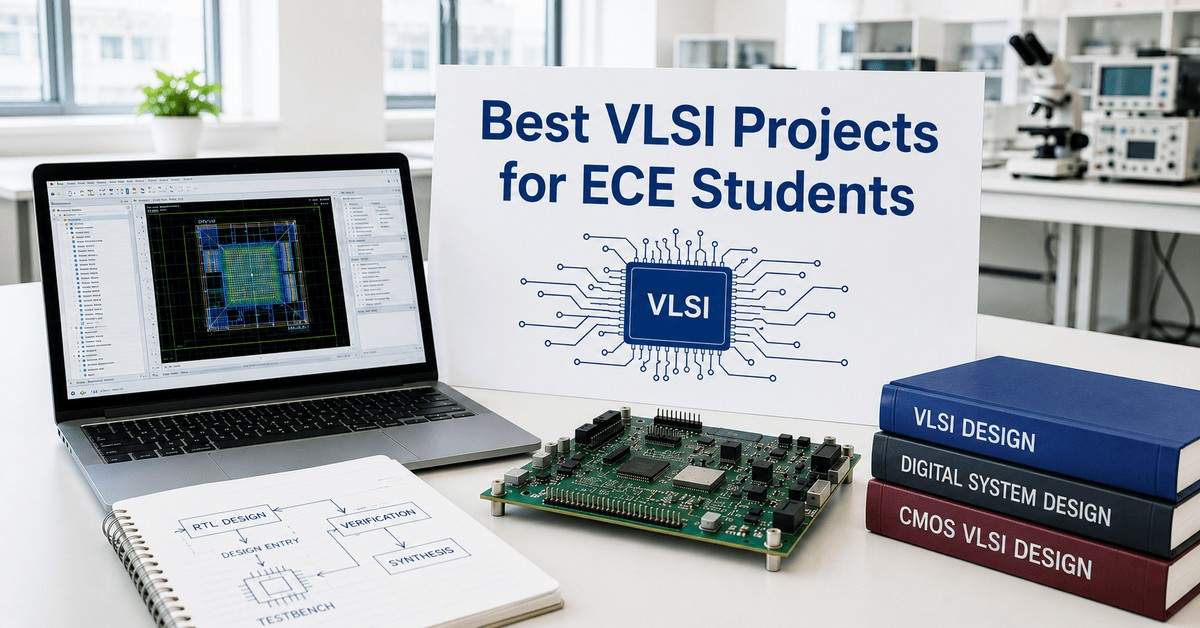 Best VLSI Projects for ECE Students
 Top 7 Transistor Logic Projects for Engineering
 Top 10 Low Power VLSI Projects
 Top 5 Nano Technology Projects using VLSI
 Top 6 Communications Projects for Students
 Top 7 Projects on DSP Core
 Top 5 Projects on Arithmetic Core
 Top 7 Projects on Finite State Machines
 Top 10 Projects on Cadence EDA Tool
 FPGA Final Year Projects for Electronics Students
 Verilog Projects for ECE
 VLSI Project Ideas for Engineering
 VLSI Mini Projects for ECE Department Students
 VLSI Projects for Final Year














 Paper Publishing