Optimizing High-Level Synthesis Sparse Matrix-Vector Kernel for Alveo FPGAs
Objective
Sparse matrix-vector multiplication (SpMV) is a critical kernel in scientific computing and high-performance applications, yet it remains challenging to optimize due to irregular memory access patterns and low computational intensity. This work targets the AMD Vitis SpMV kernel on HBM-equipped Alveo FPGAs and introduces hardware-aware optimizations that significantly improve performance, especially in reduced precision scenarios.
Abstract
Sparse matrix-vector multiplication (SpMV) is a critical kernel in scientific computing and high-performance applications, yet it remains challenging to optimize due to irregular memory access patterns and low computational intensity. This work targets the AMD Vitis SpMV kernel on HBM-equipped Alveo FPGAs and introduces hardware-aware optimizations that significantly improve performance, especially in reduced precision scenarios. Building on prior evaluations of the Vitis kernel, we propose two key enhancements: coefficient grouping and index packet coalescing. These reduce padding overhead and improve memory bandwidth efficiency without requiring a complete redesign of the vendor-supplied kernel. Experimental results over 33 matrices from the SuiteSparse collection show up to 4× speedup and an average improvement of 1.6× compared to the original Vitis kernel. Our method demonstrates how practical architectural adaptations can yield substantial performance gains, supporting the growing trend toward lower-precision and energy-efficient computing in FPGA-based accelerators.
NOTE: Without the concern of our team, please don't submit to the college. This Abstract varies based on student requirements.
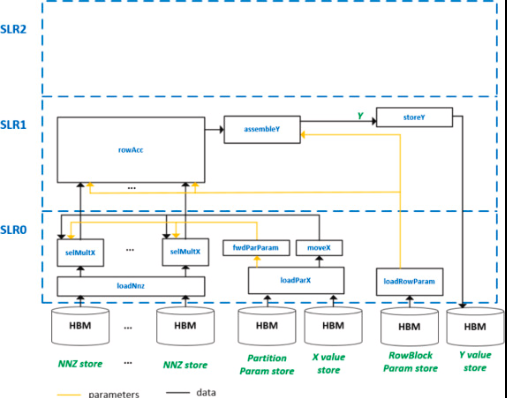
Block Diagram
Specifications
SOFTWARE REQUIREMENTS
• Xilinx
Vivado
• Windows 10/11
• OpenCV Library
HARDWARE REQUIREMENTS
•
Intel Core i3 or above
• 4 GB RAM or higher
Learning Outcomes
· Understand the fundamentals of Sparse Matrix-Vector Multiplication (SpMV).
· Learn High-Level Synthesis (HLS) optimization for FPGA implementation.
· Gain knowledge of AMD Vitis HLS and Alveo FPGA architecture.
· Understand High-Bandwidth Memory (HBM) utilization techniques.
· Learn coefficient grouping and index packet coalescing optimization methods.
· Analyze FPGA performance using throughput, bandwidth utilization, and speedup metrics.
· Develop practical skills in FPGA-based scientific computing acceleration.
Understand energy-efficient hardware optimization techniques for modern high-performance computing applications


 Paper Publishing

Request Call Back
Would you like to receive a free callback now?
Choose the best time for callback:
Leave your message and we will contact you as soon as possible

6-2-85/B, Old Maternity Hospital Road, Thyagaraja Nagar, Tirupati, Andhra Pradesh – 517501
+91 9030333433
+91 9393939065
0877-2261612

Disclaimer - Takeoff Edu Group Projects are not associated or affiliated with IEEE in any way. The IEEE Projects mentioned here are mentioned in the context of student projects, whose ideas are derived from IEEE publications, not projects of or by IEEE.

