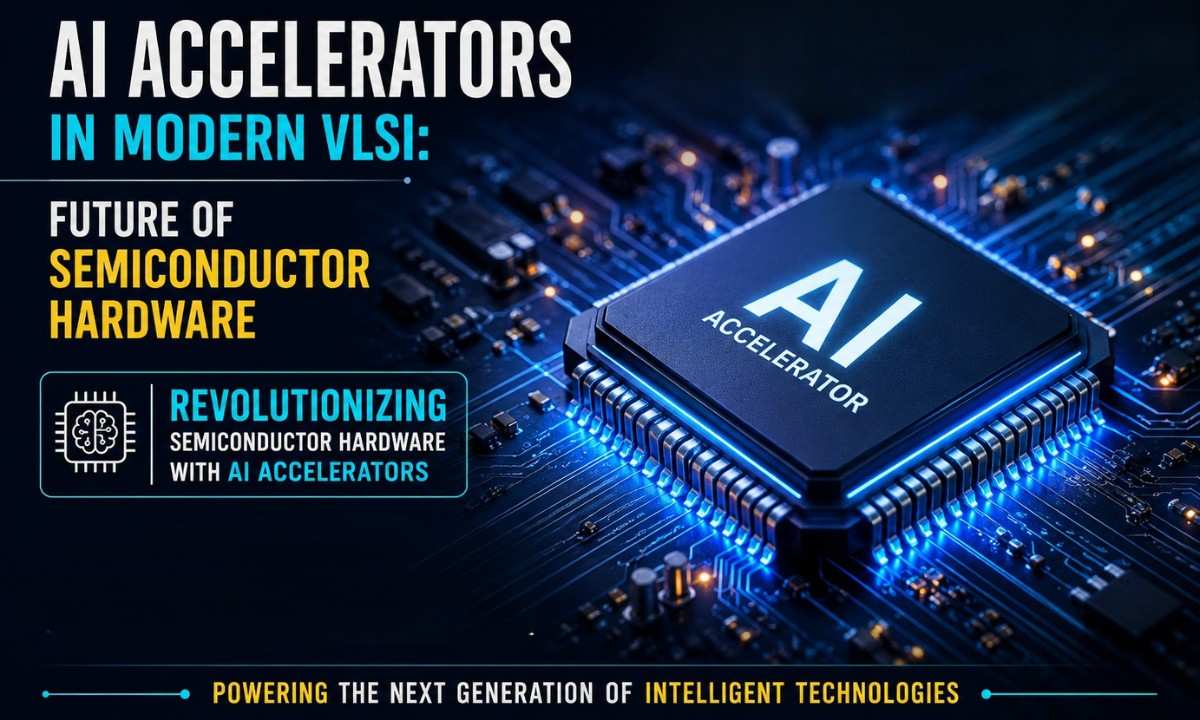

Overview:
In this blog, we will explore how AI accelerators are transforming modern VLSI design and shaping the future of semiconductor hardware. You will also learn about their applications, benefits, industry demand, and career opportunities in AI hardware and VLSI technology.
The Growing Need for Faster and Smarter VLSI Systems:-
Artificial Intelligence is transforming every major industry, from healthcare and automotive systems to robotics and cloud computing. As AI applications continue to grow, the demand for faster data processing and energy-efficient hardware is increasing rapidly. Traditional processors are no longer sufficient for handling complex AI workloads, especially in machine learning and deep learning applications.
This is where AI accelerators in modern VLSI design are becoming highly important. These specialized hardware components are designed to process AI algorithms much faster while consuming less power. Industries are now investing heavily in semiconductor hardware technologies that support high-speed AI processing, edge computing, and real-time analytics.
Modern VLSI systems integrated with AI accelerators are shaping the future of semiconductor hardware by delivering improved performance, scalability, and efficiency.
What Are AI Accelerators in Modern VLSI Design?
AI accelerators are specialized semiconductor hardware architectures designed to improve the speed and efficiency of artificial intelligence operations. These processors are optimized for machine learning workloads such as neural network computation, image recognition, speech processing, and data analytics.
In modern VLSI design, AI accelerators help engineers create high-performance chips capable of handling massive parallel computations. Unlike traditional CPUs, AI accelerators are built specifically for AI tasks, reducing latency and improving throughput.
Common Types of AI Accelerators:-
- Graphics Processing Units (GPUs)
- Tensor Processing Units (TPUs)
- Field Programmable Gate Arrays (FPGAs)
- Application-Specific Integrated Circuits (ASICs)
- Neural Processing Units (NPUs)
These AI hardware technologies are widely used in advanced semiconductor systems and intelligent electronic devices.
Why AI Accelerators Are Important in Semiconductor Hardware:-
The semiconductor industry is rapidly evolving because of increasing AI adoption. AI accelerators provide several advantages over conventional processors in modern chip design.
1. Faster Processing Speed
AI accelerators can process millions of operations simultaneously, making them ideal for deep learning applications and real-time analytics.
2. Reduced Power Consumption
Power efficiency is one of the biggest challenges in VLSI design. AI accelerators optimize energy usage while maintaining high computational performance.
3. Improved Parallel Computing
Modern AI workloads require parallel processing capabilities. AI accelerators are specifically designed to support large-scale parallel computation.
4. Enhanced Machine Learning Performance
Specialized AI hardware improves training and inference speed for machine learning models.
5. Better Scalability
AI accelerators can easily scale for large data centers, edge devices, and cloud-based applications.
6. Real-Time Data Processing
Industries like autonomous vehicles and robotics require instant processing. AI accelerators support real-time decision-making systems.
7. Efficient Neural Network Execution
Neural network accelerators improve AI performance by optimizing matrix operations and memory handling.
Applications of AI Accelerators in Modern Industries:-

AI accelerators are becoming an essential component in many semiconductor hardware applications.
Autonomous Vehicles
Self-driving cars use AI accelerators for object detection, navigation, and real-time sensor processing.
Smartphones and Consumer Electronics
Modern smartphones integrate AI chips for facial recognition, voice assistants, and image processing.
Cloud Computing and Data Centers
Data centers use AI accelerators to manage large-scale AI workloads efficiently.
Healthcare Systems
AI-powered medical devices rely on semiconductor hardware for diagnostic imaging and patient monitoring.
Robotics and Automation
Industrial robots use AI hardware to improve automation, precision, and operational efficiency.
Edge AI Devices
Smart IoT devices and embedded systems use low-power AI accelerators for local data processing.
Companies such as NVIDIA, Intel, Google, and AMD are heavily investing in AI accelerator technologies to improve semiconductor innovation.
Challenges in AI Accelerator Design:-
Although AI accelerators provide major advantages, VLSI engineers also face several design challenges.
Power and Thermal Management
High-performance AI chips generate significant heat, requiring advanced cooling solutions.
Complex Chip Architecture
Designing efficient AI hardware architectures requires expertise in semiconductor engineering and VLSI design methodologies.
Memory Bottlenecks
AI workloads require high-speed memory access, which becomes a challenge in advanced chip design.
Hardware-Software Integration
Successful AI hardware systems require efficient coordination between software frameworks and semiconductor architecture.
Future of AI Accelerators in VLSI Design:-
The future of semiconductor hardware is closely connected with AI accelerator innovation. As AI applications continue to expand, companies will require more powerful and energy-efficient hardware systems.
Future trends include:
- AI-driven chip automation
- Edge AI processing
- Neuromorphic computing
- High-performance AI ASIC development
These technologies are expected to revolutionize modern VLSI systems across industries worldwide.
AI & VLSI Project Support in Across World:-
With the growing demand for semiconductor and AI hardware technologies, students are actively looking for real-time project support to improve their practical knowledge and industry exposure.
Takeoff Edu Group provides AI and VLSI project support for students working on academic, mini, and major projects in semiconductor hardware and machine learning domains.
Key Features
- Real-time project guidance
- AI & VLSI project implementation support
- FPGA and ASIC project assistance
- Hands-on semiconductor project experience
- Expert mentorship and technical support
- Career guidance for semiconductor domains
Popular Project Areas
- Semiconductor hardware design
- AI accelerator implementation
- FPGA programming
- ASIC design flow
- Embedded systems
- Machine learning hardware applications
Conclusion:-
AI accelerators are playing a major role in transforming modern VLSI design and the future of semiconductor hardware. From faster processing and low power consumption to real-time AI applications, these advanced technologies are driving innovation across industries such as healthcare, robotics, autonomous vehicles, and cloud computing.
As the demand for AI-powered semiconductor systems continues to grow, understanding AI accelerators and modern VLSI technologies becomes increasingly important for students, researchers, and technology professionals exploring the future of intelligent hardware systems.
FAQs:-
What are AI accelerators in VLSI design?
AI accelerators are specialized semiconductor hardware components designed to improve AI and machine learning processing efficiency.
Why are AI accelerators important?
They provide faster processing, lower power consumption, and improved performance for AI applications.
What is the difference between GPU and AI accelerator?
GPUs are general-purpose parallel processors, while AI accelerators are specifically optimized for AI workloads.
Which industries use AI accelerators?
Automotive, healthcare, robotics, consumer electronics, cloud computing, and semiconductor industries widely use AI accelerators.
Is VLSI a good career option?
Yes. VLSI and semiconductor engineering offer excellent career opportunities due to the increasing demand for AI hardware professionals.
What skills are required for AI hardware design?
Knowledge of VLSI design, digital electronics, FPGA, ASIC flow, embedded systems, and machine learning fundamentals is highly valuable.
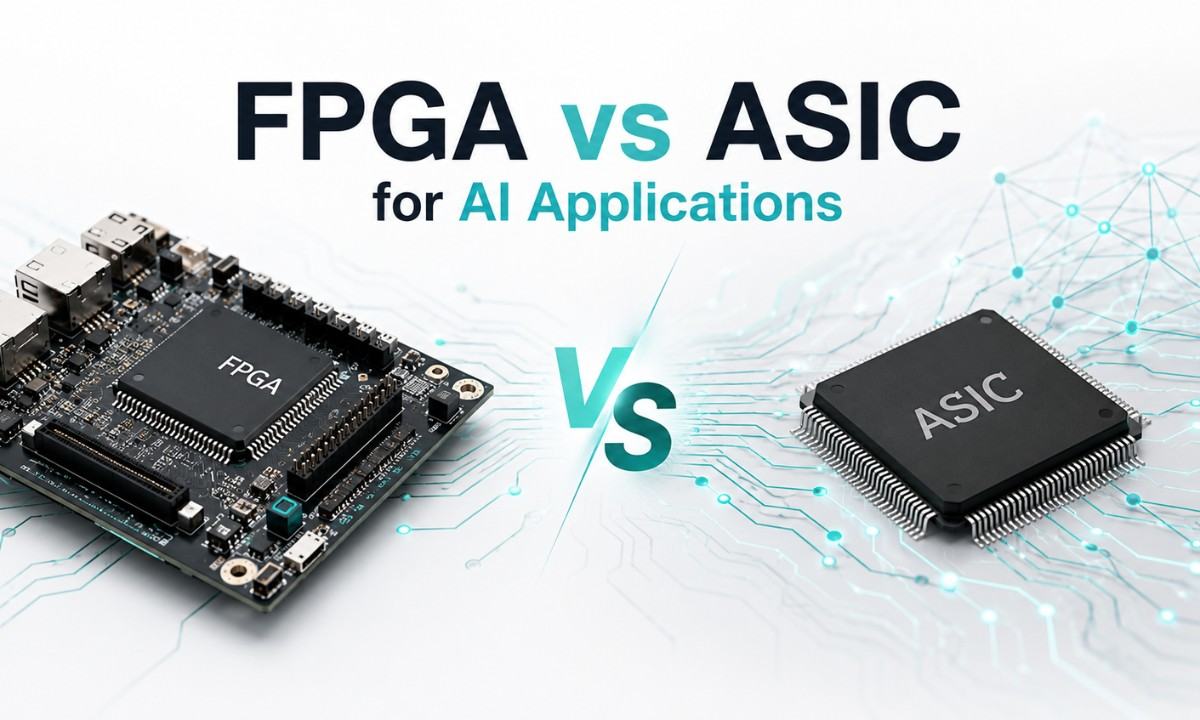 FPGA vs ASIC for AI Applications: Which Is Better for AI Workloads?
  Design and Analysis of Multi-Protocol Conversion Unit for SPI, I2C and UART
  Design of Polar Codes in 5G New Radio
  Design & Study the Performance of CMOS Based Ring Oscillator for 5G Mobile Communication
  Top IEEE VLSI Engineering Projects For Final Year Students with Source Code
  Best VLSI Projects for ECE Students
  Top 7 Transistor Logic Projects for Engineering
  Top 10 Low Power VLSI Projects
  Top 5 Nano Technology Projects using VLSI
  Top 6 Communications Projects for Students
  Top 7 Projects on DSP Core
  Top 5 Projects on Arithmetic Core
  Top 7 Projects on Finite State Machines
  Top 10 Projects on Cadence EDA Tool
  FPGA Final Year Projects for Electronics Students
  Verilog Projects for ECE
  VLSI Project Ideas for Engineering
  VLSI Mini Projects for ECE Department Students
  VLSI Projects for Final Year











 Paper Publishing




