Weighted Multi-Modal Contrastive Learning Based Hybrid Network for Alzheimer’s Disease Diagnosis
Objective
This project develops a hybrid deep learning network using Weighted Multi-Modal Contrastive Learning (WMCL) for Alzheimer’s disease diagnosis. The system classifies brain images into four categories: 'MildDemented,' 'ModerateDemented,' 'NonDemented,' and 'VeryMildDemented' using EfficientDet, DenseNet, ResNet, and GRU models. It processes MRI images with preprocessing steps like normalization and augmentation. The system, built with Flask and a user interface, provides real-time predictions and visual explanations using Grad-CAM++, aiding early Alzheimer's detection and healthcare decision-making.
Abstract
This project presents a robust approach for diagnosing Alzheimer's disease using a hybrid deep learning network based on Weighted Multi-Modal Contrastive Learning (WMCL). The system categorizes patients into four classes: 'MildDemented,' 'ModerateDemented,' 'NonDemented,' and 'VeryMildDemented.' We applied state-of-the-art deep learning models, including EfficientDet, DenseNet, and ResNet combined with GRU, to classify brain images for early diagnosis of Alzheimer's. The training process involved using MRI images, with preprocessing steps such as normalization and augmentation to enhance model performance. The system leverages Flask for the backend, with a user-friendly interface built using HTML and CSS, allowing users to register, log in, and upload MRI images. Upon uploading, the system processes the images and provides real-time predictions along with a detailed explanation using Grad-CAM++ for visual interpretability. The model's performance was evaluated using key metrics, including accuracy, precision, recall, and F1-score, ensuring high reliability in diagnosis. This system can aid healthcare professionals by offering a tool for early-stage Alzheimer's detection and facilitating interpretability in the decision-making process.
Keywords:
Alzheimer's disease, deep learning, Weighted Multi-Modal Contrastive Learning, EfficientDet, DenseNet, ResNet + GRU, Grad-CAM++, image classification, MRI, Flask, AI explainability, early diagnosis, brain imaging.NOTE: Without the concern of our team, please don't submit to the college. This Abstract varies based on student requirements.
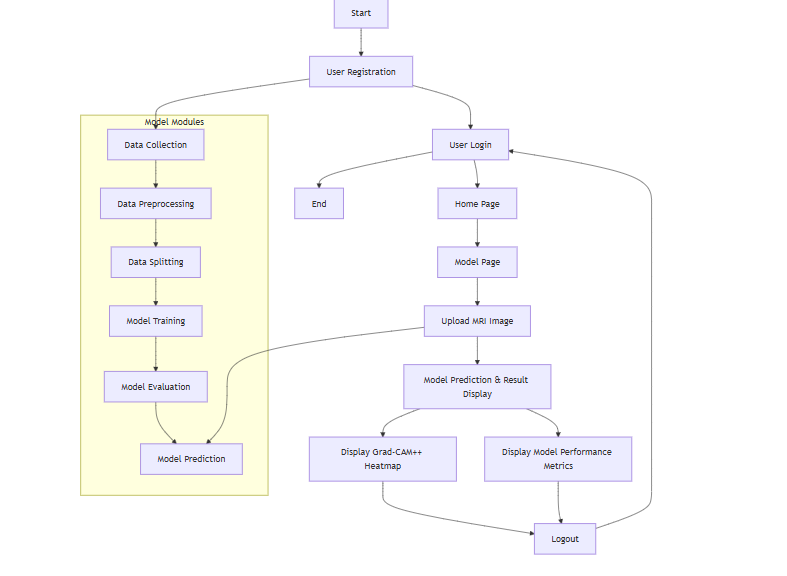
Block Diagram
Specifications
1. SOFTWARE REQUIREMENS
Operating System : Windows 7/8/10
Server-side Script : HTML, CSS, Bootstrap & JS
Programming Language : Python
Libraries : Flask, Pandas, Sklearn,Pytorch,Torchvision NumPy, Seaborn, Matplotlib,pillow
IDE/Workbench : VSCode
Technology : Python 3.8+
Server Deployment : Xampp Server
Database : MySQL
2. HARDWARE REQUIREMENTS
Processor - I5/Intel Processor
RAM - 8GB+ (min)
Hard Disk - 128 GB+
Key Board - Standard Windows Keyboard
Mouse - Two or Three Button Mouse
Monitor - Any


Related Projects
 Paper Publishing

Request Call Back
Would you like to receive a free callback now?
Choose the best time for callback:
Leave your message and we will contact you as soon as possible

6-2-85/B, Old Maternity Hospital Road, Thyagaraja Nagar, Tirupati, Andhra Pradesh – 517501
+91 9030333433
+91 9393939065
0877-2261612

Disclaimer - Takeoff Edu Group Projects are not associated or affiliated with IEEE in any way. The IEEE Projects mentioned here are mentioned in the context of student projects, whose ideas are derived from IEEE publications, not projects of or by IEEE.

