Verilog Code Generation of Hierarchical Design Using LLMs
Objective
1. To explore the capability of Large Language Models (LLMs) in generating accurate and synthesizable Verilog HDL for hierarchical digital designs. 2. To evaluate the efficiency and reliability of LLM-generated Verilog code compared to manually written RTL in terms of correctness, modularity, and hardware resource utilization.
Abstract
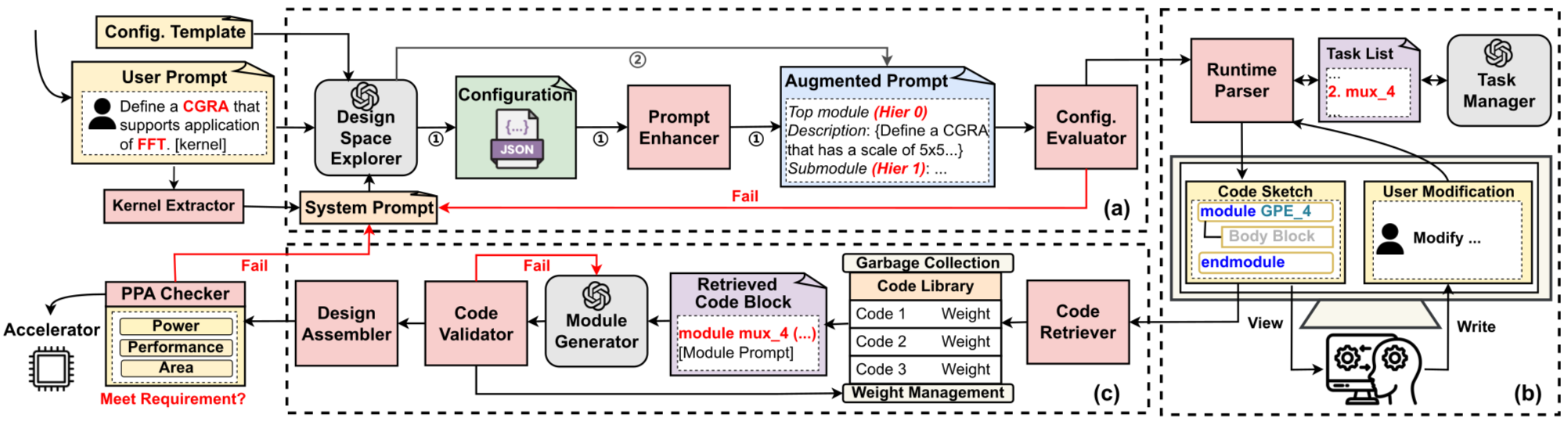
With the increasing complexity of VLSI systems, hierarchical hardware design has become essential to manage large-scale digital circuits efficiently. Verilog HDL is widely used for describing such hierarchical designs; however, manual code development is time-consuming and error-prone. Recent advancements in Large Language Models (LLMs) have enabled automated code generation by understanding high-level design specifications. This project focuses on the automatic generation of hierarchical Verilog code using LLMs. The proposed approach translates natural language or structured design descriptions into syntactically correct and modular Verilog code. By leveraging LLM capabilities, the system improves productivity, reduces human errors, and accelerates the hardware design cycle, making it suitable for modern FPGA and ASIC-based design flows.
NOTE: Without the concern of our team, please don't submit to the college. This Abstract varies based on student requirements.
Block Diagram
Specifications
Microsoft® Windows 10 / Windows 11
(64-bit)
Intel® Core™ i5 / i7 Processor or equivalent
Minimum 8 GB RAM
Minimum 500 MB free disk space
Learning Outcomes
- Understand hierarchical hardware design
concepts
- Learn automated Verilog code generation techniques
- Gain exposure to Large Language Models in VLSI design
- Analyze benefits of AI-assisted design automation
- Develop practical knowledge of Verilog HDL


Related Projects
 Paper Publishing

Request Call Back
Would you like to receive a free callback now?
Choose the best time for callback:
Leave your message and we will contact you as soon as possible

6-2-85/B, Old Maternity Hospital Road, Thyagaraja Nagar, Tirupati, Andhra Pradesh – 517501
+91 9030333433
+91 9393939065
0877-2261612

Disclaimer - Takeoff Edu Group Projects are not associated or affiliated with IEEE in any way. The IEEE Projects mentioned here are mentioned in the context of student projects, whose ideas are derived from IEEE publications, not projects of or by IEEE.

