Transmission Failure Prediction Using AI and Structural Modeling Informed by Distribution Outages
Objective
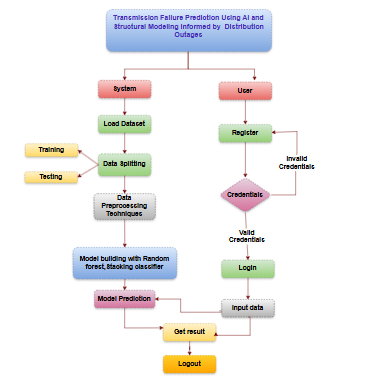
This system predicts transmission failures using AI techniques, classifying four failure types (G, C, B, A) based on real-time sensor data. It integrates Random Forest, Gradient Boosting, and Decision Tree models through a Stacking Classifier for improved accuracy. A Flask web interface provides instant failure diagnostics, enhancing predictive maintenance and grid reliability.
Abstract
TRANSMISSION FAILURE PREDICTION USING AI AND STRUCTURAL MODELING INFORMED BY DISTRIBUTION OUTAGES
ABSTARCT
Transmission systems are critical infrastructures where failures can result in widespread power disruptions and financial losses. Traditional failure detection methods rely heavily on manual inspections and post-event analysis, leading to delayed responses and increased risk. This system addresses these challenges by utilizing artificial intelligence techniques to predict four major transmission failure classes—G, C, B, and A—based on sensor readings of currents and voltages across three phases.
The backend architecture integrates multiple machine learning models, including Random Forest, Gradient Boosting, and Decision Tree classifiers, combined through a Stacking Classifier to enhance predictive accuracy and robustness. Following extensive evaluation, the Random Forest model is deployed on the frontend for real-time prediction due to its high interpretability and efficiency. A Flask-based web interface enables users to input real-time sensor data and instantly receive diagnostics identifying potential failures. The system uses MySQL for secure user data management and session handling. By providing early warnings based on live input data, it empowers transmission operators to take preventive measures, minimize downtime, and improve grid reliability. The integration of AI-driven modeling with insights informed by distribution outages offers a scalable and proactive solution for intelligent and resilient energy infrastructure management.
Keywords: Transmission Failure, Multi-class Classification, Random Forest, Stacking Classifier, Gradient Boosting, Decision Tree, Structural Modeling, Distribution Outages, Predictive Maintenance, Flask Web Application.
NOTE: Without the concern of our team, please don't submit to the college. This Abstract varies based on student requirements.
Block Diagram
Specifications
Hardware Requirements
- Processor - I7/Intel Processor
- Hard Disk -160GB
- Key Board - Standard Windows Keyboard
- Mouse - Two or Three Button Mouse
- RAM - 8Gb
. Software Requirements
• Operating System : Windows 11
• Server side Script : Python, HTML, MYSQL, CSS, Bootstrap.
• Libraries : Pandas, Flask,Scikit-learn,Numpy
• IDE : VS code
• Technology : Python 3.10+


Related Projects
 Paper Publishing

Request Call Back
Would you like to receive a free callback now?
Choose the best time for callback:
Leave your message and we will contact you as soon as possible

6-2-85/B, Old Maternity Hospital Road, Thyagaraja Nagar, Tirupati, Andhra Pradesh – 517501
+91 9030333433
+91 9393939065
0877-2261612

Disclaimer - Takeoff Edu Group Projects are not associated or affiliated with IEEE in any way. The IEEE Projects mentioned here are mentioned in the context of student projects, whose ideas are derived from IEEE publications, not projects of or by IEEE.

