train track defects detection and complaint redressal system
Objective
The primary objective of this project is to create an automated train track crack classification system that accurately distinguishes between Defective and Non-Defective railway tracks. By leveraging deep learning algorithms, including YOLOv7 and YOLOv8, the system aims to improve the efficiency and accuracy of railway track inspection processes.
Abstract
TRAIN TRACK CRACK CLASSIFICATION
Abstract
The project focuses on train track crack classification for the detection of defective and non-defective railway tracks using deep learning algorithms. The system classifies railway track images into two categories: Defective and Non-Defective. The dataset used for this task is the Railway Track Fault Detection Dataset from Kaggle, which includes images of train tracks with and without cracks. The proposed system leverages advanced machine learning algorithms like YOLOv7 and YOLOv8 to automatically classify these tracks based on their condition. The system's backend is implemented in Python, while the front-end uses HTML, CSS, and JavaScript for user interaction and display. The primary goal is to enhance the efficiency and safety of railway operations by automating the detection of track faults, reducing human error, and providing timely maintenance alerts. With 50 hours of development time allocated, this project aims to create a robust and scalable fault detection system.
NOTE: Without the concern of our team, please don't submit to the college. This Abstract varies based on student requirements.
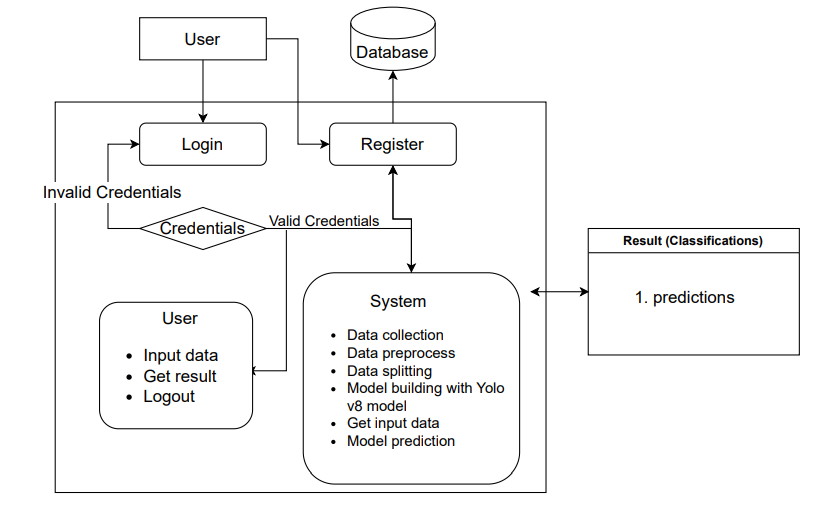
Block Diagram
Specifications
Hardware:
Operating system : Windows 7 or 7+
RAM : 8 GB
Hard disc or SSD : More than 500 GB
Processor : Intel 3rd generation or high or Ryzen with 8 GB Ram
Software:
Software’s : Python 3.10 or high version
IDE : Visual Studio Code.
Framework : Flask

Demo Video


Request for Video
Related Projects
 Paper Publishing
Request Call Back
Would you like to receive a free callback now?
Choose the best time for callback:
Leave your message and we will contact you as soon as possible

6-2-85/B, Old Maternity Hospital Road, Thyagaraja Nagar, Tirupati, Andhra Pradesh – 517501
+91 9030333433
+91 9393939065
0877-2261612

Disclaimer - Takeoff Edu Group Projects are not associated or affiliated with IEEE in any way. The IEEE Projects mentioned here are mentioned in the context of student projects, whose ideas are derived from IEEE publications, not projects of or by IEEE.

