Traffic prediction using machine learning
Objective
The project aims to develop classification (Decision Tree, XGBoost, CNN, LSTM, Stacking) and time series forecasting (ARIMA, SARIMA) models to predict traffic conditions, enhancing flow, reducing congestion, and supporting urban planning.
Abstract
Traffic prediction is essential for modern urban planning and traffic management, influencing both daily commutes and long-term infrastructure development. This dissertation investigates the use of machine learning algorithms to predict traffic patterns, utilizing two distinct datasets for classification and forecasting. For the classification task, we employ the Traffic Prediction Dataset from Kaggle, using Decision Tree, XGBoost classifier, CNN, LSTM and a Stacking classifier. These models classify traffic conditions with high accuracy, identifying patterns and anomalies in traffic flow. For forecasting the number of vehicles, we use another Kaggle dataset, implementing ARIMA, ARIMAX, SARIMA, and SARIMAX models. These time series models predict vehicle counts with precision, accounting for seasonal and exogenous factors. Our findings reveal that machine learning techniques significantly enhance traffic prediction capabilities, offering valuable insights for reducing congestion and optimizing traffic flow. The classification models provide real-time traffic condition assessments, while the forecasting models aid in long-term traffic planning and infrastructure development. This study underscores the potential of machine learning in transforming traffic management, highlighting its applicability in urban planning, policy-making, and daily traffic operations. The integration of advanced algorithms into traffic prediction systems can lead to more efficient and sustainable urban environments, ultimately improving the quality of life for commuters and residents. Our work contributes to the growing field of intelligent transportation systems, showcasing the effectiveness of machine learning in addressing complex traffic challenges.
Keywords: Traffic prediction, machine learning, urban planning, traffic management, classification, forecasting, Decision Tree, XGBoost, CNN, LSTM, Stacking classifier, ARIMA, ARIMAX, SARIMA, SARIMAX, congestion reduction, traffic flow optimization, intelligent transportation systems.
NOTE: Without the concern of our team, please don't submit to the college. This Abstract varies based on student requirements.
Block Diagram
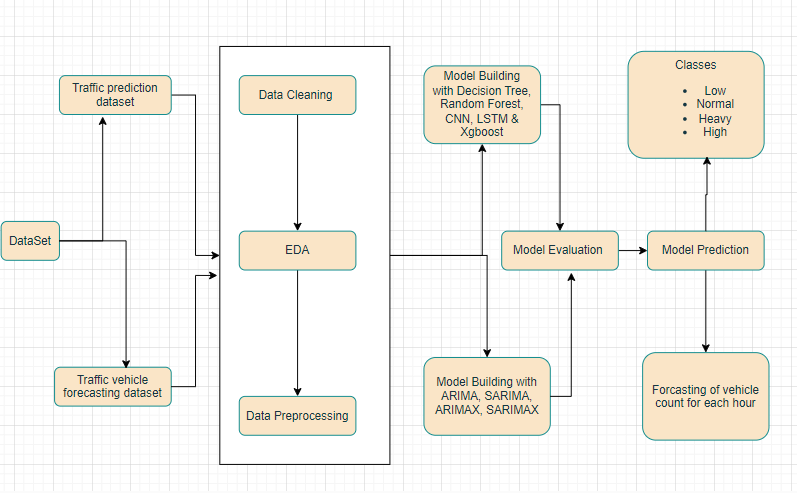
Specifications
Hardware Requirements
Processor - I3/Intel Processor
Hard Disk - 160GB
Key Board - Standard Windows Keyboard
Mouse - Two or Three Button Mouse
Monitor - SVGA
RAM - 8GB
Software Requirements:
Operating System : Windows 7/8/10
Server side Script : HTML, CSS, Bootstrap & JS
Programming Language : Python
Libraries : Flask/Django, Pandas, Mysql.connector, Os, Smtplib, Numpy
IDE/Workbench : PyCharm
Technology : Python 3.6+
Server Deployment : Xampp Server
Database : MySQL

Demo Video


Request for Video
Related Projects
 Paper Publishing
Request Call Back
Would you like to receive a free callback now?
Choose the best time for callback:
Leave your message and we will contact you as soon as possible

6-2-85/B, Old Maternity Hospital Road, Thyagaraja Nagar, Tirupati, Andhra Pradesh – 517501
+91 9030333433
+91 9393939065
0877-2261612

Disclaimer - Takeoff Edu Group Projects are not associated or affiliated with IEEE in any way. The IEEE Projects mentioned here are mentioned in the context of student projects, whose ideas are derived from IEEE publications, not projects of or by IEEE.

