Traffic classification in SDN based Iot network using two level fused network with self adaptive manta ray foraging
Objective
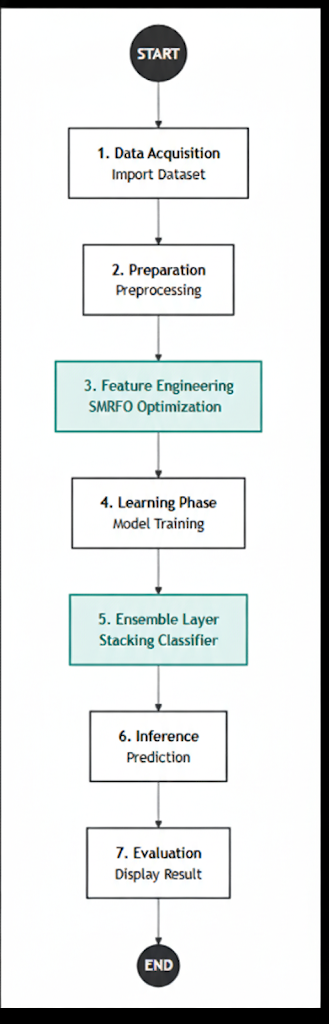
Software Defined Networking (SDN)–based IoT networks generate massive and diverse traffic, making accurate classification essential for detecting benign and malicious flows. Traditional machine learning models such as Bi-LSTM, Decision Tree, and Random Forest often struggle with high-dimensional feature spaces, limiting their performance. To address this challenge, the project introduces a two-level fused model combined with a Self-Adaptive Manta Ray Foraging Optimization (SMRFO) algorithm for efficient feature selection. SMRFO identifies the most relevant features by maximizing classification accuracy while minimizing redundancy. The selected features are then fed into advanced classifiers including XGBoost, AdaBoost, and a Stacking Classifier to enhance detection capability. This fusion strategy improves overall performance while reducing computational complexity. The system is implemented using Python and the Flask framework, incorporating modules for user authentication and traffic classification. Trained and evaluated on the CICDarknet2020 dataset, the proposed model achieves superior accuracy, precision, recall, and F1-score compared to traditional machine learning approaches.
Abstract
Software Defined Networking (SDN) based IoT networks generate large volumes of traffic with different behavior patterns. Accurate classification of this traffic is necessary to identify benign and malignant flows. Traditional machine learning models such as Bi-LSTM, Decision Tree, and Random Forest often face limitations in achieving high classification performance when feature dimensions are large. To overcome this issue, this project proposes a two-level fused model integrated with a Self-Adaptive Manta Ray Foraging Optimization (SMRFO) algorithm for feature selection.The SMRFO algorithm selects the most relevant features by optimizing classification accuracy while reducing feature redundancy. The optimized features are then used with advanced classifiers including XGBoost, AdaBoost, and Stacking Classifier. This fusion improves detection performance and reduces computational complexity. The system is implemented using Python and Flask framework, providing modules for user authentication and traffic classification. The model is trained and tested using the CICDarknet2020 dataset. Experimental evaluation demonstrates improved accuracy, precision, recall, and F1-score compared to traditional models.
Keywords: SDN, IoT Traffic Classification, SMRFO, Feature Selection, XGBoost, AdaBoost, Stacking Classifier, Darknet Detection, Ensemble Learning, Network Security.
NOTE: Without the concern of our team, please don't submit to the college. This Abstract varies based on student requirements.
Block Diagram
Specifications
H/W CONFIGURATION:
Processor - I3/Intel Processor
Hard Disk - 160GB
Key Board - Standard Windows Keyboard
Mouse - Two or Three Button Mouse
Monitor - SVGA
RAM - 8GB
S/W CONFIGURATION:
• Operating System : Windows 7/8/10
• Server-side Script : HTML, CSS, Bootstrap & JS
• Programming Language : Python
• Libraries : Flask, Pandas, MySQL. Connector, Scikit-Learn,
• IDE/Workbench : VS Code
• Technology : Python 3.8+
• Server Deployment : Xampp Server


Related Projects
 Paper Publishing

Request Call Back
Would you like to receive a free callback now?
Choose the best time for callback:
Leave your message and we will contact you as soon as possible

6-2-85/B, Old Maternity Hospital Road, Thyagaraja Nagar, Tirupati, Andhra Pradesh – 517501
+91 9030333433
+91 9393939065
0877-2261612

Disclaimer - Takeoff Edu Group Projects are not associated or affiliated with IEEE in any way. The IEEE Projects mentioned here are mentioned in the context of student projects, whose ideas are derived from IEEE publications, not projects of or by IEEE.

