Thermally Aware Machine Learning for Unified and Energy-Efficient Resource Management in Cloud Data Centers
Objective
The primary objective is to design and implement a predictive resource management system that optimizes energy consumption in cloud data centers. This involves creating machine learning models capable of accurately forecasting workload intensity based on key performance indicators such as CPU and memory utilization, network bandwidth, and disk operations. Another goal is to incorporate task priority and workload categorization into the decision-making process for resource allocation, thereby improving responsiveness and reducing latency. The project seeks to apply ensemble learning algorithms, particularly Random Forest and XGBoost, to capture complex interactions between system metrics and energy use. Additionally, the objective includes developing a user-friendly interface for monitoring and managing resource assignments. Ultimately, this system should enhance overall cloud efficiency by dynamically allocating virtual machines or containers in alignment with predicted demands, reducing unnecessary energy expenditure while maintaining service quality.
Abstract
This study presents a thermally aware machine learning approach aimed at enhancing energy efficiency and resource management within cloud data centers. By analyzing multiple system features such as CPU usage, memory consumption, network bandwidth, disk I/O, energy consumption, and service latency the proposed model predicts workload intensity categorized into low, medium, and high levels. Task priorities and optimized resource allocations, represented by the number of virtual machines or containers, are integrated into the framework to ensure balanced performance and energy conservation. Utilizing ensemble learning algorithms like Random Forest and XGBoost, the approach effectively models complex relationships between resource usage and energy consumption. The implementation employs a Python backend with the Flask framework, supported by a responsive front-end developed in HTML, CSS, and JavaScript. This solution facilitates adaptive and efficient allocation of cloud resources while minimizing power consumption, thus addressing the critical challenge of sustainability in large-scale data centers. The methodology demonstrates robust performance in predicting workload demands and optimizing resource distribution, which collectively contribute to reduced energy use and improved service latency. This integration of machine learning with resource management represents a significant step toward greener cloud computing infrastructures.
Keywords:
Energy-efficient resource management, cloud data centers, machine learning,
workload prediction, Random Forest, XGBoost, resource allocation optimization,
CPU utilization, energy consumption, service latency, Flask, cloud
sustainability.
NOTE: Without the concern of our team, please don't submit to the college. This Abstract varies based on student requirements.
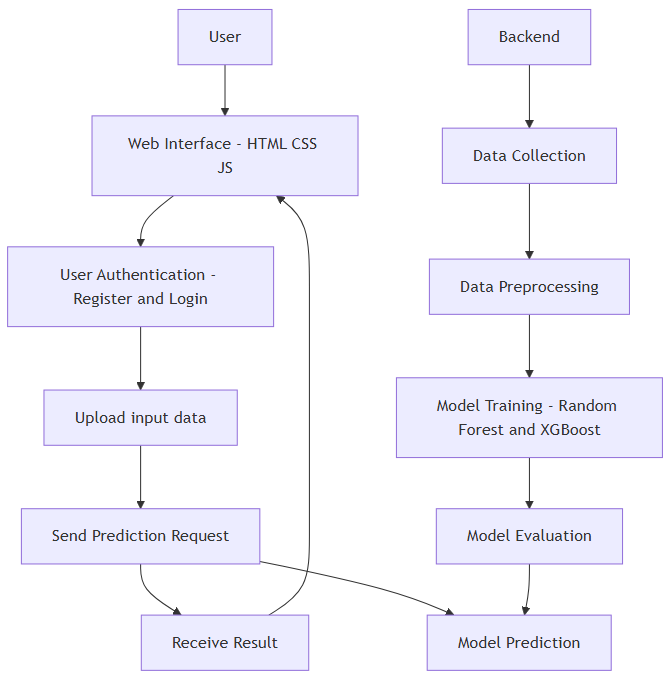
Block Diagram
Specifications
Hardware Requirements
Processor - I3/Intel Processor
Hard Disk - 160GB
Key Board - Standard Windows Keyboard
Mouse - Two or Three Button Mouse
Monitor - SVGA
RAM - 8GB
Software Requirements
Operating System : Windows 7/8/10
Server side Script : HTML, CSS, Bootstrap & JS
Programming Language : Python
Libraries : Flask/Django, Pandas, Mysql.connector, Os, Smtplib, Numpy
IDE/Workbench : PyCharm
Technology : Python 3.6+
Server Deployment : Xampp Server
Database : MySQL


Related Projects
 Paper Publishing

Request Call Back
Would you like to receive a free callback now?
Choose the best time for callback:
Leave your message and we will contact you as soon as possible

6-2-85/B, Old Maternity Hospital Road, Thyagaraja Nagar, Tirupati, Andhra Pradesh – 517501
+91 9030333433
+91 9393939065
0877-2261612

Disclaimer - Takeoff Edu Group Projects are not associated or affiliated with IEEE in any way. The IEEE Projects mentioned here are mentioned in the context of student projects, whose ideas are derived from IEEE publications, not projects of or by IEEE.

