Thalassemia disease prediction using deep learning
Objective
The project aims to develop a predictive model for Thalassemia disease using both deep learning and machine learning algorithms. The primary objective is to compare the performance of different algorithms, such as DNN, CNN, XGBoost, and Random Forest, in accurately predicting Thalassemia. A user-friendly web application will be created using Flask, allowing users to input their data and receive disease predictions. The models will be evaluated based on key metrics like accuracy, precision, recall, and F1-score to identify the best-performing algorithm. The project also seeks to provide an efficient and accurate solution for the early detection of Thalassemia, minimizing human intervention in the diagnostic process. Data preprocessing techniques, including normalization, handling missing values, and feature selection, will be implemented to ensure high-quality input data. Furthermore, the system will be designed to be simple, scalable, and adaptable, allowing for future extensions to other genetic disorders with similar prediction requirements. A secure and efficient database system will be developed to store user data and predictions while ensuring privacy.
Abstract
This project focuses on developing a predictive model for Thalassemia disease detection using deep learning and machine learning algorithms. The dataset used is based on HPLC screening data, which includes various features that help in identifying the disease. The models used for prediction include Deep Neural Networks (DNN), Convolutional Neural Networks (CNN), XGBoost, and Random Forest. Each algorithm is evaluated for its ability to accurately classify the data into Thalassemia-positive and negative categories. A web application is built using Flask, which enables users to register, log in, and input their data to receive a prediction. The project aims to provide a simple yet effective method for predicting Thalassemia disease with high accuracy. The system is evaluated on several performance metrics including accuracy, precision, recall, and F1-score to determine the most effective algorithm. This project has the potential to assist in the early detection of Thalassemia, reducing manual work and improving the efficiency of diagnosis processes.
Keywords: Thalassemia, prediction, deep learning, DNN, CNN, XGBoost, Random Forest, classification, disease detection, web application.
NOTE: Without the concern of our team, please don't submit to the college. This Abstract varies based on student requirements.
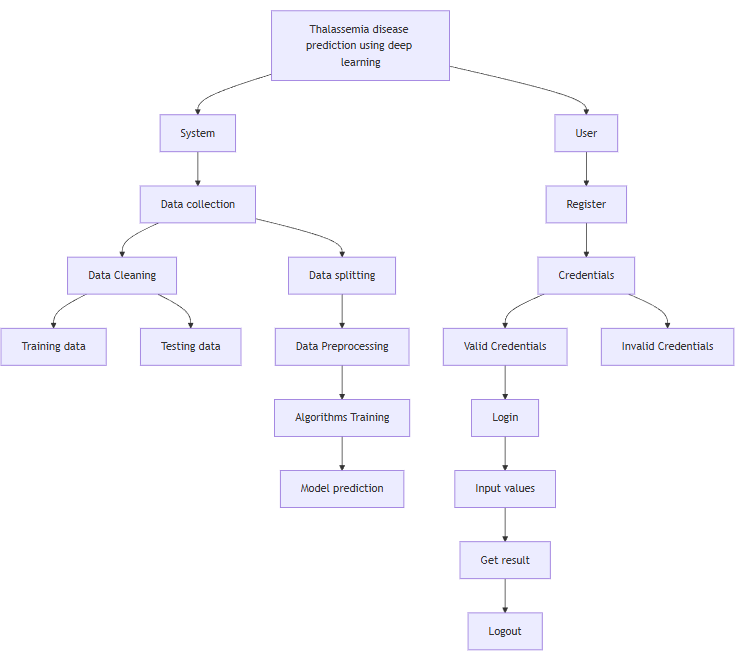
Block Diagram
Specifications
Hardware Requirements
Processor - I3/Intel Processor
Hard Disk - 160GB
Key Board - Standard Windows Keyboard
Mouse - Two or Three Button Mouse
Monitor - SVGA
RAM - 8GB
Software Requirements:
Operating System : Windows 7/8/10
Server side Script : HTML, CSS, Bootstrap & JS
Programming Language : Python
Libraries : Flask/Django, Pandas, Mysql.connector, Os, Smtplib, Numpy
IDE/Workbench : PyCharm
Technology : Python 3.6+
Server Deployment : Xampp Server
Database : MySQL


Related Projects
 Paper Publishing

Request Call Back
Would you like to receive a free callback now?
Choose the best time for callback:
Leave your message and we will contact you as soon as possible

6-2-85/B, Old Maternity Hospital Road, Thyagaraja Nagar, Tirupati, Andhra Pradesh – 517501
+91 9030333433
+91 9393939065
0877-2261612

Disclaimer - Takeoff Edu Group Projects are not associated or affiliated with IEEE in any way. The IEEE Projects mentioned here are mentioned in the context of student projects, whose ideas are derived from IEEE publications, not projects of or by IEEE.

