Symptom based disease prediction using machine learning
Objective
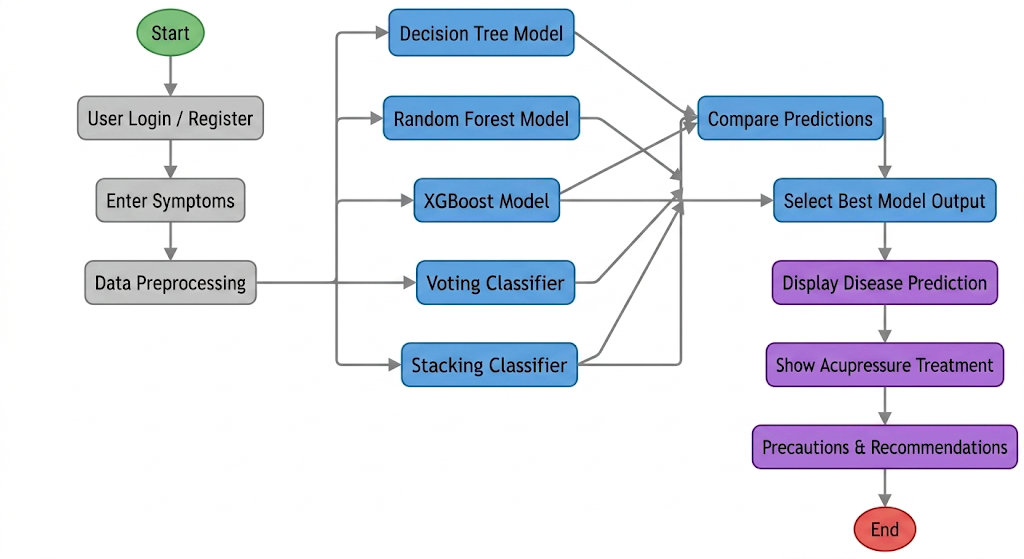
This project develops a machine learning–based system for predicting diseases using user-input symptoms. It utilizes multiple models, including Decision Tree, Random Forest, and XGBoost, along with ensemble techniques such as Voting and Stacking to improve accuracy and reliability. The system is integrated into a user-friendly web interface where users can register, log in, and enter symptoms to receive predictions. After generating results, the system provides acupressure-based treatment guidance along with precautions and recommendations. By combining predictive analytics with practical guidance, the project offers a complete and efficient solution for symptom-based disease prediction and user interaction.
Abstract
This project presents a system for predicting diseases based on given symptoms using machine learning techniques. The dataset used in this work is synthetic and consists of multiple symptom-based features represented in numerical form. The system applies various classification algorithms such as Decision Tree, Random Forest, XGBoost, Voting Classifier, and Stacking Classifier to identify patterns between input features and target classes. The goal is to improve prediction accuracy by combining multiple models and selecting the most effective approach.
The system is designed with a structured flow that includes user interaction modules such as registration, login, and classification. Once the user inputs the symptoms, the trained model processes the data and predicts the corresponding disease category. After prediction, the system provides a treatment approach using acupressure techniques through an animated representation, along with precautionary measures and recommendations.
The implementation uses a simple web interface supported by a backend framework, ensuring smooth data handling and model integration. The project demonstrates how machine learning models can be effectively used for classification tasks and enhanced with additional supportive features for better understanding and usability. The results highlight the importance of ensemble methods in improving prediction performance.
Keywords: Machine Learning, Classification, Symptoms, Disease Prediction, Ensemble Methods, Random Forest, XGBoost, Voting Classifier, Stacking, Acupressure
NOTE: Without the concern of our team, please don't submit to the college. This Abstract varies based on student requirements.
Block Diagram
Specifications
H/W CONFIGURATION:
Processor - I3/Intel Processor
Hard Disk - 160GB
Key Board - Standard Windows Keyboard
Mouse - Two or Three Button Mouse
Monitor - SVGA
RAM - 8GB
S/W CONFIGURATION:
• Operating System : Windows 7/8/10
• Server side Script : HTML, CSS, Bootstrap & JS
• Programming Language : Python
• Libraries : Flask, Pandas, MySQL. Connector, Scikit-Learn, pytorch
• IDE/Workbench : VS Code
• Technology : Python 3.8+
• Server Deployment : Xampp Server


Related Projects
 Paper Publishing

Request Call Back
Would you like to receive a free callback now?
Choose the best time for callback:
Leave your message and we will contact you as soon as possible

6-2-85/B, Old Maternity Hospital Road, Thyagaraja Nagar, Tirupati, Andhra Pradesh – 517501
+91 9030333433
+91 9393939065
0877-2261612

Disclaimer - Takeoff Edu Group Projects are not associated or affiliated with IEEE in any way. The IEEE Projects mentioned here are mentioned in the context of student projects, whose ideas are derived from IEEE publications, not projects of or by IEEE.

