SUCIDAL IDEATION DETECTION USING SOCIAL MEDIA
Objective
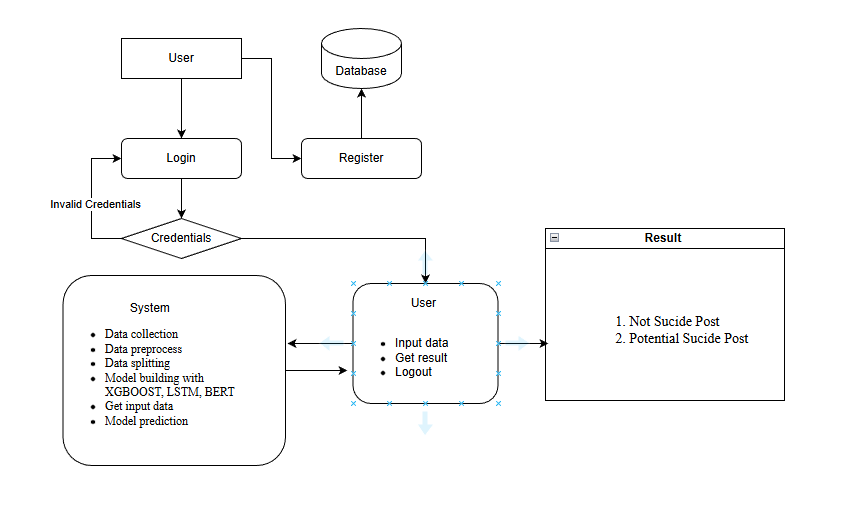
The objective of this project is to develop an automated system that can accurately identify potential suicidal ideation in social media posts. By leveraging advanced machine learning and deep learning techniques such as XGBoost, LSTM, and BERT, the system aims to classify social media content into suicidal and non-suicidal categories. The project focuses on pre-processing raw data, feature extraction using TF-IDF, and applying state-of-the-art algorithms to detect patterns indicative of suicidal thoughts. Ultimately, the goal is to provide a scalable, efficient, and real-time tool that can assist in mental health monitoring and early intervention.
Abstract
Suicidal ideation is a growing concern in the modern digital era, where individuals frequently express their emotions through social media platforms. Detecting early signs of suicidal intent can play a crucial role in preventing self-harm and facilitating timely intervention. This study focuses on classifying social media posts into two categories—potentially suicidal and non-suicidal—to identify individuals at risk. The dataset, sourced from Twitter, is preprocessed to remove noise, normalize text, and handle linguistic variations. Text features are represented using Term Frequency–Inverse Document Frequency (TF-IDF), and multiple machine learning and deep learning models—XGBoost, LSTM, and BERT—are implemented for comparative analysis. The LSTM and BERT models capture contextual and semantic nuances of language, while XGBoost efficiently handles non-linear relationships in textual patterns. The experimental results demonstrate that transformer-based models like BERT outperform traditional classifiers, achieving higher precision and recall in identifying suicidal tendencies. The proposed framework highlights the potential of AI-driven approaches in mental health surveillance, offering scalable, data-driven insights for suicide prevention and awareness programs.
Keywords: Suicidal ideation, Social media analysis, Machine learning, Deep learning, XGBoost, LSTM, BERT, TF-IDF, Text classification, Mental health detection.
NOTE: Without the concern of our team, please don't submit to the college. This Abstract varies based on student requirements.
Block Diagram
Specifications
Hardware Requirements
Processor - I3/Intel Processor
Hard Disk - 160GB
Key Board - Standard Windows Keyboard
Mouse - Two or Three Button Mouse
Monitor - SVGA
RAM - 8GB
Software Requirements:
Operating System : Windows 7/8/10
Server side Script : HTML, CSS, Bootstrap & JS
Programming Language : Python
Libraries : Django, Pandas, Numpy, Tensorflow, Scikit-learn.
IDE/Workbench : VS Code
Technology : Python 3.10
Database : SQLite


Related Projects
 Paper Publishing

Request Call Back
Would you like to receive a free callback now?
Choose the best time for callback:
Leave your message and we will contact you as soon as possible

6-2-85/B, Old Maternity Hospital Road, Thyagaraja Nagar, Tirupati, Andhra Pradesh – 517501
+91 9030333433
+91 9393939065
0877-2261612

Disclaimer - Takeoff Edu Group Projects are not associated or affiliated with IEEE in any way. The IEEE Projects mentioned here are mentioned in the context of student projects, whose ideas are derived from IEEE publications, not projects of or by IEEE.

