Southeast Asian bumblebee specimen dataset using Adaboost technique
Objective
The Machine Learning objective of using the AdaBoost technique on the Southeast Asian bumblebee specimen dataset is to enhance classification accuracy. By combining weak classifiers into a strong one, it helps in predicting various bumblebee species or behaviors, thus contributing to understanding the diversity and ecological significance of these insects in the Southeast Asian region.
Abstract
The southeast Asian bumblebee
species are facing population declines due to habitat loss, climate change, and
pesticide use. accurate identification of bumblebee species is essential for
their conservation and management in this study, we present a dataset of
southeast Asian bumblebee specimens and use the adaboost algorithm for species
classification. ad boost is a popular ensemble learning technique that combines
multiple weak classifiers to create a strong classifier.
the dataset consists of images and morphological measurements of bumblebee
specimens from various locations in southeast Asia. the ad boost algorithm is
trained on a subset of the dataset and tested on a separate validation set. the
performance of the adaboost algorithm is evaluated using metrics such as
accuracy, precision, recall, and f1 score.
Keywords : Machine learning algorithms and dataset.
NOTE: Without the concern of our team, please don't submit to the college. This Abstract varies based on student requirements.
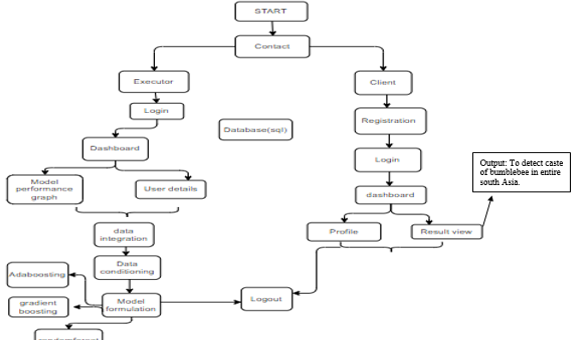
Block Diagram
Specifications
H/W CONFIGURATION:
Processor - I3/Intel Processor
Hard Disk - 160GB
Key Board - Standard Windows Keyboard
Mouse - Two or Three Button Mouse
Monitor - SVGA
RAM - 8GB
S/W CONFIGURATION:
Operating System : Windows 7/8/10
Server side Script : HTML, CSS, Bootstrap & JS
Programming Language : Python
Libraries : Flask, Pandas, Mysql.connector, Os, Smtplib, Numpy
IDE/Workbench: PyCharm
Technology: Python 3.6+
Server Deployment : Xampp Server


Related Projects
 Paper Publishing

Request Call Back
Would you like to receive a free callback now?
Choose the best time for callback:
Leave your message and we will contact you as soon as possible

6-2-85/B, Old Maternity Hospital Road, Thyagaraja Nagar, Tirupati, Andhra Pradesh – 517501
+91 9030333433
+91 9393939065
0877-2261612

Disclaimer - Takeoff Edu Group Projects are not associated or affiliated with IEEE in any way. The IEEE Projects mentioned here are mentioned in the context of student projects, whose ideas are derived from IEEE publications, not projects of or by IEEE.

