Solid Waste Image Detection Using Deep Convolutional Neural Network
Objective
To develop a deep learning-based system capable of detecting and classifying solid waste images in real-To train and evaluate YOLOv8, YOLOv9, and YOLOv10 models on a custom dataset with six waste categories: cardboard, glass, metal, paper, plastic, and trash.
Abstract
Keywords: Solid Waste Detection, YOLOv8, YOLOv9, YOLOv10, Deep Learning, Image Classification, Waste Segregation, Object Detection, Smart Waste Management
NOTE: Without the concern of our team, please don't submit to the college. This Abstract varies based on student requirements.
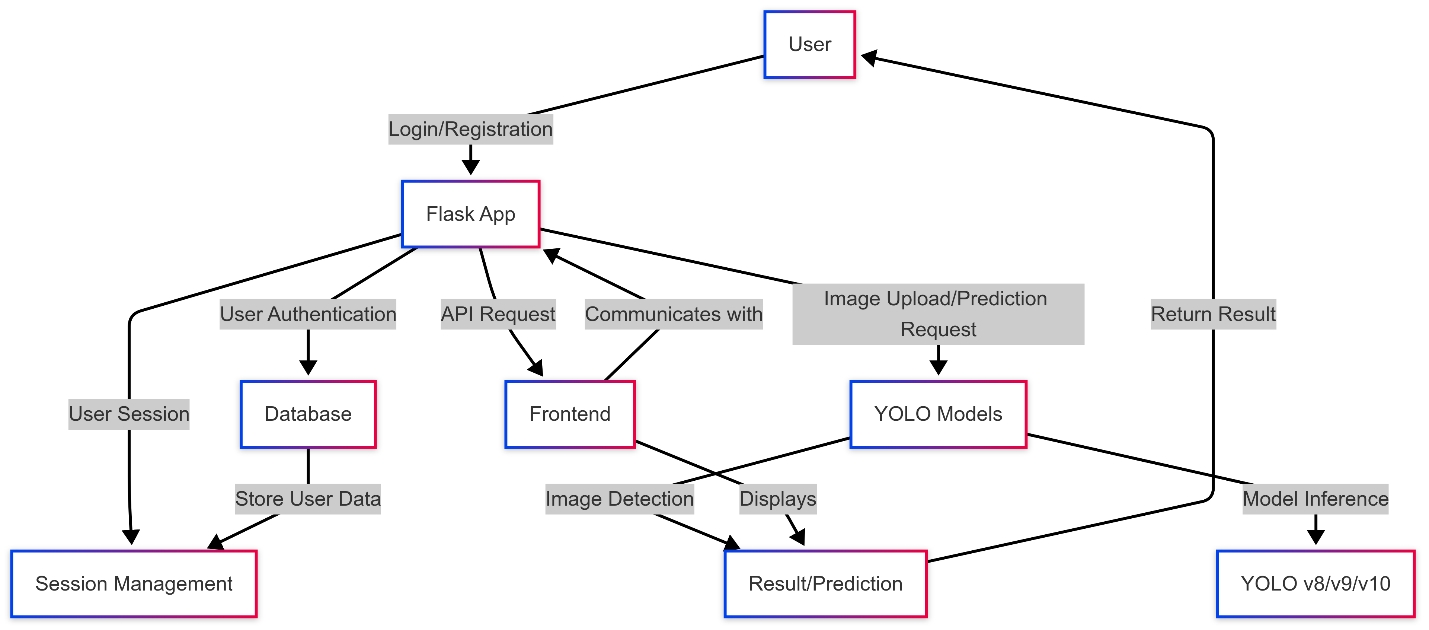
Block Diagram
Specifications
4.2 Hardware Requirements
- Processor: Intel i3 or equivalent for handling basic video processing.
- RAM: 8 GB for smooth operation.
- Storage: 160 GB hard disk.
- Cameras:
- High-definition CCTV cameras (1080p or higher resolution).
- Frame rate: Minimum 30 frames per second (FPS).
- GPU: None specified, but NVIDIA GTX 1080 or higher is recommended for faster inference in deep learning tasks.
- Network: High-speed internet connection (minimum 1 Gbps) for smooth data transfer.
4.3 Software Requirements
- Operating System:
- Windows 7/8/10 for the front-end development.
- Linux-based OS (Ubuntu 18.04 or higher) for backend deployment.
- Server-side Script: HTML, CSS, Bootstrap, and JS.
- Programming Languages:
- Python (for backend and model training).
- JavaScript, HTML, CSS (for front-end development via Streamlit).
- Deep Learning Frameworks:
- TensorFlow or PyTorch (for YOLOv8, v11, model implementation).
- OpenCV (for video processing and frame extraction).
- Libraries and Tools:
- Streamlit (for the front-end interface).
- Flask (for API integration between backend and front-end).
- NumPy, Pandas (for data processing and analysis).
- Database: MySQL or PostgreSQL (for storing logs and metadata of violations).
- Version Control: Git for version control and collaboration; GitHub or GitLab for repository hosting and CI/CD pipelines.
- IDE/Workbench: PyCharm or VSCode for Python development.
- Server Deployment: XAMPP Server.

Demo Video


Request for Video
Related Projects
 Paper Publishing
Request Call Back
Would you like to receive a free callback now?
Choose the best time for callback:
Leave your message and we will contact you as soon as possible

6-2-85/B, Old Maternity Hospital Road, Thyagaraja Nagar, Tirupati, Andhra Pradesh – 517501
+91 9030333433
+91 9393939065
0877-2261612

Disclaimer - Takeoff Edu Group Projects are not associated or affiliated with IEEE in any way. The IEEE Projects mentioned here are mentioned in the context of student projects, whose ideas are derived from IEEE publications, not projects of or by IEEE.

