smishing sms detection using machine learning and deep learning models
Objective
The objective of this project is to develop a unified, multi-modal spam detection system capable of identifying deceptive SMS and voice communications using machine learning and deep learning techniques. It aims to preprocess text and audio data, extract meaningful features such as TF-IDF vectors, embeddings, and MFCCs, and apply models like Decision Tree, Random Forest, RoBERTa, CNN, and MobileNet for accurate classification. The system further seeks to integrate these models into a user-friendly Flask web application that supports secure registration, login, and prediction. Overall, the project strives to deliver a scalable, adaptable, and efficient platform for reliable spam detection.
Abstract
The project presents a multi-modal approach for detecting spam in SMS text messages and voice communications using machine learning and deep learning techniques. The system classifies messages as SPAM or HAM by analyzing both textual and audio inputs through structured data pipelines. For SMS detection, preprocessing steps such as tokenization, stopword removal, and transformation into numerical formats like TF-IDF and embeddings are performed. Classical algorithms such as Decision Tree and Random Forest are employed to capture simple spam patterns, while transformer-based models like RoBERTa provide advanced contextual understanding for higher precision.
For voice communication, the system extracts audio features such as Mel Frequency Cepstral Coefficients (MFCCs), spectral contrast, and chroma vectors. Deep learning models like Convolutional Neural Networks (CNNs) and MobileNet analyze these extracted patterns to identify spam and legitimate voice messages. The project integrates both models within a web-based interface using Flask for the backend and HTML, CSS, and JavaScript for the frontend. Users can register, log in, and submit either text or audio inputs for spam detection.
The proposed framework ensures efficient data handling, secure session management, and accurate classification of deceptive messages. It achieves this by combining structured feature extraction with intelligent classification algorithms. The system demonstrates how multiple learning techniques can complement each other to improve prediction accuracy across different communication formats. The hybrid nature of the model allows flexibility, modularity, and scalability for future enhancements, such as multilingual dataset integration or transformer-based speech recognition. This research contributes to a stronger communication analysis framework by introducing a practical, automated, and adaptable spam detection system capable of handling diverse data types efficiently.
Keywords: smishing, spam detection, phishing, machine learning, deep learning, RoBERTa, CNN, MobileNet, Flask, MFCC.NOTE: Without the concern of our team, please don't submit to the college. This Abstract varies based on student requirements.
Block Diagram
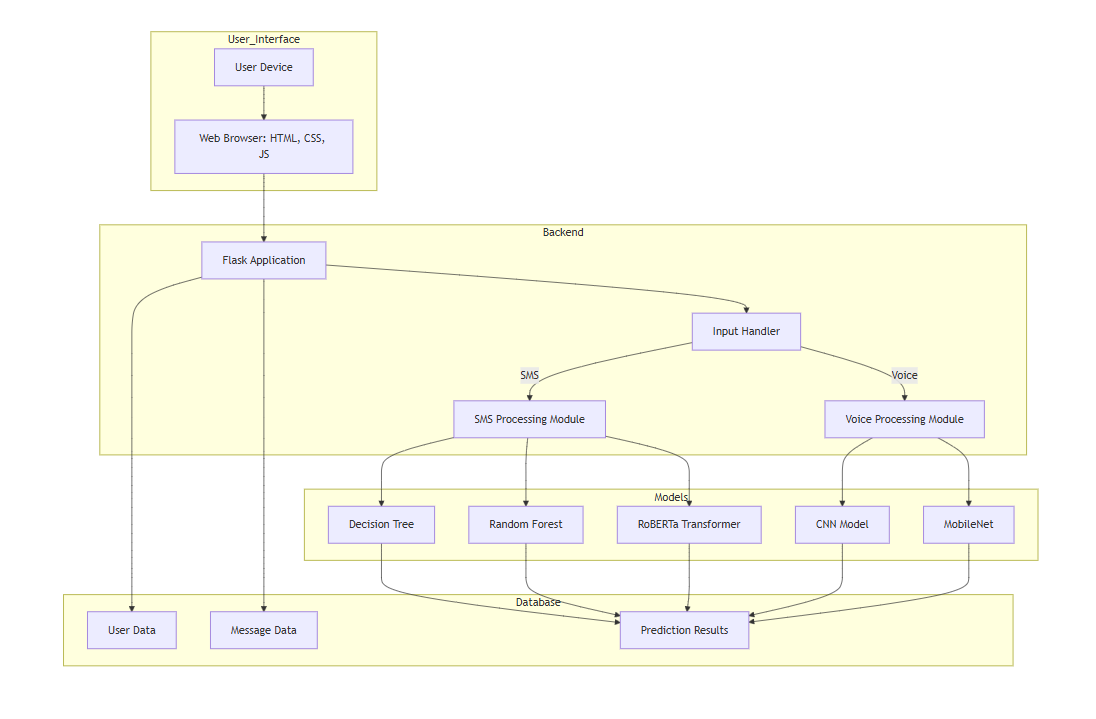
Specifications
H/W CONFIGURATION:
Processor - I3/Intel Processor
Hard Disk - 160GB
Key Board - Standard Windows Keyboard
Mouse - Two or Three Button Mouse
Monitor - SVGA
RAM - 8GB
S/W CONFIGURATION:
• Operating System : Windows 7/8/10
• Server side Script : HTML, CSS, Bootstrap & JS
• Programming Language : Python
• Libraries : Flask, Pandas, MySQL.Connector, Scikit-Learn
• IDE/Workbench : VS Code
• Technology : Python 3.8+
• Server Deployment : Xampp Server


Related Projects
 Paper Publishing

Request Call Back
Would you like to receive a free callback now?
Choose the best time for callback:
Leave your message and we will contact you as soon as possible

6-2-85/B, Old Maternity Hospital Road, Thyagaraja Nagar, Tirupati, Andhra Pradesh – 517501
+91 9030333433
+91 9393939065
0877-2261612

Disclaimer - Takeoff Edu Group Projects are not associated or affiliated with IEEE in any way. The IEEE Projects mentioned here are mentioned in the context of student projects, whose ideas are derived from IEEE publications, not projects of or by IEEE.

