Smart traffic management system by q learning and using machine learning
Objective
The objective of this project is to develop a Smart Traffic Management System that optimizes traffic flow in real-time using a combination of Q-Learning and machine learning algorithms. The primary goal is to reduce congestion, improve traffic efficiency, and enhance safety on the roads by using data-driven decisions. The system leverages three key algorithms: Random Forest, Q-Learning, and Deep Q-Network (DQN), each aimed at dynamically adjusting traffic signals based on factors like weather conditions, traffic volume, vehicle speed, and congestion. By integrating these models, the system will be able to predict traffic patterns and make real-time adjustments to traffic signals, ultimately reducing waiting times, improving road safety, and minimizing environmental impact due to excessive idling.
Abstract
The rapid advancement in traffic management systems has paved the way for smarter, more efficient transportation networks. This project introduces a Smart Traffic Management System that combines Q-learning and machine learning algorithms to optimize traffic flow and reduce congestion in real-time. The system incorporates three key algorithms: Random Forest, Q-Learning, and Deep Q-Network (DQN), each contributing uniquely to the management of traffic signals and vehicle flow. The Random Forest model achieves the highest accuracy of 99.21%, providing robust performance in predicting traffic conditions based on various features like weather, congestion, and traffic volume. In contrast, the Q-Learning algorithm, while effective for decision-making in dynamic environments, has a lower performance with an accuracy of 74.99%, indicating room for further optimization. The DQN, a deep reinforcement learning model, strikes a balance with an accuracy of 82.95%, showcasing its ability to learn optimal traffic signal policies in a complex environment. The system uses real-time data to adjust traffic signals, aiming to reduce congestion, enhance safety, and improve overall traffic efficiency. This research demonstrates the potential of integrating traditional machine learning with reinforcement learning in smart city solutions, emphasizing the evolving role of AI in transforming urban traffic systems.
Keywords: Smart Traffic Management, Q-Learning, Deep Q-Network (DQN), Random Forest, Machine Learning, Traffic Optimization, Reinforcement Learning, Real-Time Data, Smart Cities, Urban Mobility, AI Traffic Systems, Congestion Management.
NOTE: Without the concern of our team, please don't submit to the college. This Abstract varies based on student requirements.
Block Diagram
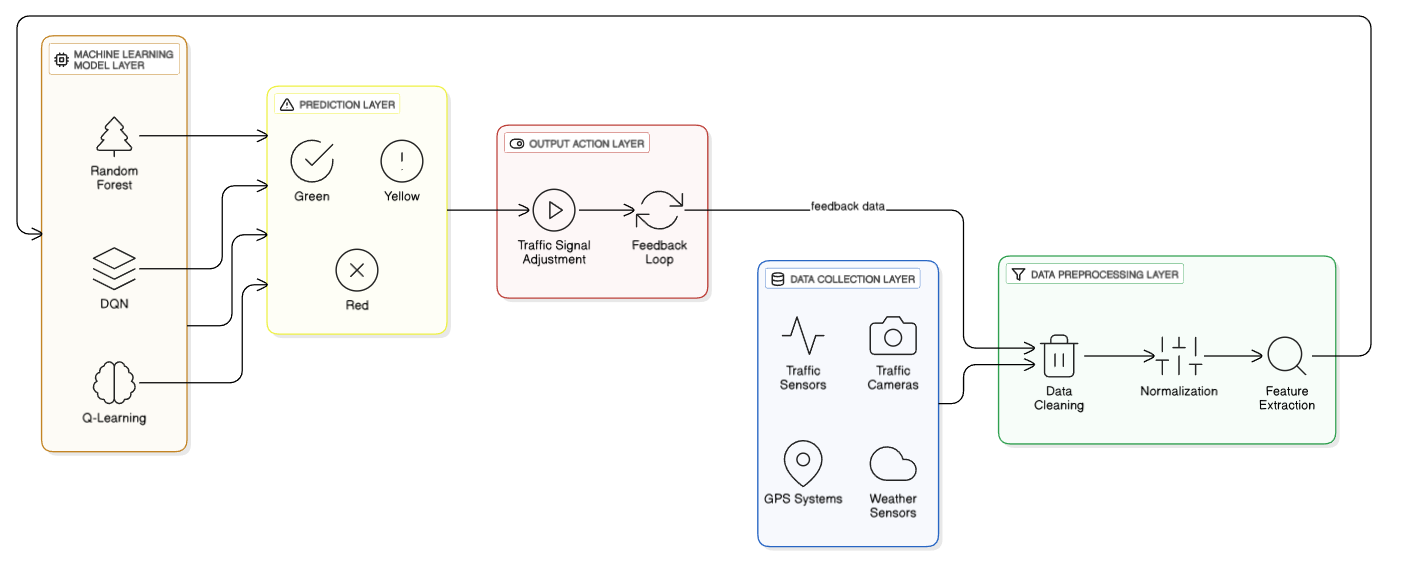
Specifications
SOFTWARE REQUIREMENS
Operating System : Windows 7/8/10
Server side Script : html,css,js
Programming Language : Python
Libraries : Django, Pandas, Torch, Keras, Sklearn, Numpy , Seaborn
IDE/Workbench : VSCode
Server Deployment : Xampp Server
Database : SQLite
HARDWARE REQUIREMENTS
Processor - I3/Intel Processor
RAM - 8GB (min)
Hard Disk - 128 GB
Key Board - Standard Windows Keyboard
Mouse - Two or Three Button Mouse
Monitor - Any

Demo Video


Request for Video
Related Projects
 Paper Publishing
Request Call Back
Would you like to receive a free callback now?
Choose the best time for callback:
Leave your message and we will contact you as soon as possible

6-2-85/B, Old Maternity Hospital Road, Thyagaraja Nagar, Tirupati, Andhra Pradesh – 517501
+91 9030333433
+91 9393939065
0877-2261612

Disclaimer - Takeoff Edu Group Projects are not associated or affiliated with IEEE in any way. The IEEE Projects mentioned here are mentioned in the context of student projects, whose ideas are derived from IEEE publications, not projects of or by IEEE.

