SMART GRADING OF WATERMELON SWEETNESS USING IMAGE PROCESSING AND MACHINE LEARNING
Objective
The objective of this project is to develop an automated system that accurately classifies watermelon sweetness using advanced YOLOv8 and YOLOv9 deep learning models. The system aims to provide a fast, non-destructive, and reliable method for grading watermelons by analyzing RGB images and extracting visual patterns related to sweetness. It focuses on building an efficient preprocessing pipeline, training YOLO models for high-accuracy predictions, and deploying the solution through a user-friendly web interface. This project ultimately seeks to offer a real-time, scalable, and cost-effective alternative to traditional manual or destructive testing methods in agricultural quality assessment.
Abstract
The project “Smart Grading of Watermelon Sweetness Using YOLOv8 and YOLOv9 aims to develop an automated system for classifying watermelons as sweet or unsweet using image-based analysis. Manual evaluation of sweetness is often inconsistent and subjective, whereas modern deep learning object detection models can detect subtle visual patterns that correlate with internal fruit quality. This system leverages image preprocessing techniques combined with YOLOv8 and YOLOv9 to detect watermelons in images and classify their sweetness level. The dataset used for this project is collected from Roboflow and contains labeled watermelon images categorized by sweetness. Images are preprocessed to normalize size, reduce noise, and enhance visual features. YOLOv8 and YOLOv9 models are trained to detect individual watermelons and classify them as sweet or unsweet with high accuracy.
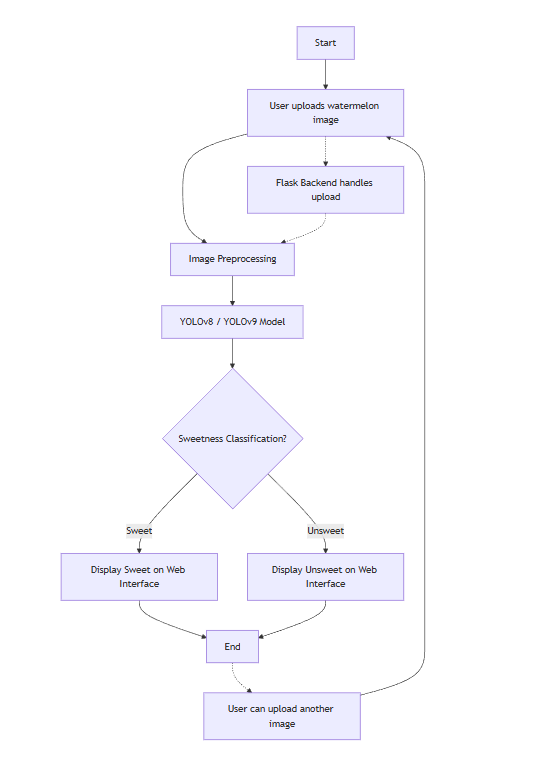
A web-based interface developed using HTML, CSS, and JavaScript allows users to upload images, while a Flask backend in Python handles prediction and communicates results to the interface. The system reduces errors associated with manual grading and ensures consistent, objective classification results. Performance evaluation of YOLOv8 and YOLOv9 is conducted to identify the most accurate and efficient model for sweetness detection. This approach demonstrates how state-of-the-art object detection models can be applied to automate fruit quality assessment, and the framework can be extended to classify other fruits or agricultural products based on visual features.
Keywords: Watermelon, YOLOv8, YOLOv9, Image Processing, Sweetness Classification, Deep Learning, Python, Flask, Object Detection
NOTE: Without the concern of our team, please don't submit to the college. This Abstract varies based on student requirements.
Block Diagram
Specifications
3.1 Hardware Requirements
Processor - I3/Intel Processor
Hard Disk - 160GB
Key Board - Standard Windows Keyboard
Mouse - Two or Three Button Mouse
Monitor - SVGA
RAM - 8GB
3.2 Software Requirements
Operating System : Windows 7/8/10
Programming Language : Python
Libraries : Pandas, Numpy, scikit-learn.
IDE/Workbench : Visual Studio Code.
Framework : Flask


Related Projects
 Paper Publishing

Request Call Back
Would you like to receive a free callback now?
Choose the best time for callback:
Leave your message and we will contact you as soon as possible

6-2-85/B, Old Maternity Hospital Road, Thyagaraja Nagar, Tirupati, Andhra Pradesh – 517501
+91 9030333433
+91 9393939065
0877-2261612

Disclaimer - Takeoff Edu Group Projects are not associated or affiliated with IEEE in any way. The IEEE Projects mentioned here are mentioned in the context of student projects, whose ideas are derived from IEEE publications, not projects of or by IEEE.

