Smart Emotion Recognition and Ayurvedic Recommendation System
Objective
The primary objective of the Smart Emotion Recognition and Ayurvedic Recommendation System is to accurately detect human emotions from text-based inputs and provide tailored Ayurvedic remedies to enhance emotional well-being. By leveraging machine learning algorithms like SVM, Random Forest, and XGBoost, the system aims to classify emotions into six categories: Happiness, Sadness, Fear, Disgust, Anger, and Surprise. Once the emotion is identified, static Ayurvedic solutions are suggested to address the user's emotional state. This project integrates modern emotion recognition techniques with traditional Ayurvedic practices, offering a personalized approach to emotional health through an intuitive chatbot interface.
Abstract
The Smart Emotion Recognition and Ayurvedic Recommendation System is designed to recognize human emotions from text-based inputs and offer personalized Ayurvedic remedies based on the detected emotions. The system classifies emotions into six categories: Happiness, Sadness, Fear, Disgust, Anger, and Surprise using text data. Advanced machine learning algorithms, including Support Vector Machine (SVM), Random Forest, and XGBoost, are utilized to process and classify the emotional content of the text. Upon recognizing the user's emotional state, the system provides static Ayurvedic recommendations, suggesting remedies tailored to alleviate the detected emotion. For example, calming methods for anger or anxiety-reducing techniques for fear are provided based on the emotional analysis. A chatbot interface enhances user interaction, ensuring a seamless and informative experience. This project combines modern emotional intelligence with traditional Ayurvedic practices to promote mental wellness through an innovative, text-based approach.
Keywords: Emotion Recognition, Ayurvedic Recommendation, SVM, Random Forest, XGBoost, Machine Learning, Text Analysis, Chatbot, Mental Wellness, Personalized Remedies.
NOTE: Without the concern of our team, please don't submit to the college. This Abstract varies based on student requirements.
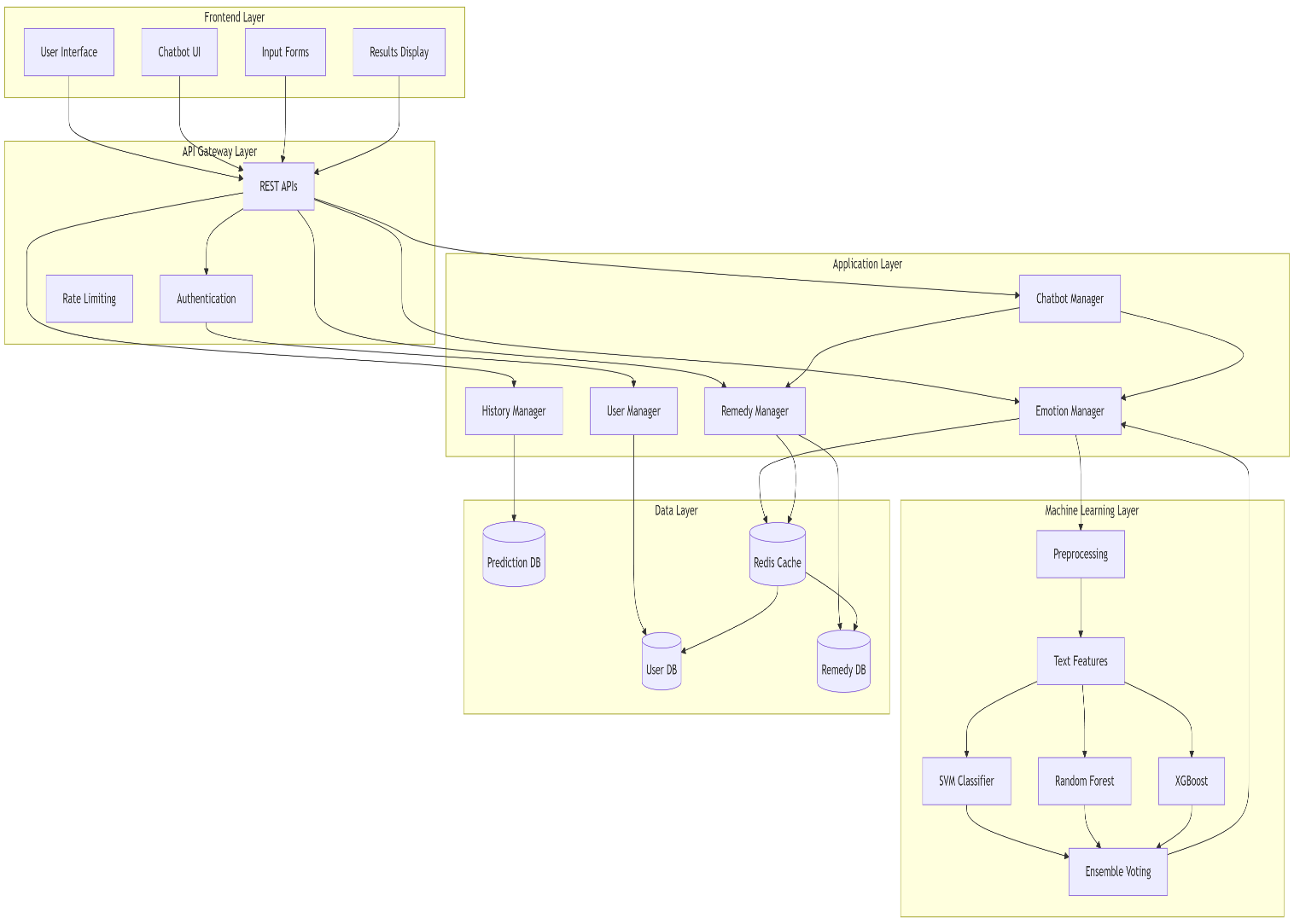
Block Diagram
Specifications
Hardware Requirements
Processor - I3/Intel Processor
Hard Disk - 160GB
Key Board - Standard Windows Keyboard
Mouse - Two or Three Button Mouse
Monitor - SVGA
RAM - 8GB
Software Requirements:
Operating System : Windows 7/8/10
Server side Script : HTML, CSS, Bootstrap & JS
Programming Language : Python
Libraries : Django, Pandas, Numpy, Tensorflow, Scikit-learn.
IDE/Workbench : VS Code
Technology : Python 3.10
Database : SQLite


Related Projects
 Paper Publishing

Request Call Back
Would you like to receive a free callback now?
Choose the best time for callback:
Leave your message and we will contact you as soon as possible

6-2-85/B, Old Maternity Hospital Road, Thyagaraja Nagar, Tirupati, Andhra Pradesh – 517501
+91 9030333433
+91 9393939065
0877-2261612

Disclaimer - Takeoff Edu Group Projects are not associated or affiliated with IEEE in any way. The IEEE Projects mentioned here are mentioned in the context of student projects, whose ideas are derived from IEEE publications, not projects of or by IEEE.

