SKIN CANCER DETECTION USING DEEP LEARNING
Objective
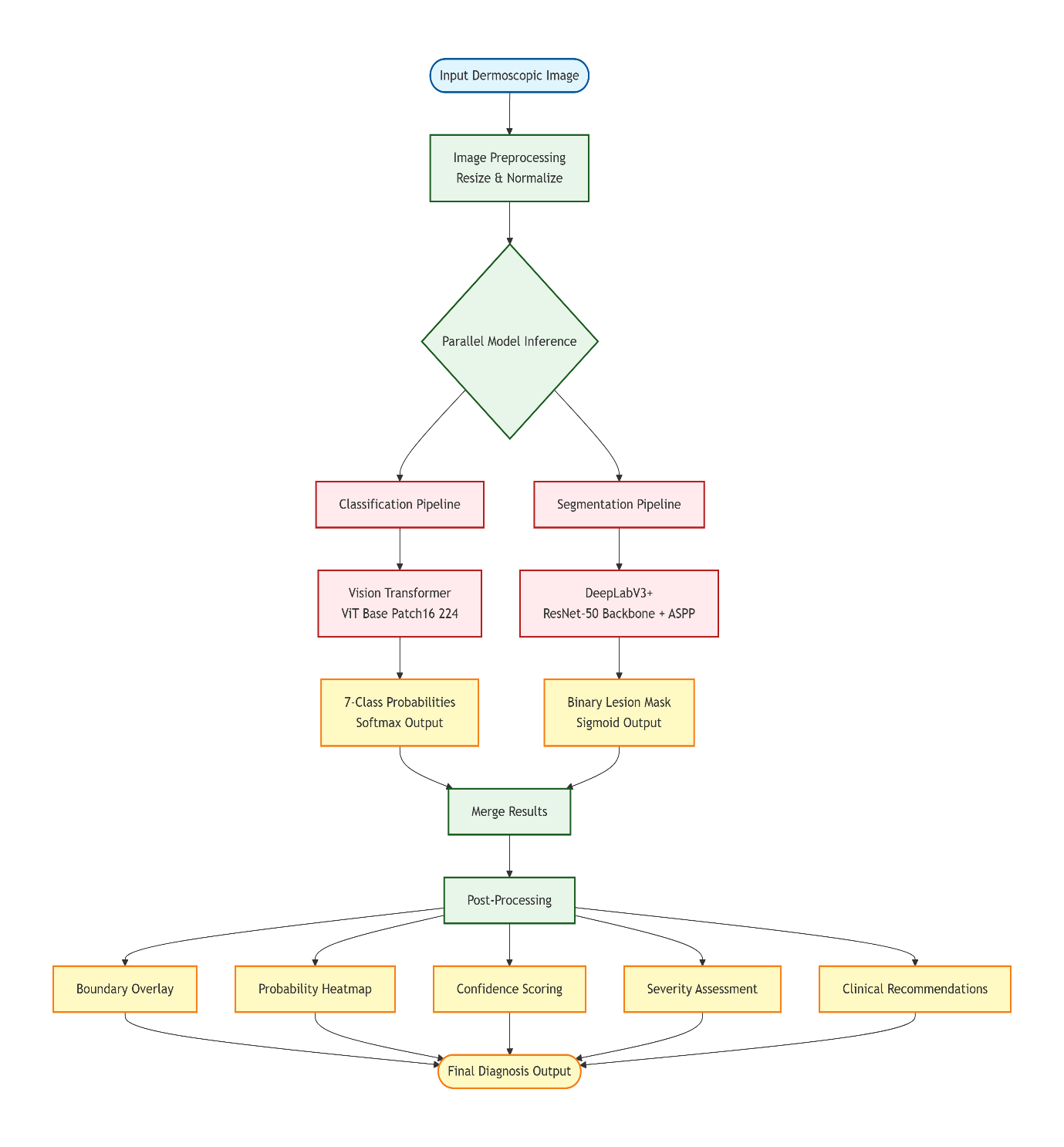
This paper presents an automated skin lesion analysis system using deep learning for classification and segmentation of dermoscopic images. The system leverages the HAM10000 dataset and explores DenseNet121, Vision Transformer, U-Net, and DeepLabV3+ models. The best models are integrated into a Flask-based web application for on-demand image review, lesion boundary visualization, classification, confidence scoring, and clinical recommendations. This interactive platform provides valuable insights for early skin cancer detection, benefiting both clinicians and patients.
Abstract
Skin cancer is one of the most prevalent and life-threatening malignancies worldwide, where early and accurate diagnosis significantly improves patient outcomes. This paper presents an automated skin lesion analysis system leveraging deep learning for simultaneous classification and segmentation of dermoscopic images. The proposed system utilizes the HAM10000 dataset comprising images across seven diagnostic categories: Melanoma (MEL), Melanocytic Nevi (NV), Basal Cell Carcinoma (BCC), Actinic Keratosis (AKIEC), Benign Keratosis (BKL), Dermatofibroma (DF), and Vascular Lesion (VASC). For classification, DenseNet121 and Vision Transformer (ViT) architectures are explored and compared, while U-Net and DeepLabV3+ with ResNet-50 backbone and Atrous Spatial Pyramid Pooling (ASPP) are evaluated for precise lesion segmentation. The best-performing models are deployed within a Flask-based web application that provides on-demand review of uploaded dermoscopic images, delivering instant lesion boundary visualization, disease classification, confidence scoring, severity assessment, and personalized clinical recommendations. This interactive diagnostic feedback system empowers both clinicians and patients with immediate, actionable insights, demonstrating that integrating convolutional and transformer-based deep learning models into an end-to-end web platform offers a reliable and scalable solution for early skin cancer detection.
Keywords: Skin cancer detection, dermoscopy, DenseNet121, Vision Transformer, U-Net, DeepLabV3+, HAM10000, web-based diagnosis, deep learning, Flask web application.
NOTE: Without the concern of our team, please don't submit to the college. This Abstract varies based on student requirements.
Block Diagram
Specifications
1. SOFTWARE REQUIREMENS
Operating System : Windows 7/8/10
Server-side Script : HTML, CSS, Bootstrap & JS
Programming Language : Python
Libraries : Flask, Pandas, Sklearn,Pytorch,Torchvision NumPy, Seaborn, Matplotlib,pillow, albumentations
IDE/Workbench : VSCode
Technology : Python 3.10+
Server Deployment : Mysql Server
Database : Mysql
2. HARDWARE REQUIREMENTS
Processor - I5/Intel Processor
RAM - 8GB+ (min)
Hard Disk - 128 GB+
Key Board - Standard Windows Keyboard
Mouse - Two or Three Button Mouse
Monitor - Any

Demo Video


Request for Video
Related Projects
 Paper Publishing
Request Call Back
Would you like to receive a free callback now?
Choose the best time for callback:
Leave your message and we will contact you as soon as possible

6-2-85/B, Old Maternity Hospital Road, Thyagaraja Nagar, Tirupati, Andhra Pradesh – 517501
+91 9030333433
+91 9393939065
0877-2261612

Disclaimer - Takeoff Edu Group Projects are not associated or affiliated with IEEE in any way. The IEEE Projects mentioned here are mentioned in the context of student projects, whose ideas are derived from IEEE publications, not projects of or by IEEE.

