Robustness of Workload Forecasting Models in Cloud Data Centers
Objective
The primary objective of this research is to evaluate and compare the performance of four machine learning models in forecasting workload demands, specifically CPU usage percentage, within cloud data centers. To achieve this, the study first aims to preprocess and analyze a dataset that includes various cloud infrastructure parameters such as CPU usage, memory usage, disk throughput, and network throughput. The performance of four machine learning algorithms—Random Forest Regressor, XGBoost Regressor, AdaBoost Regressor, and LightGBM Regressor—is then evaluated based on key metrics like Mean Squared Error (MSE), R-squared (R²), and prediction accuracy. By comparing these models, the research aims to identify the most effective algorithm for accurate CPU usage prediction. The findings will contribute to the development of a forecasting tool that can assist cloud service providers in optimizing resource allocation, thereby improving operational efficiency. Additionally, the research will explore potential future improvements in workload forecasting and suggest further avenues for research in this domain.
Abstract
This research investigates the performance and robustness of various workload forecasting models within cloud data centers. Workload prediction plays a critical role in resource management, capacity planning, and cost optimization. Cloud service providers rely on accurate workload forecasting models to efficiently allocate resources and minimize costs while ensuring service availability. This study uses a dataset comprising key metrics such as CPU usage, memory usage, disk throughput, and network throughput in cloud environments. The primary objective is to predict CPU usage percentage using machine learning techniques. Four models are employed for prediction: Random Forest Regressor, XGBoost Regressor, AdaBoost Regressor, and LightGBM Regressor. The models are evaluated based on performance metrics like accuracy, mean squared error (MSE), and R-squared (R²). The research aims to identify the most effective algorithm for workload forecasting in cloud data centers and contribute to improving resource management strategies. Through the use of these models, the study demonstrates their strengths and weaknesses in handling complex data patterns. The project provides a foundation for future advancements in workload forecasting models for cloud computing systems.
Keywords: Cloud Data Centers, Workload Forecasting, Resource Management, CPU Usage Prediction, Machine Learning, Random Forest, XGBoost, AdaBoost, LightGBM, Capacity Planning.
NOTE: Without the concern of our team, please don't submit to the college. This Abstract varies based on student requirements.
Block Diagram
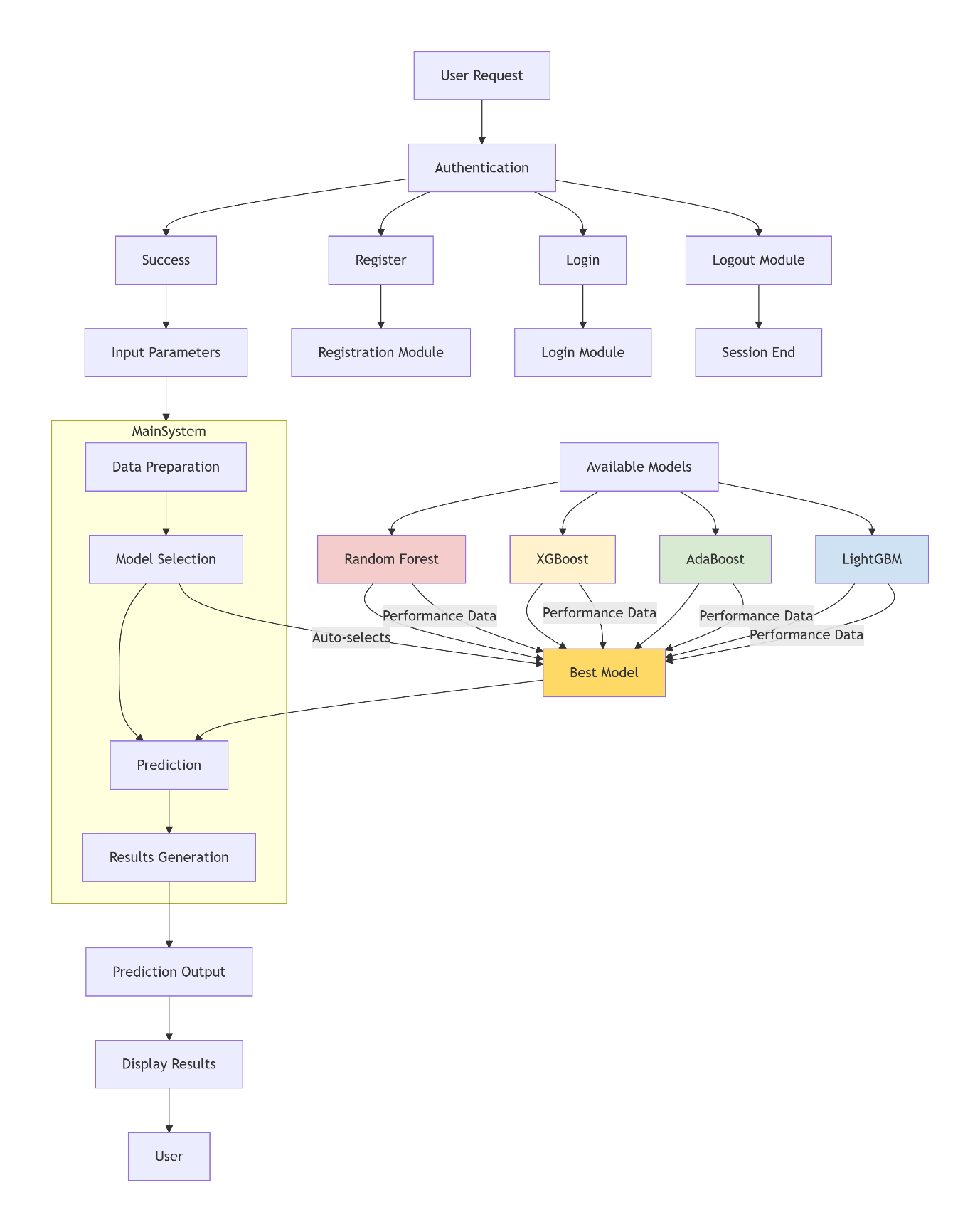
Specifications
HARDWARE REQUIREMENTS
• Processor - I5/Intel Processor
• RAM - 8GB (min)
• Hard Disk - 160 GB
• Key Board - Standard Windows Keyboard
• Mouse - Two or Three Button Mouse
• Monitor - Any
SOFTWARE REQUIREMENS
• Operating System : Windows 7/8/10
• Server side Script : HTML, CSS, Bootstrap & JS
• Programming Language : Python
• Libraries : Flask, Pandas, Mysql.connector, Os, Numpy,
Scikit-learn.
• IDE/Workbench : VS-Code
• Technology : Python 3.10+
• Server Deployment : Xampp Server
• Database : MySQL


Related Projects
 Paper Publishing

Request Call Back
Would you like to receive a free callback now?
Choose the best time for callback:
Leave your message and we will contact you as soon as possible

6-2-85/B, Old Maternity Hospital Road, Thyagaraja Nagar, Tirupati, Andhra Pradesh – 517501
+91 9030333433
+91 9393939065
0877-2261612

Disclaimer - Takeoff Edu Group Projects are not associated or affiliated with IEEE in any way. The IEEE Projects mentioned here are mentioned in the context of student projects, whose ideas are derived from IEEE publications, not projects of or by IEEE.

