Road Risk Prediction using Machine Learning
Objective
The primary objective of this project is to develop and evaluate predictive models to accurately estimate the target variable using ensemble learning techniques. Specifically, three powerful machine learning algorithms—Random Forest, XGBoost, and LightGBM—are implemented, trained, and rigorously compared based on their coefficient of determination (R²) scores. The goal is to identify the best-performing model by maximizing predictive accuracy and explanatory power, thereby enabling reliable and robust predictions. Ultimately, the project aims to select the optimal model (Random Forest, with an R² of 0.88280) for deployment while providing insights into the comparative strengths of each ensemble method.
Abstract
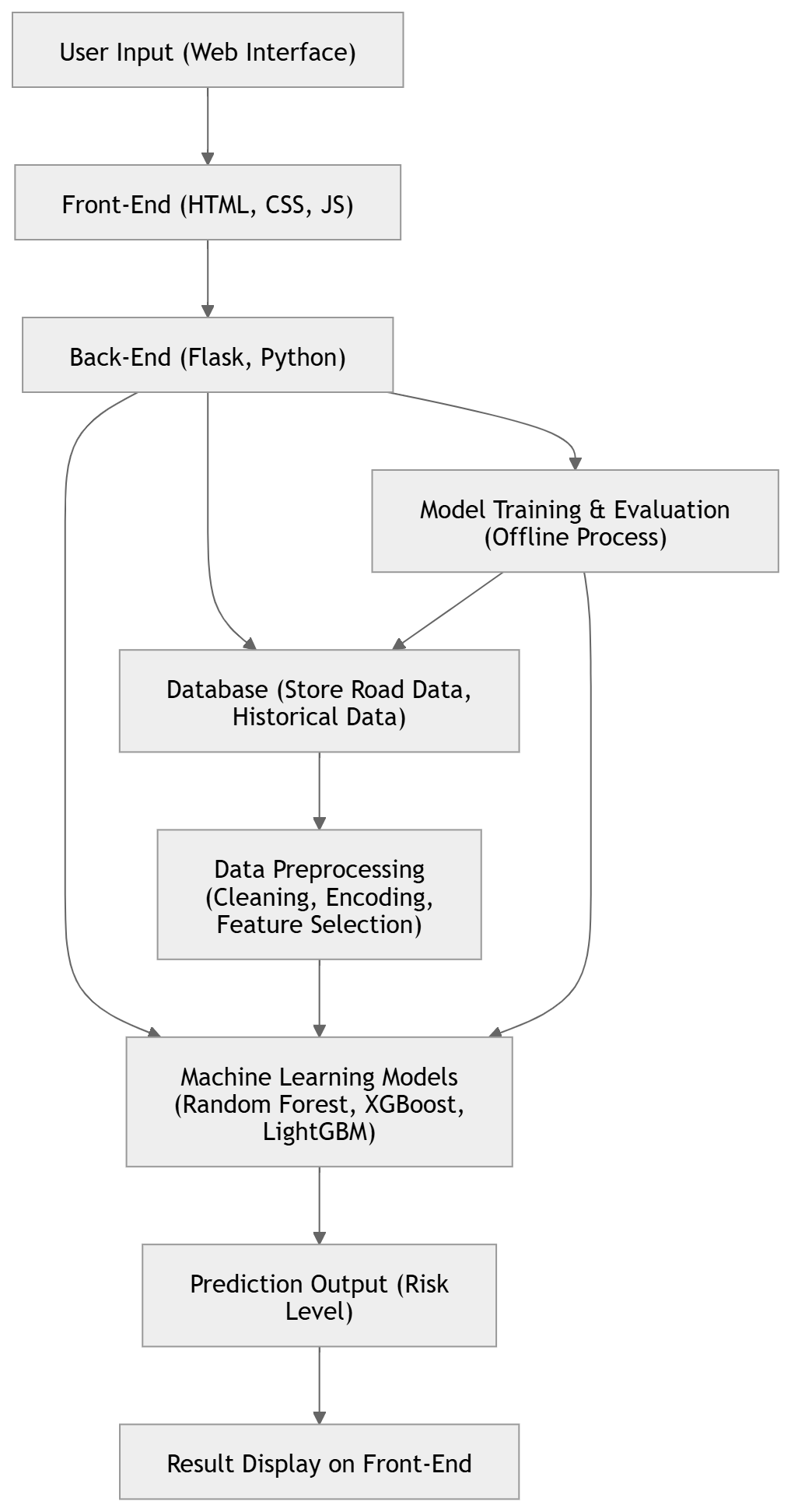
Road accidents are a significant concern for public safety and infrastructure management. Predicting the risk of road accidents can help authorities take preventive measures, reduce accidents, and improve overall road safety. This project focuses on developing a machine learning-based system for predicting road accident risks based on various road and environmental factors. The dataset used in this study contains parameters such as road type, number of lanes, curvature, speed limit, lighting, weather, road signs, time of day, holiday, school season, and historical accident data. The target variable is the accident risk level, which is classified based on these factors. To achieve this, three powerful machine learning algorithms—Random Forest, XGBoost, and LightGBM—are used to train and evaluate the model. These algorithms have proven to be effective in handling complex datasets and predicting outcomes with high accuracy. The system is built with a Flask back-end, using Python for model development, and an intuitive HTML/CSS/JS front-end for data input and result display. The system aims to predict accident risk levels for different road segments, helping authorities prioritize high-risk areas for intervention. By providing real-time predictions, the system has the potential to improve road safety and reduce the occurrence of accidents, ultimately saving lives and resources.
Keywords:
Road Safety, Accident Prediction, Machine Learning, Random Forest, XGBoost, LightGBM, Flask, Data Analysis, Risk Classification, Road Risk Factors, Public Safety, Traffic Analysis, Environmental Factors, Accident Prevention, Predictive Modeling, Traffic Management.
NOTE: Without the concern of our team, please don't submit to the college. This Abstract varies based on student requirements.
Block Diagram
Specifications
H/W CONFIGURATION:
Ø Processor - I3/Intel Processor
Ø RAM - 8GB (min)
Ø Hard Disk - 128 GB
Ø Key Board - Standard Windows Keyboard
Ø Mouse - Two or Three Button Mouse
Ø Monitor -Any
S/W CONFIGURATION:
Ø Operating System : Windows 7/8/10
Ø Server side Script : HTML, CSS & JS
Ø Programming Language : Python
Ø Libraries :Python, Flask, Pandas, NumPy, Scikit-learn, XGBoost, LightGBM, Random Forest, Matplotlib, Seaborn, SQLAlchemy, Joblib
Ø IDE/Workbench : VSCode
Ø Technology : Python 3.6+
Ø Database : MySQL


Related Projects
 Paper Publishing

Request Call Back
Would you like to receive a free callback now?
Choose the best time for callback:
Leave your message and we will contact you as soon as possible

6-2-85/B, Old Maternity Hospital Road, Thyagaraja Nagar, Tirupati, Andhra Pradesh – 517501
+91 9030333433
+91 9393939065
0877-2261612

Disclaimer - Takeoff Edu Group Projects are not associated or affiliated with IEEE in any way. The IEEE Projects mentioned here are mentioned in the context of student projects, whose ideas are derived from IEEE publications, not projects of or by IEEE.

