Risc processer with Fft are architeture
Objective
The main objective appears to be designing a RISC (Reduced Instruction Set Computing) microprocessor CPU that incorporates Fast Fourier Transform (FFT) capabilities. This design aims to address the specific needs of digital signal processing applications.
Abstract
The demand for efficient Digital Image Processing (DIP) systems has led to the exploration of hardware architectures optimized for speed, power, and resource utilization. This paper presents the design and implementation of a pipelined architecture for Fast Fourier Transform (FFT) and Inverse Fast Fourier Transform (IFFT), specifically tailored for DIP applications. The proposed architecture is developed using Verilog HDL for hardware realization and MATLAB for data preprocessing and visualization. The FFT and IFFT modules are designed to handle high-throughput data streams, leveraging pipelining to achieve significant speedup while maintaining a compact hardware footprint. In the preprocessing phase, MATLAB is utilized to convert images into numerical data that can be processed by the FFT module. After processing, the transformed data is reconverted into image format using MATLAB to verify the accuracy of the FFT and IFFT operations. The design incorporates modularity, scalability, and hardware efficiency, making it suitable for real-time DIP applications. The implementation is validated on FPGA hardware, demonstrating its effectiveness in terms of speed, accuracy, and resource usage. This study highlights the potential of pipelined FFT/IFFT architectures in enhancing the performance of DIP systems.
Keywords:-Fast Fourier Transform (FFT), Inverse Fast Fourier Transform (IFFT), radix-2 butterflies, adders, multipliersNOTE: Without the concern of our team, please don't submit to the college. This Abstract varies based on student requirements.
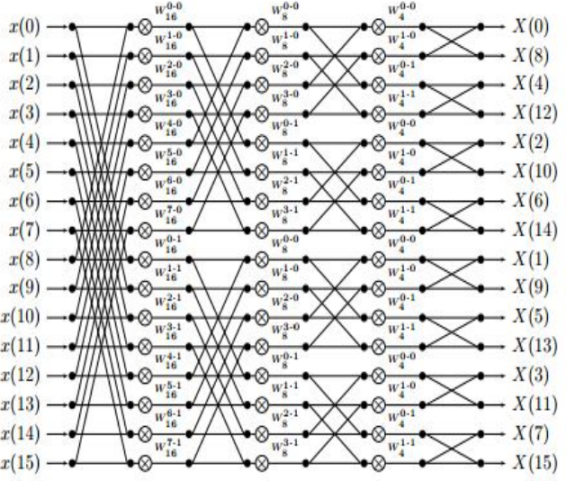
Block Diagram
Specifications
Software Requirements:
· Xilinx vivado Tool
· HDL: Verilog
Hardware Requirements:
· Microsoft® Windows XP,
· Intel® Pentium® 4 processor or Pentium 4 equivalent with SSE support
· 512 MB RAM
· 100 MB of available disk space
Learning Outcomes
- Basics of Digital Electronics
- FPGA design Flow
- Introduction to Verilog Coding
- Different modeling styles in Verilog
o Data Flow modeling
o Structural modeling
o Behavioral modeling
o Mixed level modeling
- Concept of Approximation
- Importance of Approximate computing
- Drawbacks of Exact Computing in error tolerant applications
- Introduction to Arithmetic Circuits
- Knowledge on RISC Processor
- Applications of Multipliers in real time
- Scope of approximation concept in today’s world
- Applications in real time
· Xilinx Vivado for design and simulation
· Generation of Netlist
· Solution providing for real time problems
· Project Development Skills:
o Problem Analysis Skills
o Problem Solving Skills
o Logical Skills
o Designing Skills
o Testing Skills
o Debugging Skills
o Presentation Skills
o Thesis Writing Skills


Related Projects
 Paper Publishing

Request Call Back
Would you like to receive a free callback now?
Choose the best time for callback:
Leave your message and we will contact you as soon as possible

6-2-85/B, Old Maternity Hospital Road, Thyagaraja Nagar, Tirupati, Andhra Pradesh – 517501
+91 9030333433
+91 9393939065
0877-2261612

Disclaimer - Takeoff Edu Group Projects are not associated or affiliated with IEEE in any way. The IEEE Projects mentioned here are mentioned in the context of student projects, whose ideas are derived from IEEE publications, not projects of or by IEEE.

