Respiratory Sound for Lung Disease Classification
Objective
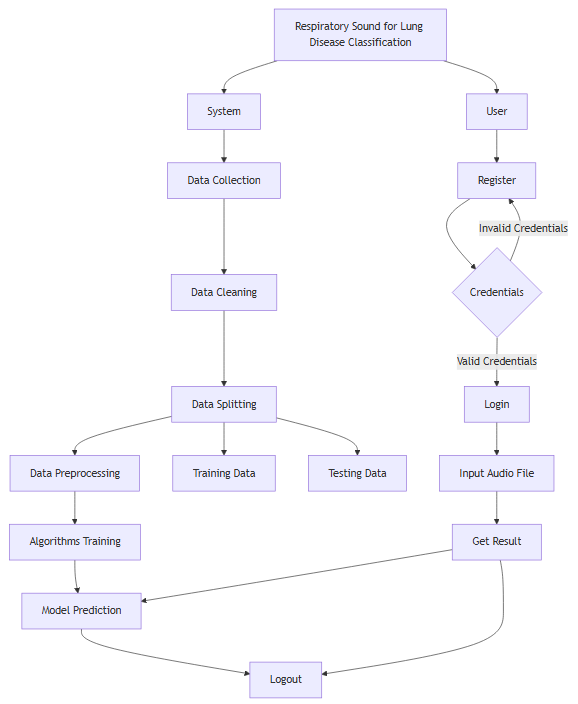
The primary objective is to create a functional model that identifies lung diseases from respiratory audio samples with high accuracy. This involves preprocessing audio data to extract meaningful features suitable for machine learning algorithms. Different models such as CNN, RCNN, LSTM, and Conformer Transformers will be trained and evaluated to select the most effective approach. Another goal is to design an intuitive web interface that allows users to upload audio files, register accounts, log in, and receive disease classification results. Ensuring the system is responsive and secure is also important. Lastly, the project aims to document the entire process to provide insights into the methodology and support future improvements
Abstract
This project focuses on classifying lung diseases by analyzing respiratory sound recordings. The system processes audio inputs to identify conditions such as COPD, Bronchiolitis, Pneumonia, Upper Respiratory Tract Infection (URTI), and healthy lungs. Various machine learning algorithms, including Convolutional Neural Networks (CNN), Recurrent CNN (RCNN), Long Short-Term Memory networks (LSTM), and Conformer Transformers, are employed to achieve accurate classification. The dataset used for training and testing is sourced from Kaggle and contains labeled respiratory sound samples. The application includes a user interface with modules for registration, login, prediction, and logout, built using HTML, CSS, and JavaScript for the front end, while the back end is developed with Python and the Flask framework. The goal is to provide a reliable and efficient tool for detecting lung diseases using respiratory audio data. This approach combines audio signal processing and deep learning to support early diagnosis and improve health analysis.
Keywords: respiratory sounds, lung disease classification, COPD, Bronchiolitis, Pneumonia, URTI, CNN, LSTM, Conformer Transformers, Flask.
NOTE: Without the concern of our team, please don't submit to the college. This Abstract varies based on student requirements.
Block Diagram
Specifications
Hardware Requirements
Processor - I3/Intel Processor
Hard Disk - 160GB
Key Board - Standard Windows Keyboard
Mouse - Two or Three Button Mouse
Monitor - SVGA
RAM - 8GB
Software Requirements:
Operating System : Windows 7/8/10
Server side Script : HTML, CSS, Bootstrap & JS
Programming Language : Python
Libraries : Flask/Django, Pandas, Mysql.connector, Os, Smtplib, Numpy
IDE/Workbench : PyCharm
Technology : Python 3.6+
Server Deployment : Xampp Server
Database : MySQL

Demo Video


Request for Video
Related Projects
 Paper Publishing
Request Call Back
Would you like to receive a free callback now?
Choose the best time for callback:
Leave your message and we will contact you as soon as possible

6-2-85/B, Old Maternity Hospital Road, Thyagaraja Nagar, Tirupati, Andhra Pradesh – 517501
+91 9030333433
+91 9393939065
0877-2261612

Disclaimer - Takeoff Edu Group Projects are not associated or affiliated with IEEE in any way. The IEEE Projects mentioned here are mentioned in the context of student projects, whose ideas are derived from IEEE publications, not projects of or by IEEE.

