REALIZATION OF LOW POWER AND EFFICIENT SEQUENTIAL CIRCUITS USING REVERSIBLE LOGIC GATES
Objective
Reduce Power Dissipation • Since reversible logic ideally conserves information, it can significantly lower energy loss in sequential circuits. • Applying reversible gates (like Toffoli, Fredkin, Peres, etc.) in flip-flops or counters aims to minimize the usual power consumption associated with conventional (irreversible) logic.
Abstract
Reversible computing is a computational model that seeks to reduce energy dissipation by guaranteeing that the computational process is reversible. Every circuit performs reversible computing which maps to a distinct output and allows the input to be rebuilt from the output. We proposed optimized versions of sequential circuits using reversible logic gates, such as Peres and URG gates and performed simulations to analyze their behavior. These improved gates are more effective for usage in larger reversible circuits because they show optimal outputs while retaining their reversible characteristics. Later reversible flip-flops are designed with optimized reversible gates. Additionally, our study investigates the use of reversible logic in the context of shift registers, which are crucial parts of digital circuits used for data manipulation and storage. Reversible shift registers using the improved reversible gates are designed. To maintain data integrity, these reversible shift registers have optimal results compared to their traditional equivalents. We thoroughly examined and compared the suggested reversible implementations of shift registers and flip-flops regarding constant inputs, garbage outputs, and power dissipation. In conclusion, optimizing reversible gates and using them to create essential digital components is included. The suggested methodologies and approaches facilitated the development of reversible computing systems that are more economical and efficient
Keywords— Reversible computing, Reversible logic gates, Quantum cost, Peres gate, URG gate, Flip-flops, shift registers, Power dissipation, Data integrity, Energy efficiency, Economical computing systems.
NOTE: Without the concern of our team, please don't submit to the college. This Abstract varies based on student requirements.
Block Diagram
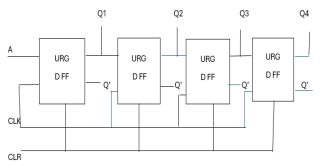
Specifications
Software Requirements
- Xilinx Vivado Design Suite (2020.2 or later)
- Verilog HDL for RTL design and implementation
- Vivado Simulator (XSIM) for functional and timing verification
Learning Outcomes
· Understand the fundamentals of reversible computing and its role in reducing energy dissipation
· Analyze the structure and functionality of optimized reversible logic gates such as Peres and URG
· Design reversible sequential circuits including flip-flops and shift registers
· Evaluate reversible circuits based on garbage outputs, constant inputs, and power dissipation
· Compare reversible logic implementations with traditional irreversible circuits
· Apply reversible logic concepts to build energy-efficient digital systems
.


Related Projects
 Paper Publishing

Request Call Back
Would you like to receive a free callback now?
Choose the best time for callback:
Leave your message and we will contact you as soon as possible

6-2-85/B, Old Maternity Hospital Road, Thyagaraja Nagar, Tirupati, Andhra Pradesh – 517501
+91 9030333433
+91 9393939065
0877-2261612

Disclaimer - Takeoff Edu Group Projects are not associated or affiliated with IEEE in any way. The IEEE Projects mentioned here are mentioned in the context of student projects, whose ideas are derived from IEEE publications, not projects of or by IEEE.

