Product Reviews
Objective
Product reviews primarily Machine Learning to provide consumers with insights and opinions on products, helping them make informed purchasing decisions. They offer an understanding of a product's quality, functionality, and value, fostering trust and transparency between buyers and sellers.
Abstract
With the rapid rise of e-commerce, a big number of products are being sold online, and a growing number of people are making purchases online. People provide feedback on products purchased in the form of reviews when shopping. User-generated product and service reviews are widely available on the internet. We employ emotive analysis to extract the required info from the vast amount of material available on the internet. Sentiment analysis uses the notion of natural language processing to extract abstract and to-the-point information for source materials. It is used to deal with the identification and consolidation of client feedback. These reviews are extremely important in assessing potential customers for products as well as market trends. This document presents an overview of product reviews by categorizing them as good, negative, or neutral. The amount of information available on the internet is enormous. Because reviews are highly unstructured, machine learning algorithms such as nave Bayes and support vector machine algorithms are used. These algorithms take unstructured product reviews as inputs, perform preprocessing, calculate polarity of reviews, extract features on which comments are made, and plot a graph for the result. Finally, the algorithms' precision, recall, and accuracy are assessed.
NOTE: Without the concern of our team, please don't submit to the college. This Abstract varies based on student requirements.
Block Diagram
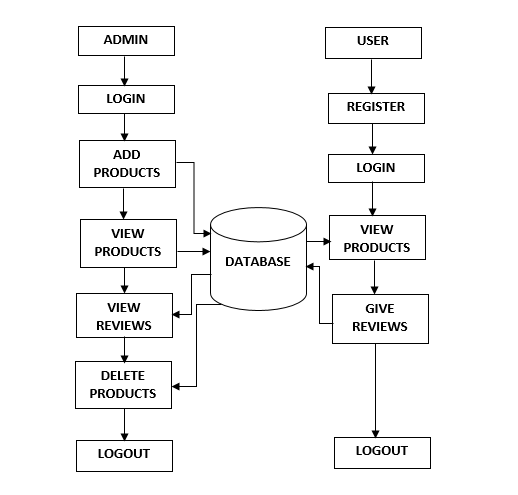
Specifications
SYSTEM SPECIFICATIONS
HARDWARE SPECIFICATIONS:
Processor: I3/Intel Processor
RAM : 4GB (min)
Hard Disk: 128 GB
Key Board: Standard Windows Keyboard
Mouse : Two or Three Button Mouse
Monitor : Any
SOFTWARE SPECIFICATIONS:
Operating System: Windows 7+
Server-side Script: Python 3.6+
IDE : PyCharm IDE
Libraries Used : Pandas, Numpy, Scikit-Learn
Framework :Flask
Data Base :MySql


Related Projects
 Paper Publishing

Request Call Back
Would you like to receive a free callback now?
Choose the best time for callback:
Leave your message and we will contact you as soon as possible

6-2-85/B, Old Maternity Hospital Road, Thyagaraja Nagar, Tirupati, Andhra Pradesh – 517501
+91 9030333433
+91 9393939065
0877-2261612

Disclaimer - Takeoff Edu Group Projects are not associated or affiliated with IEEE in any way. The IEEE Projects mentioned here are mentioned in the context of student projects, whose ideas are derived from IEEE publications, not projects of or by IEEE.

