Privacy Preserving Public Auditing Protocol for Regenerating Code Based Cloud
Objective
To critically evaluate the security measures of privacy-preserving public auditing protocol for regenerating-code-based cloud storage, identify its vulnerabilities, particularly concerning the proxy's ability to falsely authenticate data blocks, and offer insights that can guide the development of more secure and robust public auditing protocols in future cloud computing applications.
Abstract
Public auditing protocol is crucial for the success of cloud computing, as it can ensure the outsourced data in cloud server are not tampered by attackers. Due to its importance, public auditing protocol has received considerable attention in the past years. In 2015, Liu et al. proposed a privacy-preserving public auditing protocol for regenerating-code-based cloud storage and claimed it is secure under the considered security model. However, in this article, we will show that their protocol is not as secure as they claimed, i.e., the proxy delegated by the data owner can forge an authenticator for any data block, which obviously invalidates their protocol’s security. We hope that by identifying the design flaw, similar weaknesses can be avoided in future protocol design
Key words : Public auditing, Cloud computing, Privacy-preserving, Regenerating code, Proxy delegation, Authenticator, Security flaw
NOTE: Without the concern of our team, please don't submit to the college. This Abstract varies based on student requirements.
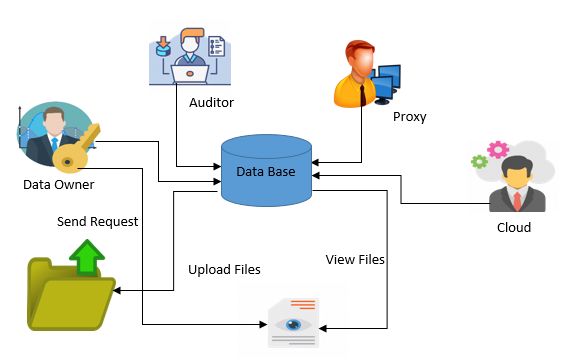
Block Diagram
Specifications
Hardware CONFIGURATION:
· Processor - I3/Intel Processor
· Hard Disk -160GB
· Key Board - Standard Windows Keyboard
· Mouse - Two or Three Button Mouse
· Monitor - SVGA
· RAM - 4Gb
Software CONFIGURATION:
• Operating System : Windows 7/8/10
• Server side Script : Python, HTML, MYSQL, CSS, Bootstrap.
• Libraries : PANDAS, DjangoIDE, PyCharm
• Technology : Python 3.6+


Related Projects
 Paper Publishing

Request Call Back
Would you like to receive a free callback now?
Choose the best time for callback:
Leave your message and we will contact you as soon as possible

6-2-85/B, Old Maternity Hospital Road, Thyagaraja Nagar, Tirupati, Andhra Pradesh – 517501
+91 9030333433
+91 9393939065
0877-2261612

Disclaimer - Takeoff Edu Group Projects are not associated or affiliated with IEEE in any way. The IEEE Projects mentioned here are mentioned in the context of student projects, whose ideas are derived from IEEE publications, not projects of or by IEEE.

