Prediction of Solid waste generation using deep learning and transfer learning techniques
Objective
The primary objective of this study is to explore the effectiveness of machine learning algorithms in the prediction and early detection of Autism Spectrum Disorder (ASD). This research aims to implement and evaluate various algorithms, including XGBoost, Random Forest, LSTM, Support Vector Machines (SVM), and Stacking Classifiers, to determine the most accurate, efficient, and reliable model for ASD prediction. Through this, the goal is to enhance the identification of ASD-related patterns and improve diagnostic methods, ultimately leading to better early interventions.
Abstract
PREDICTION OF SOLID WASTE GENERATION USING DEEP LEARNING AND TRANSFER LEARNING TECHNIQUES
ABSTRACT
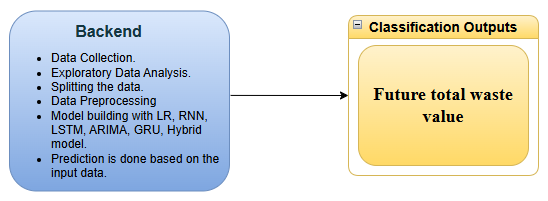
The goal of this project is to develop a predictive model to forecast the Total Waste generated based on various waste categories over time. The dataset contains key columns such as Date, Silt, Weed Waste, Wet Waste, Dry Waste, Tender Coconut, Sanitary Waste, Chicken Waste, Mutton, Fish & Other Waste, and Mixed Waste, with the target variable being Total Waste. This project aims to predict future trends in waste generation using a combination of advanced machine learning techniques, including Long Short-Term Memory (LSTM), Linear Regression, Recurrent Neural Networks (RNN), ARIMA/SARIMA, Gated Recurrent Units (GRU), and a Hybrid model of LSTM & GRU. The models will be trained on historical data to capture temporal patterns and trends in the waste generation process. The expected output of this study will be a forecasted graph showing the predicted Total Waste over future time periods, providing valuable insights for waste management planning and sustainability efforts.
Keywords: predictive model, Total Waste, waste categories, time series, LSTM, Linear Regression, RNN, ARIMA/SARIMA, GRU, Hybrid model, temporal patterns, waste generation, sustainability, waste management planning, machine learning, future trends.
NOTE: Without the concern of our team, please don't submit to the college. This Abstract varies based on student requirements.
Block Diagram
Specifications
Hardware Requirements
Processor - I3/Intel Processor
Hard Disk - 160GB
Key Board - Standard Windows Keyboard
Mouse - Two or Three Button Mouse
Monitor - SVGA
RAM - 8GB
Software Requirements
• Operating System : Windows 7/8/10
• Programming Language : Python
• Libraries : Pandas, Numpy, scikit-learn.
• IDE/Workbench : Visual Studio Code.


Related Projects
 Paper Publishing

Request Call Back
Would you like to receive a free callback now?
Choose the best time for callback:
Leave your message and we will contact you as soon as possible

6-2-85/B, Old Maternity Hospital Road, Thyagaraja Nagar, Tirupati, Andhra Pradesh – 517501
+91 9030333433
+91 9393939065
0877-2261612

Disclaimer - Takeoff Edu Group Projects are not associated or affiliated with IEEE in any way. The IEEE Projects mentioned here are mentioned in the context of student projects, whose ideas are derived from IEEE publications, not projects of or by IEEE.

