Predicting customer purchase behaviour
Objective
The primary objective of this project is to develop a robust and accurate predictive model that classifies customers into three distinct purchasing behavior categories rare, occasional, and frequent based on their demographic and behavioral data. The project uses supervised machine learning algorithms, specifically Random Forest and XGBoost, to perform this classification.The goal is to leverage the information contained in features such as age, gender, income, education, loyalty status, promotion usage, and satisfaction score to determine the likelihood of a customer's purchasing behavior. By doing so, businesses can understand the dynamics of their customer base, improve customer segmentation, and design targeted marketing and loyalty strategies.
Abstract
This study aims to predict customer purchase behavior by classifying individuals into three categories: rare, occasional, and frequent buyers. Utilizing the "Customer Purchases Behaviour" dataset from Kaggle, we analyze key demographic and transactional features such as age, gender, income, education, region, loyalty status, purchase frequency, purchase amount, product category, promotion usage, and satisfaction score. These features provide crucial insights into customer behavior patterns. The primary objective is to build predictive models using Random Forest and XGBoost algorithms to classify the purchase behavior accurately. The dataset includes both categorical and numerical variables, allowing for a comprehensive evaluation of consumer patterns. Feature engineering, normalization, and model tuning are performed to optimize accuracy and performance. The classification outcome aids businesses in targeted marketing, loyalty strategies, and promotional planning. This predictive modeling approach supports data-driven decision-making in retail and e-commerce sectors by identifying high-value customers and tailoring engagement strategies effectively.
Keywords: Customer Purchase Behavior, Classification, Random Forest, XGBoost, Predictive Modeling, Consumer Analytics, Purchase Frequency, Retail Strategy, Data Mining, Machine Learning, Loyalty Status, Promotion Usage, Satisfaction Score.
NOTE: Without the concern of our team, please don't submit to the college. This Abstract varies based on student requirements.
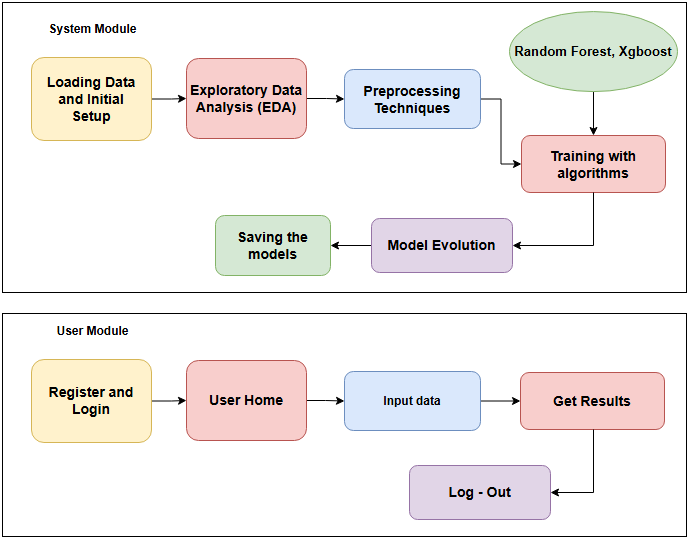
Block Diagram
Specifications
Hardware Requirements
Processor - I3/Intel Processor
Hard Disk - 160GB
Key Board - Standard Windows Keyboard
Mouse - Two or Three Button Mouse
Monitor - SVGA
RAM - 8GB
Software Requirements:
Operating System : Windows 7/8/10
Server side Script : HTML, CSS, Bootstrap & JS
Programming Language : Python
Libraries : Flask/Django, Pandas, Mysql.connector, Os, Smtplib, Numpy
IDE/Workbench : PyCharm
Technology : Python 3.6+
Server Deployment : Xampp Server
Database : MySQL


Related Projects
 Paper Publishing

Request Call Back
Would you like to receive a free callback now?
Choose the best time for callback:
Leave your message and we will contact you as soon as possible

6-2-85/B, Old Maternity Hospital Road, Thyagaraja Nagar, Tirupati, Andhra Pradesh – 517501
+91 9030333433
+91 9393939065
0877-2261612

Disclaimer - Takeoff Edu Group Projects are not associated or affiliated with IEEE in any way. The IEEE Projects mentioned here are mentioned in the context of student projects, whose ideas are derived from IEEE publications, not projects of or by IEEE.

