Political Tweets Analysis in The Domain of Natural Language Processing
Objective
The objective of this project is to employ Natural Language Processing (NLP) techniques to analyze political tweets. Through sentiment analysis, topic modeling, and trend identification, we aim to gain insights into public opinion, political discourse, and emerging issues in the political landscape, enabling a deeper understanding of social and political dynamics on digital platforms.
Abstract
In an era marked by unprecedented digital engagement, social media platforms have become pivotal arenas for political discourse. This study delves into the realm of Natural Language Processing (NLP) to analyze political tweets, offering a comprehensive exploration of sentiment, sentiment shifts, and trending topics. By harnessing cutting-edge NLP techniques, this research uncovers the complex interplay of language, emotions, and political ideologies in the digital sphere. Our approach begins with data collection and preprocessing, including the extraction of tweets from diverse sources. Leveraging state-of-the-art NLP models, sentiment analysis unveils the emotional undertones of political discourse, shedding light on the dynamics of public opinion. Additionally, sentiment shift analysis tracks temporal changes in sentiment to capture evolving perspectives.
Furthermore, this study employs topic modeling to identify key political themes, discourse patterns, and emerging trends. It also explores the impact of user demographics and geographic location on tweet content and sentiment. By merging quantitative and qualitative methodologies, this research offers valuable insights into the complexities of political communication in the digital age. The findings not only enrich our understanding of political discourse but also provide a foundation for data-driven decision-making in politics, policy formulation, and election campaigns. In an era where tweets hold the power to shape public opinion and influence political landscapes, this study contributes to the evolving field of NLP, illuminating the intricate tapestry of politics woven through the fabric of social media.
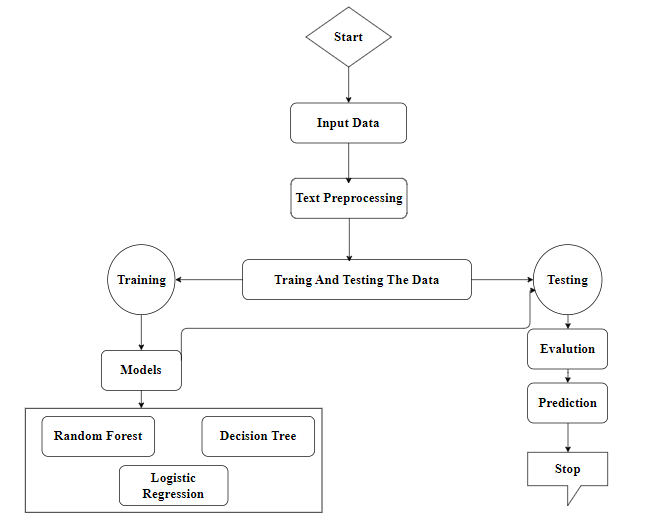
Keywords: Decision Tree, Random Forest and Logistic Regression.
NOTE: Without the concern of our team, please don't submit to the college. This Abstract varies based on student requirements.
Block Diagram
Specifications
H/W CONFIGURATION:
Processor - I3/Intel Processor
Hard Disk - 160GB
Key Board - Standard Windows Keyboard
Mouse - Two or Three Button Mouse
Monitor - SVGA
RAM - 8GB
S/W CONFIGURATION:
Operating System : Windows 7/8/10
Server side Script : HTML, CSS, Bootstrap & JS
Programming Language : Python
Libraries : Flask, Pandas, Mysql.connector, Os, Smtplib, Numpy
IDE/Workbench : PyCharm
Technology : Python 3.6+
Server Deployment : Xampp Server


Related Projects
 Paper Publishing

Request Call Back
Would you like to receive a free callback now?
Choose the best time for callback:
Leave your message and we will contact you as soon as possible

6-2-85/B, Old Maternity Hospital Road, Thyagaraja Nagar, Tirupati, Andhra Pradesh – 517501
+91 9030333433
+91 9393939065
0877-2261612

Disclaimer - Takeoff Edu Group Projects are not associated or affiliated with IEEE in any way. The IEEE Projects mentioned here are mentioned in the context of student projects, whose ideas are derived from IEEE publications, not projects of or by IEEE.

