PneuXNet An Enhanced Feature Extraction and Transformation Approach for Pneumonia Detection
Objective
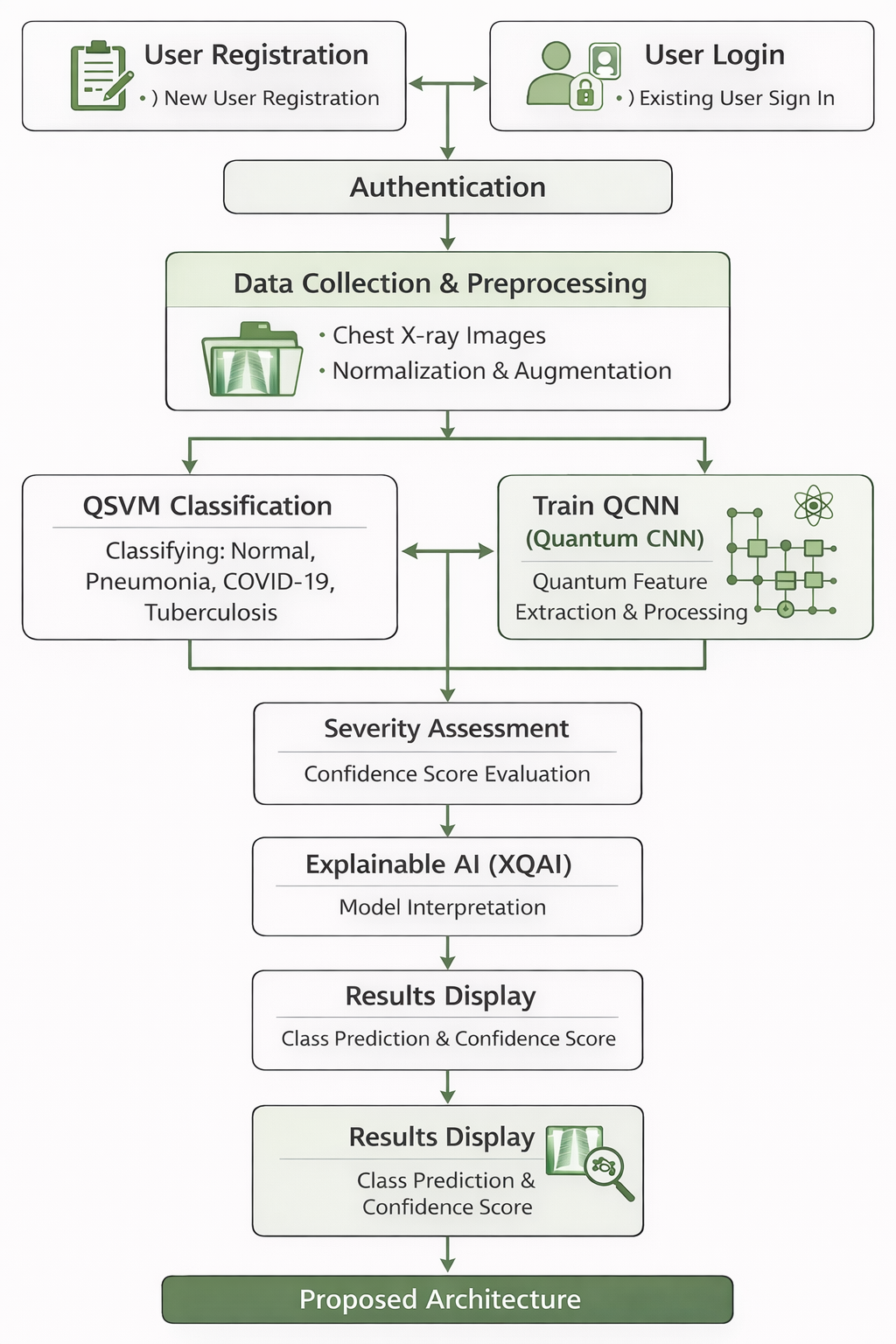
The primary objective of the Hybrid Quantum project is to develop a hybrid deep learning framework capable of classifying chest X-ray images into four distinct categories: Normal, Pneumonia, COVID-19, and Tuberculosis. This is achieved by combining Convolutional Neural Networks (CNN) for feature extraction with Quantum Support Vector Machine (QSVM) for classification. The CNN is responsible for automatically extracting spatial features such as lung structures and disease indicators from the X-ray images, while QSVM is utilized to classify these features into the appropriate categories, leveraging quantum computing for improved decision boundaries and faster convergence compared to traditional SVMs. Furthermore, Hybrid Quantum incorporates a severity assessment feature, which provides a confidence score for each prediction, helping healthcare professionals assess the reliability of the results. Additionally, the integration of Explainable Quantum AI (XQAI) ensures transparency and interpretability, allowing clinicians to trust and understand the model's reasoning. The aim is to create a comprehensive and efficient tool for respiratory disease detection and assessment.
Abstract
The rise of respiratory diseases such as Pneumonia, COVID-19, and Tuberculosis highlights the need for advanced, accurate diagnostic systems. This paper presents Hybrid Quantum, a novel hybrid deep learning framework designed for multi-class medical image classification and severity assessment. The system classifies chest X-ray images into four categories: Normal, Pneumonia, COVID-19, and Tuberculosis. The model combines Convolutional Neural Networks (CNN) for efficient feature extraction with Quantum Support Vector Machine (QSVM) for classification. CNN excels in automatically extracting relevant spatial features from X-ray images, such as lung structures and disease markers, using convolutional and pooling layers. QSVM is employed to perform the final classification, leveraging quantum computing principles to improve decision boundaries and speed up convergence compared to traditional SVMs. The framework also incorporates severity assessment by generating a confidence score for each classification, helping clinicians assess the certainty of the predictions. Furthermore, Explainable Quantum AI (XQAI) is integrated to enhance transparency and interpretability, allowing healthcare professionals to trust and understand the model's decision-making process. Initial results from testing on a diverse dataset of chest X-rays demonstrate promising classification accuracy and computational efficiency. This hybrid model presents significant potential for real-time clinical decision support and paves the way for future advancements in AI and quantum computing integration for healthcare applications.
Keywords: Multi-class classification, Convolutional Neural Networks (CNN), Quantum Support Vector Machine (QSVM), Explainable Quantum AI (XQAI), Pneumonia, COVID-19, Tuberculosis, Chest X-ray, Severity assessment, Prognosis prediction, Deep learning, Quantum computing, Medical image classification, AI in healthcare, Quantum-enhanced classification, Diagnostic systems.NOTE: Without the concern of our team, please don't submit to the college. This Abstract varies based on student requirements.
Block Diagram
Specifications
4.1 SOFTWARE REQUIREMENS
Operating System : Windows 7/8/10
Server side Script : HTML, CSS, Bootstrap & JS
Programming Language : Python
Libraries Flask, Pandas, Torch, Keras, Sklearn, Numpy , Seaborn
IDE/Workbench : VSCode
Server Deployment : Xampp Server
Database : MySQL
4.2 HARDWARE REQUIREMENTS
Processor - I3/Intel Processor
RAM - 8GB (min)
Hard Disk - 128 GB
Key Board - Standard Windows Keyboard
Mouse - Two or Three Button Mouse
Monitor - Any

Demo Video


Request for Video
Related Projects
 Paper Publishing
Request Call Back
Would you like to receive a free callback now?
Choose the best time for callback:
Leave your message and we will contact you as soon as possible

6-2-85/B, Old Maternity Hospital Road, Thyagaraja Nagar, Tirupati, Andhra Pradesh – 517501
+91 9030333433
+91 9393939065
0877-2261612

Disclaimer - Takeoff Edu Group Projects are not associated or affiliated with IEEE in any way. The IEEE Projects mentioned here are mentioned in the context of student projects, whose ideas are derived from IEEE publications, not projects of or by IEEE.

