Performance of Hybrid Stacking and Bagging Methods Based on Machine Learning Algorithms in the Classification of Dengue Fever Incidence Rate
Objective
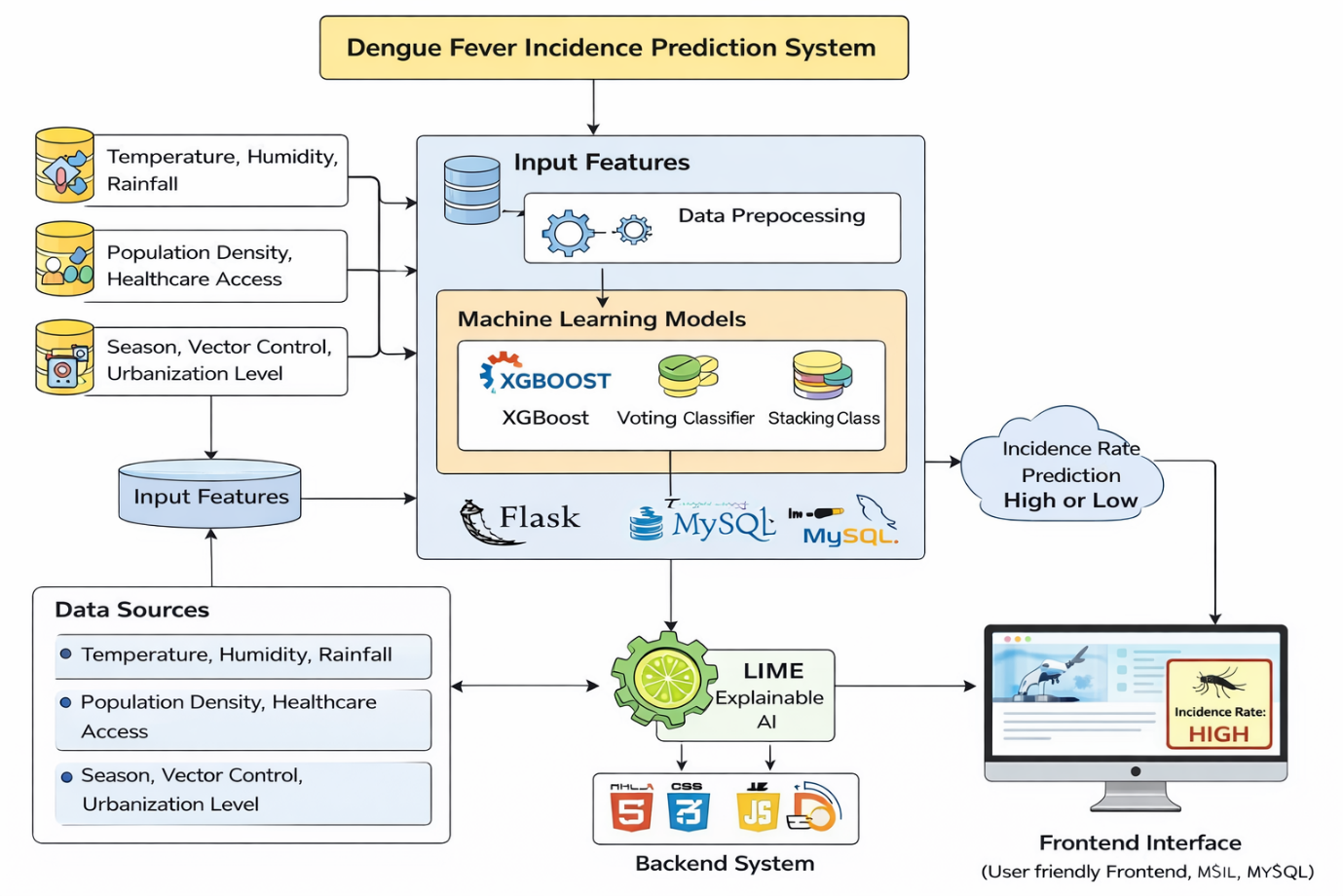
The objective of this project is to develop a machine learning-based system to accurately classify dengue fever incidence rates as High or Low based on environmental, demographic, and healthcare-related factors. The system leverages key input features such as temperature, humidity, rainfall, reported cases, population density, season, vector control measures, urbanization level, and healthcare access to build a robust predictive model. Multiple algorithms, including XGBoost and ensemble techniques such as Voting and Stacking classifiers, are implemented to improve prediction accuracy and reliability. Explainable AI techniques like LIME are integrated to provide transparency and interpretability of model decisions. Finally, a user-friendly web application is developed using Flask, HTML, CSS, and MySQL to enable efficient prediction, visualization, and analysis of dengue incidence rates.
Abstract
This project focuses on predicting the incidence rate of Dengue fever in a specific region, categorized as either high or low. By utilizing machine learning techniques, such as SVM, XGBoost, and ensemble models like Voting and Stacking classifiers, the system processes various input parameters such as temperature, humidity, rainfall, reported cases, population density, season, vector control, urbanization level, and healthcare access. These features play a vital role in determining the severity of dengue fever incidence. To further enhance transparency, the model employs LIME for explainable AI, allowing users to understand how specific features impact predictions. The project is developed with a Flask backend and MySQL database, with a user-friendly frontend built using HTML, CSS, and JavaScript. By automating the prediction of dengue fever incidence, this system aims to assist healthcare professionals and policymakers in resource allocation and preventive measures.
Keywords: Dengue Fever, Incidence Rate Prediction , Machine Learning , SVM , XGBoost, Ensemble Models , Stacking Classifier , Voting Classifier , Explainable AI , LIME , Flask, MySQL
NOTE: Without the concern of our team, please don't submit to the college. This Abstract varies based on student requirements.
Block Diagram
Specifications
Hardware Requirements
Processor - I3/Intel Processor
Hard Disk - 160GB
Key Board - Standard Windows Keyboard
Mouse - Two or Three Button Mouse
Monitor - SVGA
RAM - 8GB
Software Requirements:
Operating System : Windows 7/8/10
Server side Script : HTML, CSS, Bootstrap & JS
Programming Language : Python
Libraries : Django, Pandas, NumPy, TensorFlow, Scikit-learn.
IDE/Workbench : VS Code
Technology : Python 3.10
Database : SQLite


Related Projects
 Paper Publishing

Request Call Back
Would you like to receive a free callback now?
Choose the best time for callback:
Leave your message and we will contact you as soon as possible

6-2-85/B, Old Maternity Hospital Road, Thyagaraja Nagar, Tirupati, Andhra Pradesh – 517501
+91 9030333433
+91 9393939065
0877-2261612

Disclaimer - Takeoff Edu Group Projects are not associated or affiliated with IEEE in any way. The IEEE Projects mentioned here are mentioned in the context of student projects, whose ideas are derived from IEEE publications, not projects of or by IEEE.

