Operational Performance Assessment of PV-Powered Street Lighting A Comparative Study of Different Machine Learning Prediction Models
Objective
This project aims to optimize the performance of photovoltaic (PV)-powered street lighting systems by leveraging machine learning prediction models. It compares Hybrid Models (Linear Regression + Random Forest), CatBoost Regressor, and XGBoost Regressor to predict the efficiency and energy consumption of the systems based on factors like traffic density, ambient light, weather conditions, and geographical location. The system uses Flask for the web framework, with joblib for model deployment and MySQL for database management. The project provides actionable insights to optimize energy consumption, helping to create sustainable and efficient street lighting solutions through predictive analytics.
Abstract
This project aims to assess the operational performance of photovoltaic (PV)-powered street lighting systems using machine learning prediction models. The study focuses on comparing the performance of various algorithms, including Hybrid Models (Linear Regression and Random Forest), CatBoost Regressor, and XGBoost Regressor, to predict the efficiency and energy consumption of PV-powered street lighting. By utilizing environmental and operational data such as traffic density, ambient light, weather conditions, power state, and geographical location, the system evaluates the sustainability and efficiency of these lighting systems. Data is uploaded via a user-friendly interface, and the models are evaluated on performance metrics such as Mean Absolute Error (MAE), Mean Squared Error (MSE), Root Mean Squared Error (RMSE), and R² Score. The predictive capabilities of the models are used to provide actionable insights for optimizing energy consumption, helping to improve the sustainability of street lighting systems. The project uses Flask as the web framework, with joblib for model deployment and MySQL for database management. The end goal is to enable more efficient and environmentally friendly street lighting solutions by leveraging machine learning for performance assessment and prediction.
Keywords:
Photovoltaic, Street Lighting, Machine Learning, Prediction Models, Hybrid Model, CatBoost, XGBoost, Energy Efficiency, Sustainability, Flask, Model Evaluation, Performance Metrics.
NOTE: Without the concern of our team, please don't submit to the college. This Abstract varies based on student requirements.
Block Diagram
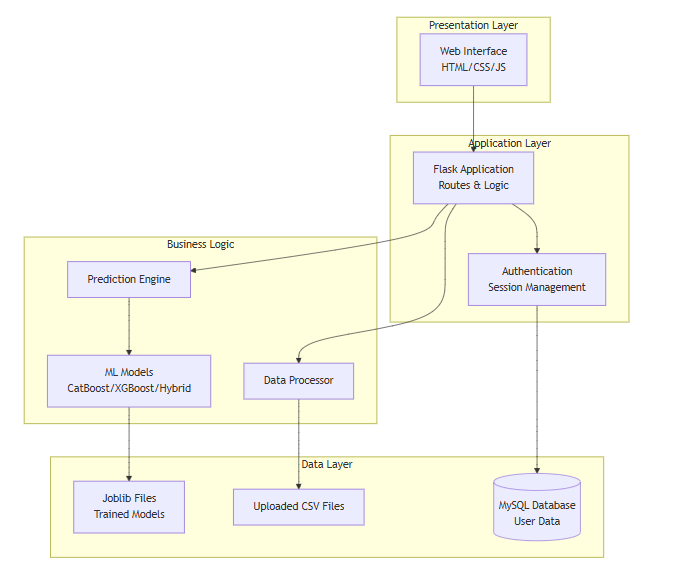
Specifications
SOFTWARE REQUIREMENS
Operating System : Windows 7/8/10
Server side Script : HTML, CSS, Bootstrap & JS
Programming Language : Python
Libraries : Flask, Pandas, Torch, Keras, Sklearn, Numpy , Seaborn
IDE/Workbench : VSCODE
Server Deployment : Xampp Server
Database : MySQL
HARDWARE REQUIREMENTS
Processor - I3/Intel Processor
RAM - 8GB (min)
Hard Disk - 128 GB
Key Board - Standard Windows Keyboard
Mouse - Two or Three Button Mouse
Monitor - Any


Related Projects
 Paper Publishing

Request Call Back
Would you like to receive a free callback now?
Choose the best time for callback:
Leave your message and we will contact you as soon as possible

6-2-85/B, Old Maternity Hospital Road, Thyagaraja Nagar, Tirupati, Andhra Pradesh – 517501
+91 9030333433
+91 9393939065
0877-2261612

Disclaimer - Takeoff Edu Group Projects are not associated or affiliated with IEEE in any way. The IEEE Projects mentioned here are mentioned in the context of student projects, whose ideas are derived from IEEE publications, not projects of or by IEEE.

