Online Recruitment Fraud (ORF) Detection Using Deep Learning Approaches
Objective
The primary objective of this project is to develop an advanced deep learning-based system for detecting fraudulent job postings on online recruitment platforms. By leveraging state-of-the-art models such as GPT-2, XLNet, and LSTM, the system aims to accurately differentiate between genuine and fraudulent job listings.
Abstract
Online Recruitment Fraud (ORF) Detection Using Deep Learning Approaches
ABSTRACT:
Online recruitment platforms have revolutionized job searching, but they also present significant challenges due to the rise in fraudulent job postings that deceive job seekers and lead to financial and personal harm. This study proposes an advanced deep learning-based approach to detecting online recruitment fraud (ORF). The research utilizes the publicly available Fake Job Posting Prediction dataset, which contains real and fraudulent job postings, for training and evaluation. Existing models such as BERT and RoBERTa have demonstrated strong performance in text classification tasks. However, to further enhance accuracy and robustness, we introduce a hybrid approach leveraging GPT-2, XLNet, and LSTM. GPT-2 and XLNet, with their transformer-based architectures, are employed to capture contextual and semantic relationships in job descriptions, while LSTM is used for sequential pattern learning to improve fraud detection. The system is designed to effectively distinguish between real and fraudulent job postings, minimizing false positives and false negatives. The performance of the proposed models is evaluated using standard classification metrics such as accuracy, precision, recall, and F1-score. Experimental results indicate that our approach significantly improves ORF detection, offering a reliable solution to safeguard job seekers from fraudulent employment opportunities. This research contributes to enhancing trust and security in online recruitment platforms.
Keywords: Online Recruitment Fraud Detection, Deep Learning, GPT-2, XLNet, LSTM
NOTE: Without the concern of our team, please don't submit to the college. This Abstract varies based on student requirements.
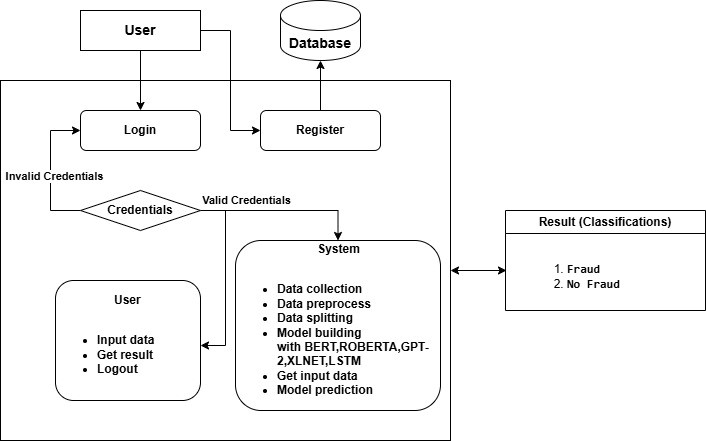
Block Diagram
Specifications
Hardware Requirements
Operating system : Windows 7 or 7+
RAM : 8 GB
Hard disc or SSD : More than 500 GB
Processor : Intel 3rd generation or high or Ryzen with 8 GB Ram
Software Requirements:
Software’s : Python 3.10 or high version
IDE : Visual Studio Code.
Framework : Flask
IDE/Workbench : PyCharm
Technology : Python 3.6+
Server Deployment : Xampp Server
Database : MySQL


Related Projects
 Paper Publishing

Request Call Back
Would you like to receive a free callback now?
Choose the best time for callback:
Leave your message and we will contact you as soon as possible

6-2-85/B, Old Maternity Hospital Road, Thyagaraja Nagar, Tirupati, Andhra Pradesh – 517501
+91 9030333433
+91 9393939065
0877-2261612

Disclaimer - Takeoff Edu Group Projects are not associated or affiliated with IEEE in any way. The IEEE Projects mentioned here are mentioned in the context of student projects, whose ideas are derived from IEEE publications, not projects of or by IEEE.

