Mortality rate of human detection using decision tree
Objective
The Machine Learning objective of detecting human mortality rate using a decision tree is to categorize individuals into risk groups by analyzing various health-related attributes. By creating structured rules, in understanding the key factors contributing to mortality, facilitating early intervention, better healthcare planning, and potentially improving life expectancy.
Abstract
The study aims to develop a decision tree-based model for detecting the morality rate of humans, addressing the ethical considerations associated with mortality prediction. The model utilizes a decision tree algorithm to analyze a comprehensive set of factors and features derived from a diverse dataset comprising individual attributes, medical histories, lifestyle factors, and socio-demographic information. The decision tree algorithm is employed due to its ability to handle both numerical and categorical data, making it suitable for capturing complex relationships between variables. The dataset used for model training and evaluation is sourced from a large-scale population-based study, encompassing a wide range of subjects across different age groups, geographical locations, and socio-economic backgrounds. The developed decision tree model aims to provide accurate predictions regarding the mortality rate of individuals, thereby enabling timely intervention and targeted healthcare interventions. Ethical considerations related to privacy, data protection, and consent are carefully addressed throughout the study, ensuring compliance with established regulations and guidelines. The performance of the decision tree model is assessed using various evaluation metrics, including accuracy, precision, recall, and F1 score, using cross-validation techniques. The results obtained from the evaluation demonstrate the effectiveness of the decision tree-based approach in detecting mortality rates, offering valuable insights for healthcare professionals, policymakers, and researchers.
KEYWORDS: morality dataset, decision trees,
NOTE: Without the concern of our team, please don't submit to the college. This Abstract varies based on student requirements.
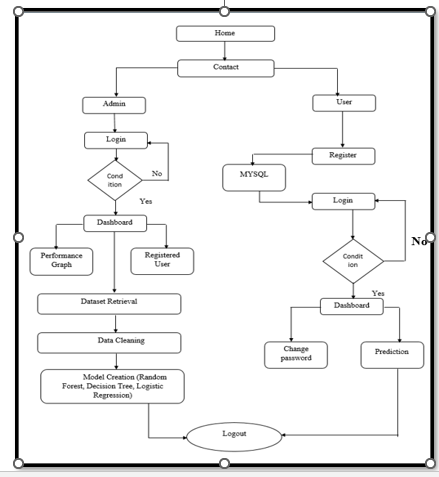
Block Diagram
Specifications
Hardware:
Operating system : Windows 7 or 7+
RAM : 8 GB
Hard disc or SSD : More than 500 GB
Processor : Intel 3rd generation or high or Ryzen with 8 GB Ram
Software:
Software’s : Python 3.6 or high version
IDE: PyCharm.
Framework : Django


Related Projects
 Paper Publishing

Request Call Back
Would you like to receive a free callback now?
Choose the best time for callback:
Leave your message and we will contact you as soon as possible

6-2-85/B, Old Maternity Hospital Road, Thyagaraja Nagar, Tirupati, Andhra Pradesh – 517501
+91 9030333433
+91 9393939065
0877-2261612

Disclaimer - Takeoff Edu Group Projects are not associated or affiliated with IEEE in any way. The IEEE Projects mentioned here are mentioned in the context of student projects, whose ideas are derived from IEEE publications, not projects of or by IEEE.

