ML Based Crop Yield Prediction System Using Multi Feature Agricultural Data
Objective
The primary objective of this project is to develop an efficient and reliable crop yield prediction system using machine learning techniques. The project aims to collect and preprocess various agricultural data, including factors such as soil type, rainfall, temperature, fertilizer usage, and irrigation methods, to ensure accurate model training. Once the data is processed, multiple machine learning models like SVM Regressor, Random Forest Regressor, XGBoost, and ANN will be trained to predict crop yields. The best-performing model will then be integrated into a web-based application built using the Flask framework for the back-end, and HTML, CSS, and JavaScript for the front-end. This application will allow users to input agricultural data and receive real-time predictions about crop yield, with secure access and user management features such as registration and login. The models will be evaluated for accuracy using metrics like Mean Absolute Error (MAE) and R-squared (R²) to ensure the reliability of the predictions.
Abstract
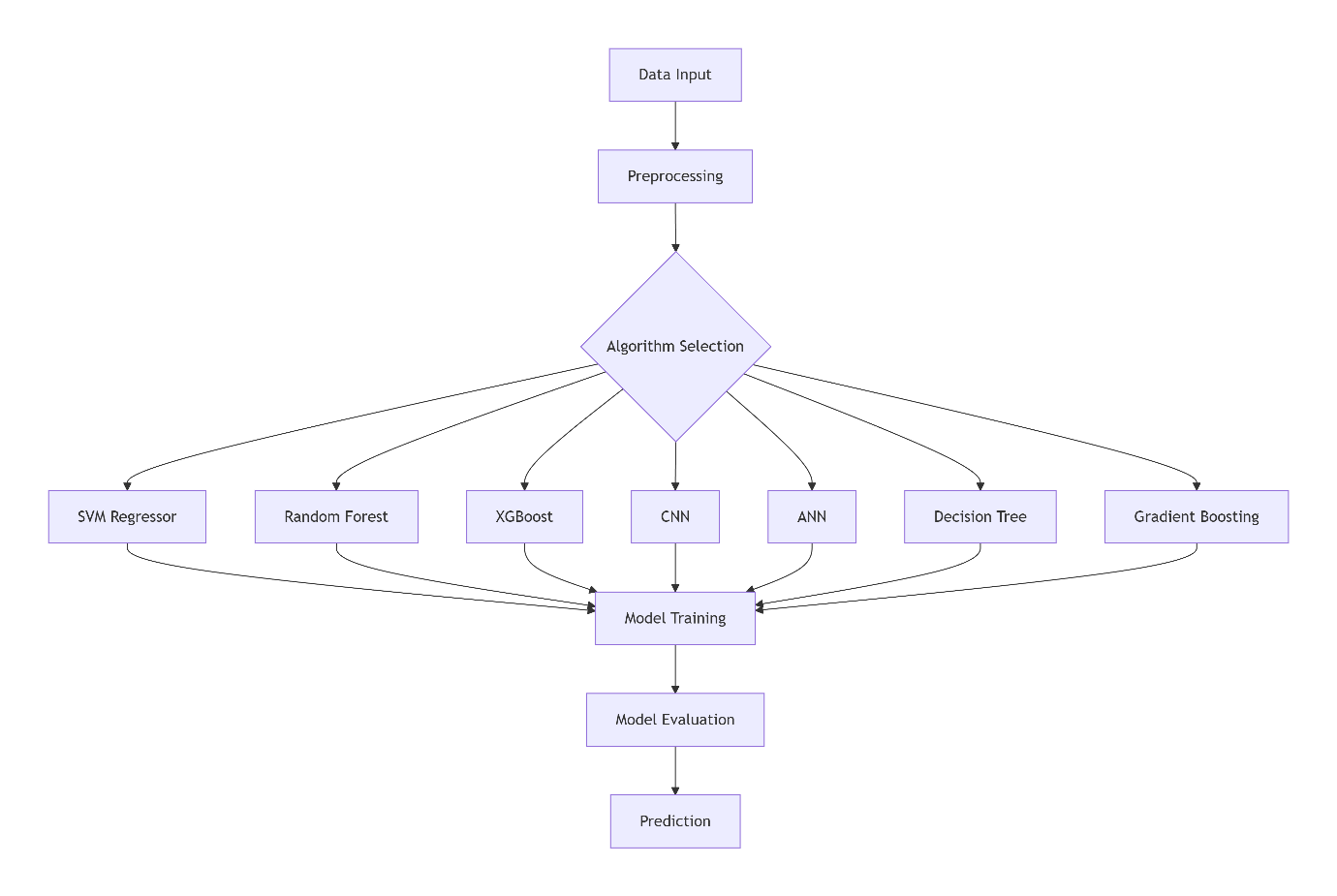
The ML-Based Crop Yield Prediction System aims to provide accurate crop yield predictions by utilizing machine learning techniques on agricultural data. The system incorporates various features, such as soil type, weather conditions, rainfall, temperature, fertilizer usage, and irrigation practices, which are known to affect crop growth and productivity. Several machine learning models, including SVM Regressor, Random Forest Regressor, XGBoost Regressor, Convolutional Neural Networks (CNN), Artificial Neural Networks (ANN), Decision Tree, and Gradient Boosting Regressor, are employed to analyze the data and make reliable predictions. These models are trained using historical agricultural data to predict crop yields based on input parameters, helping agricultural planners, farmers, and researchers optimize their crop management strategies.
The system is developed using the Flask framework for the backend, and HTML, CSS, and JavaScript are used to design the front-end interface. The user-friendly application allows users to input various agricultural data points and receive accurate crop yield predictions accurately. By providing a tool that combines data science with agricultural expertise, this project aims to enhance decision-making processes, improve resource allocation, and increase crop productivity. The predictions provided by the system help optimize farming practices, making the process more efficient and sustainable, and ultimately improving food security.
Keywords: Crop yield prediction, Machine learning, SVM Regressor, Random Forest, XGBoost, CNN, ANN, Decision Tree, Gradient Boosting, Flask.
NOTE: Without the concern of our team, please don't submit to the college. This Abstract varies based on student requirements.
Block Diagram
Specifications
HARDWARE REQUIREMENTS
• Processor - I5/Intel Processor
• RAM - 8GB (min)
• Hard Disk - 160 GB
• Key Board - Standard Windows Keyboard
• Mouse - Two or Three Button Mouse
• Monitor - Any
SOFTWARE REQUIREMENS
• Operating System : Windows 7/8/10
• Server side Script : HTML, CSS, Bootstrap & JS
• Programming Language : Python
• Libraries : Flask, Pandas, Mysql.connector, Os, Numpy,
Scikit-learn.
• IDE/Workbench : VS-Code
• Technology : Python 3.10+
• Server Deployment : Xampp Server
• Database : MySQL

Demo Video


Request for Video
Related Projects
 Paper Publishing
Request Call Back
Would you like to receive a free callback now?
Choose the best time for callback:
Leave your message and we will contact you as soon as possible

6-2-85/B, Old Maternity Hospital Road, Thyagaraja Nagar, Tirupati, Andhra Pradesh – 517501
+91 9030333433
+91 9393939065
0877-2261612

Disclaimer - Takeoff Edu Group Projects are not associated or affiliated with IEEE in any way. The IEEE Projects mentioned here are mentioned in the context of student projects, whose ideas are derived from IEEE publications, not projects of or by IEEE.

