Machine Learning in Ambient Assisted Living for Enhanced Elderly Healthcare
Objective
The objective of this project is to enhance elderly healthcare within Ambient Assisted Living (AAL) environments using machine learning and real-time physiological monitoring. By analyzing vital signs such as heart rate, blood pressure, glucose, and SpO?, the system aims to detect abnormal patterns and automatically trigger alerts for timely caregiver intervention. The approach integrates threshold-based logic with intelligent predictive models, explainable AI, and multimodal sensor fusion to ensure accurate, transparent, and proactive care. Additionally, the project addresses ethical concerns by promoting privacy-preserving techniques and responsible AI usage, enabling elderly individuals to live independently with safety, dignity, and continuous health support.
Abstract
The integration of Machine Learning (ML) within Ambient Assisted Living (AAL) frameworks is revolutionizing elderly healthcare by enabling proactive, intelligent, and explainable support systems. This study utilizes a vital-sign monitoring dataset comprising real-time physiological parameters—Heart Rate, Blood Pressure, Glucose Levels, and SpO₂—paired with threshold-based alerts and caregiver notifications. Such data mirrors the core of AAL systems, which depend on IoT-based continuous monitoring to detect health anomalies. Our analysis reveals that alerts are typically triggered when one or more vitals exceed safe limits, prompting timely caregiver intervention. ML models are applied to predict emergency patterns, reducing response time and enhancing elder safety. Further, Explainable AI (XAI) methods are incorporated to elucidate decision-making, thereby increasing trust among users and caregivers—for instance, highlighting exact parameter breaches that led to alerts. Additionally, multimodal data fusion integrates diverse sensor inputs, ensuring accurate and context-aware health assessments. Generative AI (GenAI) is also considered for augmenting data diversity and powering personalized virtual assistants. Despite technological advancements, this work emphasizes the importance of ethical considerations and privacy preservation, given the sensitive nature of health data. Secure architectures, encryption, and consent-driven data governance are recommended. Ultimately, this study demonstrates that ML-enhanced AAL systems can deliver timely, explainable, and secure health monitoring solutions that support aging in place with autonomy and dignity.
Keywords: Ambient Assisted Living, Elderly Healthcare, Machine Learning, Real-time Monitoring, IoT, Explainable AI, Vital Signs, Generative AI, Privacy, Caregiver Alert System.
NOTE: Without the concern of our team, please don't submit to the college. This Abstract varies based on student requirements.
Block Diagram
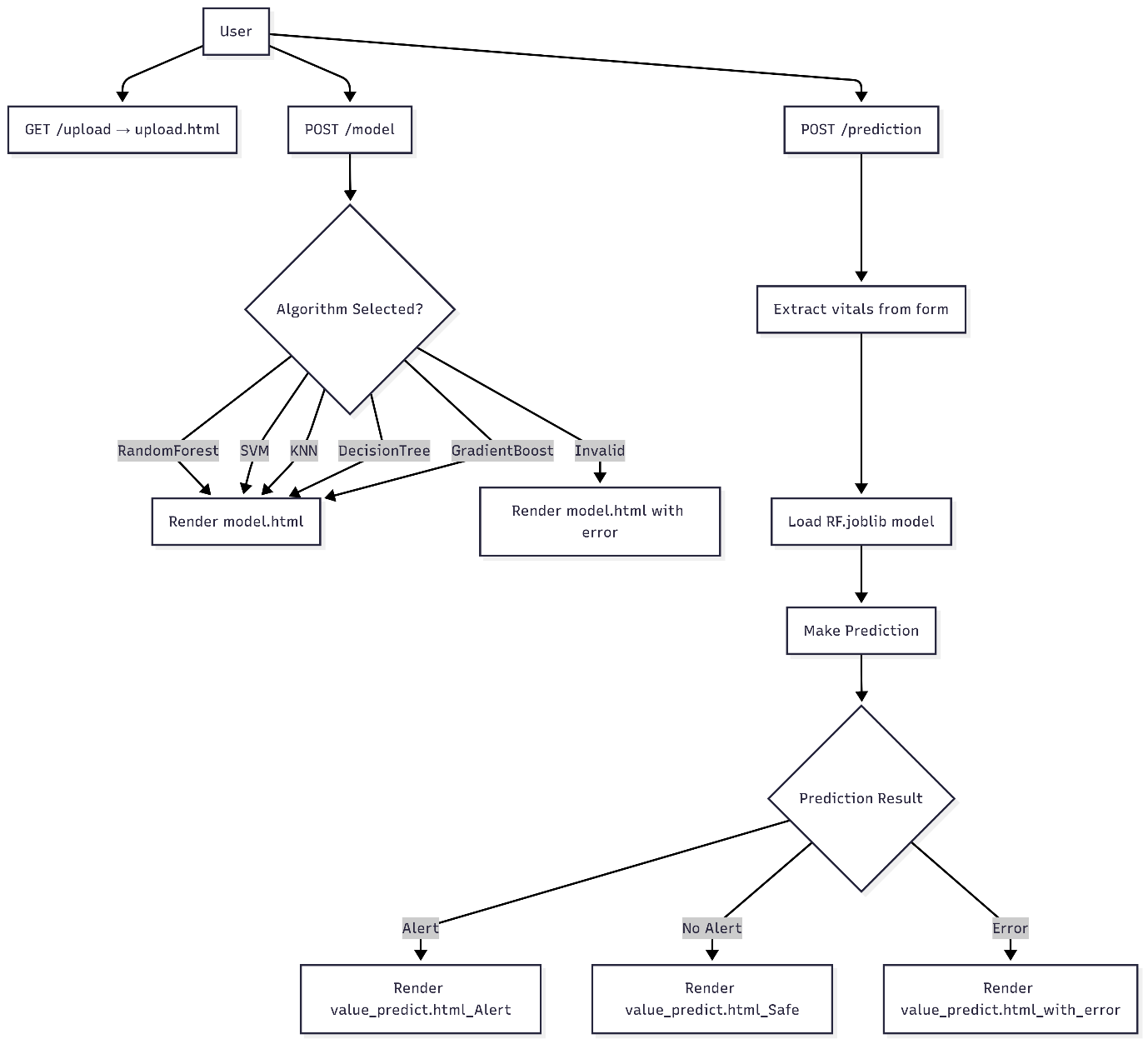
Specifications
SOFTWARE REQUIREMENS
Operating System : Windows 7/8/10
Server side Script : HTML, CSS, Bootstrap & JS
Programming Language : Python
Libraries Flask, Pandas, Torch, Keras, Sklearn,Numpy , Seaborn
IDE/Workbench : VSCode
Server Deployment : Xampp Server
Database : MySQL
HARDWARE REQUIREMENTS
Processor - I3/Intel Processor
RAM - 8GB (min)
Hard Disk - 128 GB
Key Board - Standard Windows Keyboard
Mouse - Two or Three Button Mouse
Monitor - Any


Related Projects
 Paper Publishing

Request Call Back
Would you like to receive a free callback now?
Choose the best time for callback:
Leave your message and we will contact you as soon as possible

6-2-85/B, Old Maternity Hospital Road, Thyagaraja Nagar, Tirupati, Andhra Pradesh – 517501
+91 9030333433
+91 9393939065
0877-2261612

Disclaimer - Takeoff Edu Group Projects are not associated or affiliated with IEEE in any way. The IEEE Projects mentioned here are mentioned in the context of student projects, whose ideas are derived from IEEE publications, not projects of or by IEEE.

