Machine Learning-Based Method for LOSNLOS Identification in V2V Environment
Objective
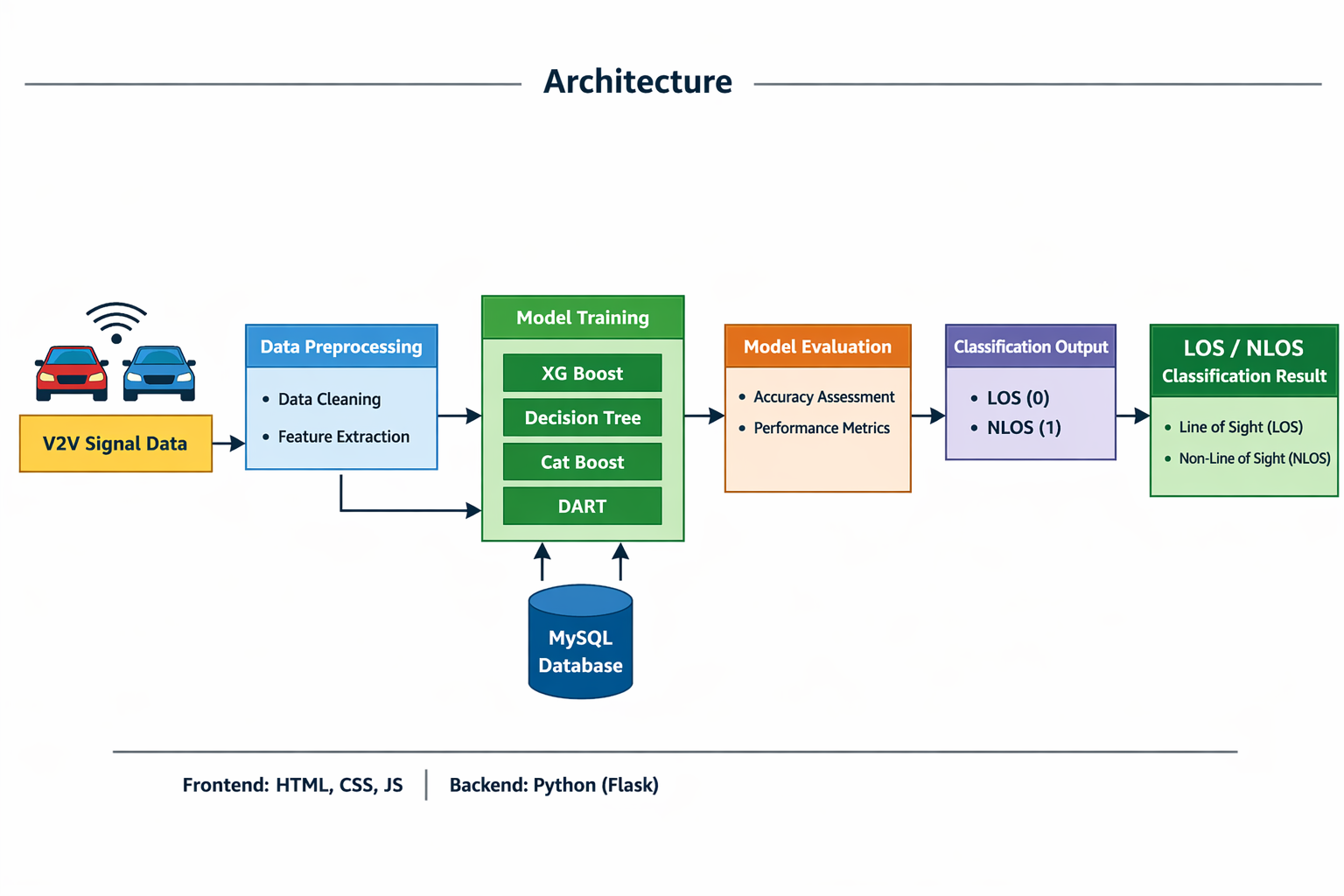
The objective of this project is to develop an efficient machine learning-based system for accurately classifying Line-of-Sight (LOS) and Non-Line-of-Sight (NLOS) conditions in vehicle-to-vehicle (V2V) communication environments. The system utilizes GNSS-based input parameters such as signal strength, Doppler values, and positional data to ensure robust and reliable predictions. Multiple algorithms including Decision Trees, XGBoost, CatBoost, and DART are implemented and evaluated to identify the most effective model. Additionally, Explainable AI techniques such as LIME are integrated to provide interpretability and enhance trust in the model’s predictions. Finally, a user-friendly web application is developed using Flask, HTML, CSS, and MySQL to enable seamless interaction, prediction, and analysis
Abstract
The rise of vehicle-to-vehicle (V2V) communication systems has made it essential to accurately classify the Line of Sight (LOS) and Non-Line of Sight (NLOS) conditions in wireless communication for improved connectivity and safety. This project proposes a machine learning-based method for LOS/NLOS classification in the V2V environment using a variety of input parameters like GPS time, satellite codes, Doppler shift values, and error data. The dataset used for training is sourced from the Kaggle GNSS classification competition, incorporating real-time data related to GPS, Doppler shifts, and satellite parameters. The system employs advanced machine learning algorithms, such as XGBoost, Decision Trees, and CatBoost, DART (Dropouts meet Multiple Additive Regression Trees) to analyse and classify the data efficiently. The system is designed with a user-friendly interface using HTML, CSS, and JavaScript, while the backend is powered by Python and Flask, integrated with MySQL for data storage and management. The classification output is a binary label (0 for LOS, 1 for NLOS), providing critical information for optimizing V2V communication performance and reliability.
Keywords: LOS (Line of Sight), NLOS (Non-Line of Sight), V2V Communication, Machine Learning, XGBoost, CatBoost, Decision Tree, DART (Dropouts meet Multiple Additive Regression Trees) , GPS Data, Doppler Shift
NOTE: Without the concern of our team, please don't submit to the college. This Abstract varies based on student requirements.
Block Diagram
Specifications
Hardware Requirements
Processor - I3/Intel Processor
Hard Disk - 160GB
Key Board - Standard Windows Keyboard
Mouse - Two or Three Button Mouse
Monitor - SVGA
RAM - 8GB
Software Requirements:
Operating System : Windows 7/8/10
Server side Script : HTML, CSS, Bootstrap & JS
Programming Language : Python
Libraries : Django, Pandas, NumPy, TensorFlow, Scikit-learn.
IDE/Workbench : VS Code
Technology : Python 3.10
Database : SQLite


Related Projects
 Paper Publishing

Request Call Back
Would you like to receive a free callback now?
Choose the best time for callback:
Leave your message and we will contact you as soon as possible

6-2-85/B, Old Maternity Hospital Road, Thyagaraja Nagar, Tirupati, Andhra Pradesh – 517501
+91 9030333433
+91 9393939065
0877-2261612

Disclaimer - Takeoff Edu Group Projects are not associated or affiliated with IEEE in any way. The IEEE Projects mentioned here are mentioned in the context of student projects, whose ideas are derived from IEEE publications, not projects of or by IEEE.

