Machine Learning Algorithm for Stroke Disease Classification
Objective
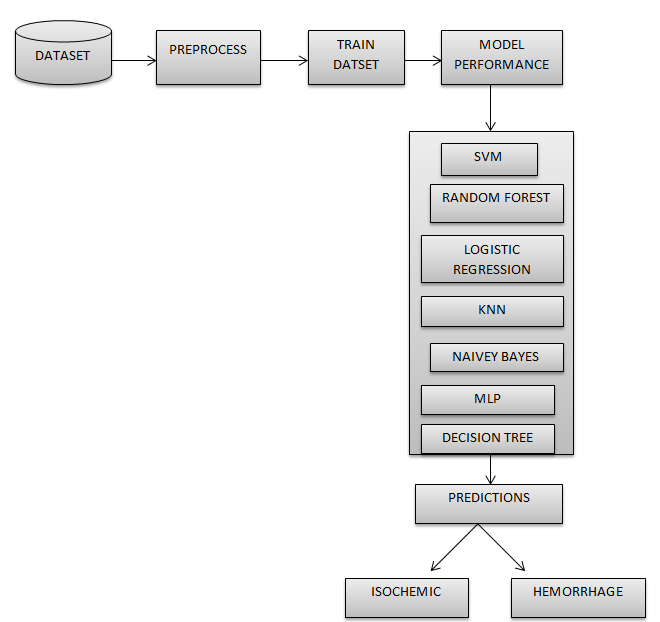
In this proposed model, we are using eight machine learning algorithms or stroke disease classification. Here, we preprocess the data to improve the image quality of CT scans of stroke patients by optimizing the quality of image to improve image results and to reduce noise, and also applying machine learning algorithms to classify the patients images into two sub-types of stroke disease.
Abstract
Machine learning (ML) delivers an accurate and quick prediction outcome and it has become a powerful tool in health setting, offering personalized clinical care for stroke patients. ML applications in health care are growing, nonetheless there is a greater need for further investigation in some research fields.
Therefore, this study aimed to systematically review the state of the art on ML techniques for brain stroke and classify the research studies into 2 categories based on their functionalities. By using seven machine learning algorithms we can generate the predictions, they are K-Nearest Neighbors, Naive Bayes, Logistic Regression, Decision Tree, Random Forest, Multi-layer Perceptron (MLP-NN) and Support Vector Machine.
Keywords: CT Scan Image, Machine Learning Algorithms, Stroke Ischemic, Stroke Hemorrhage.
NOTE: Without the concern of our team, please don't submit to the college. This Abstract varies based on student requirements.
Block Diagram
Specifications
SOFTWARE SPECIFICATIONS:
- Technology: Machine Learning, Application.
- Libraries: Pandas, Numpy, Sci-Kit Learning.
- Version: Python 3.6+
- Server-side scripts: HTML, CSS, JS
- Frame works: Flask
- IDE: Pycharm
HARDWARE SPECIFICATIONS:
- RAM: 8GB, 64-bit os.
- Processor: I3/Intel processor
- Hard Disk Capacity: 128 GB +
Learning Outcomes
- Scope of Real Time Application Scenarios.
- How Internet Works.
- What is a search engine and how browser can work.
- What type of technology versions are used.
- Use of HTML , CSS and BOOTSTRAP on UI Designs.
- Data Parsing Front-End to Back-End.
- Working Procedure.
- Introduction to basic technologies used for.
- How project works.
- Input and Output modules.
- Frame work use.
- Datasets properties.
- Machine learning algorithms.
- Smote technique in imbalanced.
- Types of strokes.
- Working of Decision Trees.
- Implementing SVM.
- What is KNN.
- Benefits if ensemble techniques.
- Project Development Skills:
- Problem analyzing skills.
- Problem solving skills.
- Creativity and imaginary skills.
- Programming skills.
- Deployment.
- Testing skills.
- Debugging skills.
- Project presentation skills.
- Thesis writing skills.


Related Projects
 Paper Publishing

Request Call Back
Would you like to receive a free callback now?
Choose the best time for callback:
Leave your message and we will contact you as soon as possible

6-2-85/B, Old Maternity Hospital Road, Thyagaraja Nagar, Tirupati, Andhra Pradesh – 517501
+91 9030333433
+91 9393939065
0877-2261612

Disclaimer - Takeoff Edu Group Projects are not associated or affiliated with IEEE in any way. The IEEE Projects mentioned here are mentioned in the context of student projects, whose ideas are derived from IEEE publications, not projects of or by IEEE.

