Machine Learning Algorithm For Brain Stroke Detection
Objective
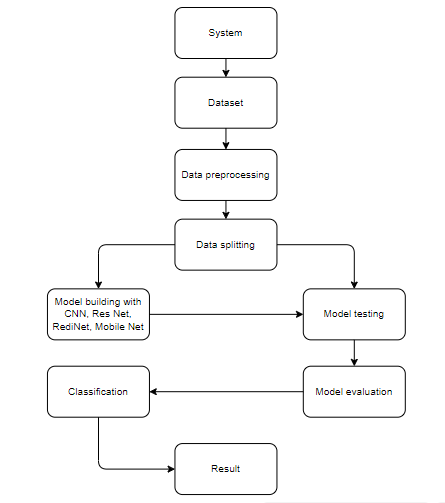
This project compares CNN, ResNet, MobileNet, and RadiNet for brain stroke detection from medical imaging, aiming to enhance diagnostic accuracy and develop advanced tools for timely, accurate stroke identification.
Abstract
This study investigates the effectiveness of different deep learning models in detecting brain strokes from imaging data.(Chandaran et al., n.d.) We employed four distinct algorithms—Convolutional Neural Network (CNN), ResNet, MobileNet, and RadiNet—on both normal and augmented image datasets. Our findings highlight a stark contrast in performance: while traditional CNNs achieved an accuracy of 96% on unaltered images, their effectiveness significantly decreased to 55% with augmented images. Conversely, MobileNet demonstrated remarkable robustness, maintaining a 99% accuracy rate across both datasets. ResNet also performed well, particularly with normal images at 98% accuracy. RadiNet, however, showed varied results with 90% accuracy on normal images and a decrease to 79% with augmented data. These results underline the potential and limitations of advanced neural networks in medical imaging, suggesting a pathway towards more accurate and reliable stroke detection methodologies.
KEYWORDS: Stroke Detection, Deep Learning, Convolutional Neural Networks, Image Augmentation, Medical Imaging.
NOTE: Without the concern of our team, please don't submit to the college. This Abstract varies based on student requirements.
Block Diagram
Specifications
Hardware Requirements
Processor - I3/Intel Processor
Hard Disk - 160GB
Key Board - Standard Windows Keyboard
Mouse - Two or Three Button Mouse
Monitor - SVGA
RAM - 8GB
Software Requirements:
Operating System : Windows 7/8/10/11
Server side Script : HTML, CSS, Bootstrap & JS
Programming Language : Python
Libraries : Flask, Pandas, Mysql.connector, Os, Smtplib, Numpy
IDE/Workbench : PyCharm or VS Code
Technology : Python 3.6+
Server Deployment : Xampp Server
Database : MySQL


Related Projects
 Paper Publishing

Request Call Back
Would you like to receive a free callback now?
Choose the best time for callback:
Leave your message and we will contact you as soon as possible

6-2-85/B, Old Maternity Hospital Road, Thyagaraja Nagar, Tirupati, Andhra Pradesh – 517501
+91 9030333433
+91 9393939065
0877-2261612

Disclaimer - Takeoff Edu Group Projects are not associated or affiliated with IEEE in any way. The IEEE Projects mentioned here are mentioned in the context of student projects, whose ideas are derived from IEEE publications, not projects of or by IEEE.

