lung diseases detection and classification of chest x6 using cnn
Objective
The core objective of this project is to develop a machine learning-based tool capable of classifying chest X-rays into six distinct lung condition categories: normal, bacterial pneumonia, viral pneumonia, COVID-19, tuberculosis, and emphysema. By employing CNN, along with the MobileNet and DenseNet architectures, the project aims to enhance classification accuracy while minimizing the computational load. This solution will provide an automated method to assist healthcare workers in diagnosing patients, offering results that are fast, consistent, and reliable. The project will focus on ensuring that the model not only performs well across different lung diseases but also maintains high levels of performance through rigorous validation. The final outcome will be a model that offers a significant improvement over traditional diagnostic methods, helping to save both time and resources in healthcare settings.
Abstract
This project focuses on the detection of various lung conditions, including Normal, Pneumonia-Bacterial, Pneumonia-Viral, COVID-19, Tuberculosis, and Emphysema using chest X-ray images. The dataset used for this task is the Chest X-Ray 6 Classes Dataset available on Kaggle, which contains labeled X-ray images for each of the six categories. The main objective of this project is to develop a machine learning model that can automatically classify the chest X-ray images into the correct category, facilitating faster and more accurate diagnosis of these respiratory conditions.
For this task, Convolutional Neural Networks (CNN), along with advanced architectures such as MobileNet and DenseNet, are used to extract meaningful features from the X-ray images. These algorithms are chosen for their ability to process image data effectively, reducing computational complexity while maintaining high accuracy. The model is trained and validated on the Kaggle dataset, and its performance is evaluated using metrics such as accuracy, precision, recall, and F1-score. The proposed system aims to provide a robust solution for early detection and classification of lung diseases, contributing to the improvement of medical diagnostics.
Keywords: Chest X-ray, Pneumonia, COVID-19, Tuberculosis, Emphysema, CNN, MobileNet, DenseNet.
NOTE: Without the concern of our team, please don't submit to the college. This Abstract varies based on student requirements.
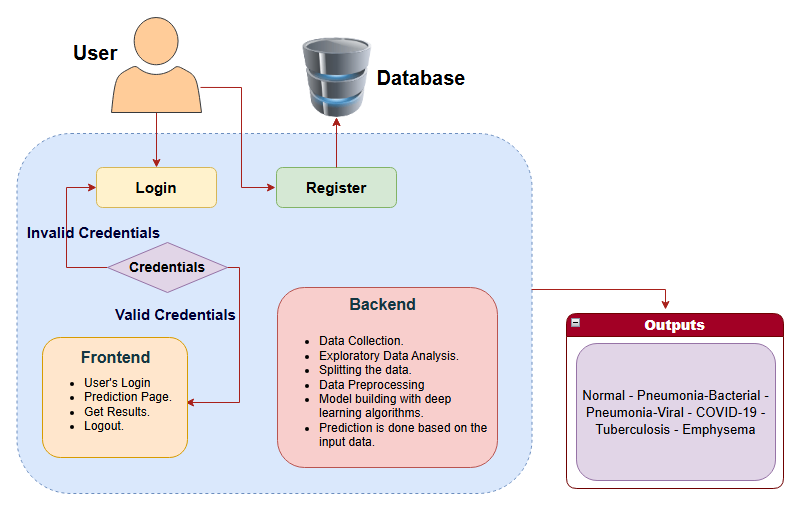
Block Diagram
Specifications
Hardware Requirements
Processor - I3/Intel Processor
Hard Disk - 160GB
Key Board - Standard Windows Keyboard
Mouse - Two or Three Button Mouse
Monitor - SVGA
RAM - 8GB
Software Requirements:
Operating System : Windows 7/8/10
Server side Script : HTML, CSS, Bootstrap & JS
Programming Language : Python
Libraries : Flask/Django, Pandas, Mysql.connector, Os, Smtplib, Numpy
IDE/Workbench : PyCharm
Technology : Python 3.6+
Server Deployment : Xampp Server
Database : MySQL

Demo Video


Request for Video
Related Projects
 Paper Publishing
Request Call Back
Would you like to receive a free callback now?
Choose the best time for callback:
Leave your message and we will contact you as soon as possible

6-2-85/B, Old Maternity Hospital Road, Thyagaraja Nagar, Tirupati, Andhra Pradesh – 517501
+91 9030333433
+91 9393939065
0877-2261612

Disclaimer - Takeoff Edu Group Projects are not associated or affiliated with IEEE in any way. The IEEE Projects mentioned here are mentioned in the context of student projects, whose ideas are derived from IEEE publications, not projects of or by IEEE.

