Lung Disease Detection and Classification using Spirometric Dataset
Objective
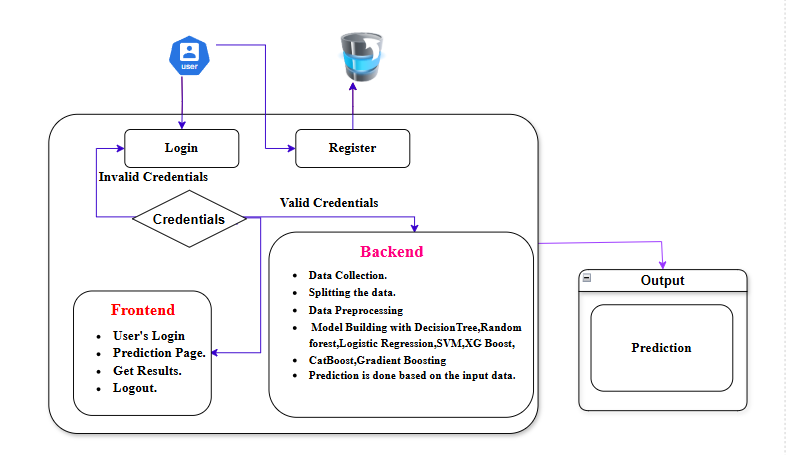
The primary objective of this project is to design and implement an efficient, accurate, and reliable machine learning-based system for the detection and classification of lung diseases using spirometric datasets. Specifically, the system aims to predict six distinct lung condition categories — Normal, Obstruction, Unclassified, Restriction, PRISm, and Mixed — by analyzing patient spirometric data. To achieve high classification performance, the project employs a comparative approach, training multiple machine learning models including Decision Tree, Random Forest, XGBoost, SVM, CatBoost, Gradient Boosting, and Logistic Regression.
Abstract
The project, titled "Lung Disease Detection and Classification Using Spirometric Data Set," aims to develop a robust machine learning system for predicting lung disease classes based on spirometric data. The system employs multiple algorithms, including Decision Tree, Random Forest, XGBoost, Support Vector Machine (SVM), CatBoost, Gradient Boosting, and Logistic Regression, to ensure high predictive accuracy. To optimize feature selection, the K-best method is used for dimension reduction, identifying the top 20-25 most relevant features from the dataset. This enhances model efficiency and reduces computational complexity. The system is designed to classify lung conditions into six distinct categories: Normal, Obstruction, Unclassified, Restriction, PRISm (Preserved Ratio Impaired Spirometry), and Mixed. By inputting spirometric data, the model analyzes patterns and predicts the corresponding lung disease class. Each algorithm is trained and evaluated to determine the best-performing model for accurate classification. This approach ensures reliable detection and classification of lung diseases, aiding clinicians in early diagnosis and treatment planning. The integration of advanced feature selection and diverse algorithms makes the system versatile and effective for real-world medical applications.
Keywords:
Lung Disease Detection, Spirometric Data, Machine Learning, Decision Tree, Random Forest,XGBoost, Support Vector Machine (SVM), CatBoost, Gradient Boosting, Logistic Regression,,K-best Feature Selection,Dimension Reduction
NOTE: Without the concern of our team, please don't submit to the college. This Abstract varies based on student requirements.
Block Diagram
Specifications
H/W CONFIGURATION:
· Processor - I3/Intel Processor
· Hard Disk - 160GB
· Key Board - Standard Windows Keyboard
· Mouse - Two or Three Button Mouse
· Monitor - SVGA
· RAM - 8GB
S/W CONFIGURATION:
· Operating System : Windows 7/8/10
· Server side Script : HTML, CSS, Bootstrap & JS
· Programming Language : Python
· Libraries : Flask, Pandas, MySQL. Connector, Os, Smtplib, Numpy
· IDE/Workbench : PyCharm
· Technology : Python 3.6+
· Server Deployment : Xampp Server

Demo Video


Request for Video
Related Projects
 Paper Publishing
Request Call Back
Would you like to receive a free callback now?
Choose the best time for callback:
Leave your message and we will contact you as soon as possible

6-2-85/B, Old Maternity Hospital Road, Thyagaraja Nagar, Tirupati, Andhra Pradesh – 517501
+91 9030333433
+91 9393939065
0877-2261612

Disclaimer - Takeoff Edu Group Projects are not associated or affiliated with IEEE in any way. The IEEE Projects mentioned here are mentioned in the context of student projects, whose ideas are derived from IEEE publications, not projects of or by IEEE.

