Low Power Crypto-chip design for IoT applications
Objective
The main objective appears to be designing and implementing a low-power cryptographic chip for Internet of Things (IoT) applications. Specifically, the focus is on creating a low-power RISC-V processor with integrated cryptographic acceleration for IoT devices.
Abstract
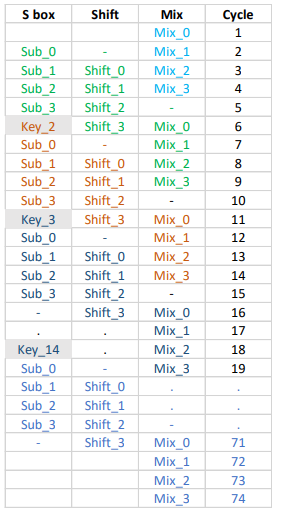
Cryptography is associated with the process of converting ordinary plain text into ambiguous text and vice versa. Hardware Security plays a major role in most of the applications which include net banking, e-commerce, military, satellite, wireless communications, electronic gadgets, digital image processing, etc. There are three types of cryptographic techniques; Symmetric key cryptography, Hash functions and Public key cryptography. Symmetric key algorithms namely Advanced Encryption Standard (AES), and Data Encryption Standard use the same key for encryption and decryption. It is much faster, easy to implement and requires less processing power. In this paper we are proposing 128-bit AES algorithm is highly optimized in Key schedule and Sub bytes blocks, for Area and Power. The optimization has been done by reusing the S-box block. We are optimizing the algorithm with a new approach where internal operations are 32-bit operations, as compared to 128-bit operations. The proposed implementation helps in re-using the same hardware in a pipelined fashion which results in an area reduction by using slice registers. This in turn results in a power reduction in a FPGA implementation. The throughput (Mbps) of the proposed implementation using Virtex-7 (xc7vx485tffg1157) FPGA improved.
Keywords: Advanced Encryption Standard (AES), FPGA, LUT (Look up table), Mbps (megabit per second), sub (sub bytes), shift (shift rows), mix (mix column), add (add round key).
NOTE: Without the concern of our team, please don't submit to the college. This Abstract varies based on student requirements.
Block Diagram
Specifications
Software Requirements:
· Xilinx ISE Tool
· HDL: Verilog
Hardware Requirements:
· Microsoft® Windows XP,
· Intel® Pentium® 4 processor or Pentium 4 equivalent with SSE support
· 512 MB RAM
· 100 MB of available disk space


Related Projects
 Paper Publishing

Request Call Back
Would you like to receive a free callback now?
Choose the best time for callback:
Leave your message and we will contact you as soon as possible

6-2-85/B, Old Maternity Hospital Road, Thyagaraja Nagar, Tirupati, Andhra Pradesh – 517501
+91 9030333433
+91 9393939065
0877-2261612

Disclaimer - Takeoff Edu Group Projects are not associated or affiliated with IEEE in any way. The IEEE Projects mentioned here are mentioned in the context of student projects, whose ideas are derived from IEEE publications, not projects of or by IEEE.

